
Integration Intelligence: how scores work
The integration registry, the eight scored dimensions and their evidence, confidence, implementation levels, attribution rules, gaps and recommendations, reliability, history, the assistant, permissions and the API.
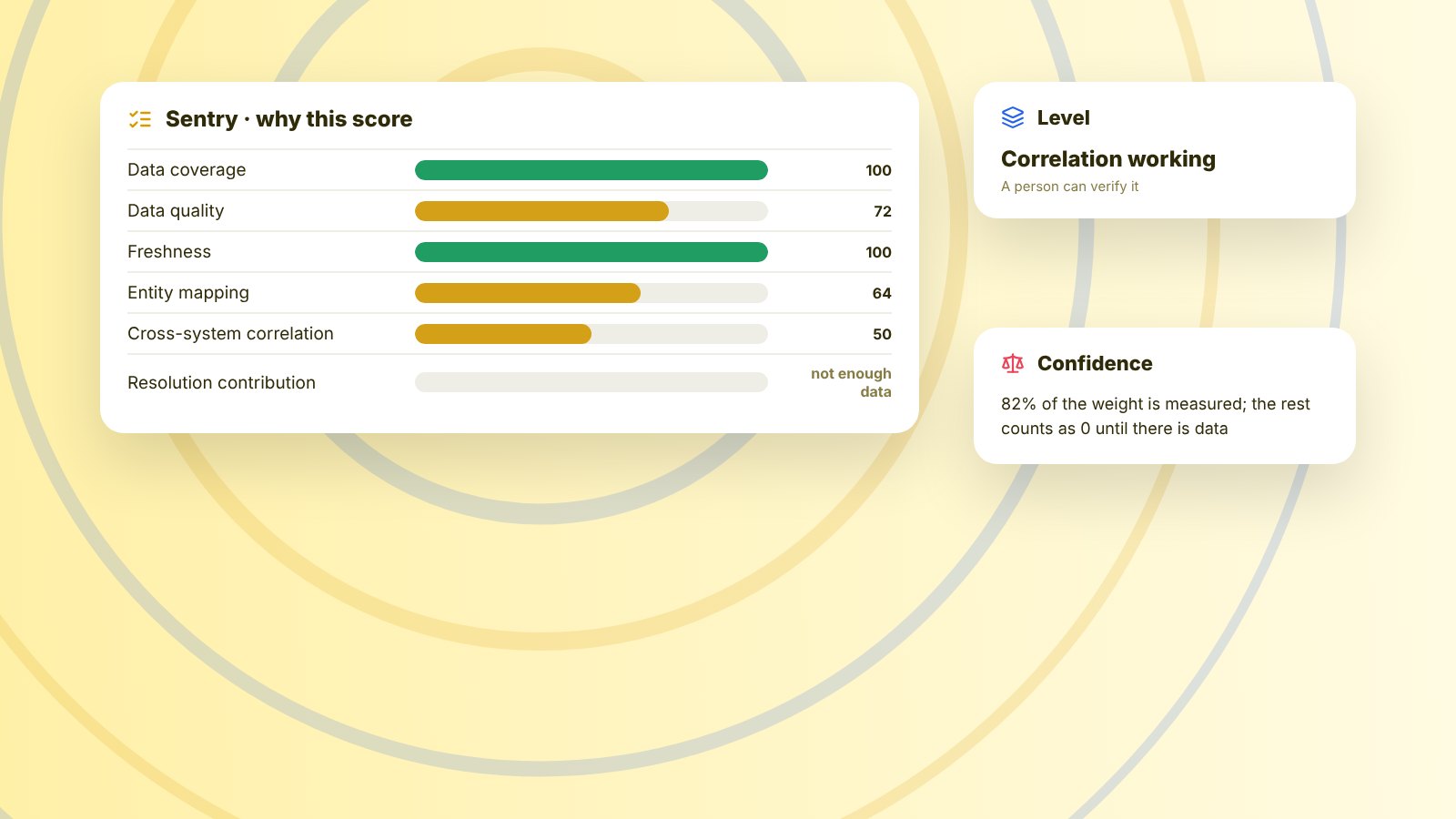
Integration Intelligence measures how much each connected system improves TicketResolve’s intelligence: the data it delivers, whether its records match other systems, and whether its evidence helped investigations and verified resolutions. It’s part of every plan at no extra charge. Open it from TR Investigate → Integration intelligence.
The registry
Every integration TicketResolve supports is listed: help desks and channels, knowledge sources, monitoring and observability, CI/CD, source code, engineering trackers, incident management, Kubernetes, CRM and billing, and the Security Intelligence connectors (cloud, identity, endpoint, scanners, ratings and threat intelligence). For each one, the registry records its category, the data objects it should provide, the shared entities those objects map to (ticket, customer account, service, deployment, error, code change, asset, finding) and what it enables. Connection state comes from the integration itself — the registry doesn’t add a second way to connect.
Notification and workspace tools (Slack alerts, webhooks, API keys, SSO) appear with their state but aren’t scored as intelligence sources.
The eight dimensions
| Dimension | Default weight | How it’s measured |
|---|---|---|
| Data coverage | 15 | Share of the data objects it should provide that have records (critical objects count double). Monitoring and code over 90 days, deployments 90, trackers 365, Kubernetes 7. |
| Data quality | 15 | 100 minus the weighted share of records failing each field check — e.g. errors without a service, fingerprint, environment or release; deployments without a service or commit; tickets without a subject or requester; accounts without a domain. Critical fields weigh three times optional ones. |
| Freshness | 10 | Newest record against what that kind of data needs (errors and Kubernetes within hours, tickets and deployments within days, documents within a month), falling to 0 at four times that; minus 20 while the last run is failing. |
| Entity mapping | 15 | Share of records that resolve to an identifier another system also has: an error’s release matches a deployment, a deployment’s commit is in the code history, a ticket’s requester is a contact on a customer account, an incident’s service is a monitored service. |
| Cross-system correlation | 15 | Of the capabilities it takes part in (e.g. code change to production error, deployment to incident, ticket to customer account), how many have linked records now. |
| Investigation contribution | 15 | 60 points for reach — used in a quarter of the workspace’s investigations over 90 days scores full — plus 40 for how often its evidence was linked to a hypothesis. |
| Resolution contribution | 10 | Verified outcomes where its evidence supported the confirmed cause, plus security findings it reported that were verified fixed or closed at the source, against a quarter of the workspace’s verified outcomes (at least 3). |
| Operational reliability | 5 | Share of runs in the last 30 days that succeeded, minus 25 when credentials were rejected. Where an integration keeps no run history, from its current state: working 80, needs attention 20, off 0. |
A dimension that doesn’t apply (correlation for an integration that takes part in no capability) is left out. A dimension without enough data yet counts as 0 and lowers the confidence — the share of the weight that rests on measured data. A low-confidence score says so next to it.
Every dimension shows its reason and the figures behind it. Each score carries a calculation version (currently iis-1) so history stays comparable when the method changes.
Implementation levels
- Connected, no data yet: credentials saved, nothing received.
- Data ingestion working: records are arriving.
- Entity mapping working: some records match identifiers in other systems.
- Used by TR intelligence: its evidence was used in an investigation or contributed to a verified outcome.
- Cross-system correlation working: used, and part of a capability with linked records.
- Production verified: a person with “Administer Integration Intelligence” confirmed it, saying what they checked. Only possible once it reaches the level above; never set automatically.
Attribution
Investigation evidence is attributed to the integration it came from by its provider and kind (a Sentry error, a GitHub deployment, a commit, a PagerDuty incident, a ticket from your help desk). An integration is credited for a resolution only when its evidence was linked to a hypothesis that was confirmed and the outcome was verified. Contradicting or ruling out a wrong cause is shown too. Correlation isn’t causation: linked records show that systems line up, not why something happened.
Gaps and recommendations
The coverage matrix shows each TicketResolve engine against the data types it uses, and which are connected. Capabilities are working (linked records found), connected, no links found (the systems are there but identifiers don’t match yet), partly connected or not connected; each gap lists the integrations that would fill it with their setup effort.
Recommendations come from each integration’s own checks: reconnect after rejected credentials, fill a critical field missing from 5% or more of records, improve a mapping below 50%, check a stale sync, or look at an integration with data that no investigation has used in 90 days. Where a fix needs a permission in the other system, the recommendation names it.
Reliability, history and alerts
The Reliability tab lists each connected integration’s runs over 30 days, rejected credentials and rate limits, the last success, the newest data and the last error. Scores are saved once a day per integration with every dimension and its inputs; Trends shows the average and the biggest changes. People who can view Integration Intelligence are alerted when credentials are rejected or a score falls 15 points or more in a week (turn this off in Settings).
Asking questions
Status questions — which integrations are failing, which capabilities are missing, which engines lack data — are answered from the calculated figures with no AI. Other questions get one written answer from a daily limit (30 by default, 0–100); every point must cite the figures, uncited points are removed, and numbers that aren’t in the figures are flagged. Names and error messages from other systems are treated as data, never as instructions.
Permissions
| Permission | What it allows |
|---|---|
| View Integration Intelligence | The scorecard, details, coverage, reliability, trends and the assistant |
| Administer Integration Intelligence | Weights, the daily AI limit, alerts, taking a snapshot and marking production verified |
Admins and owners have both. Support leads, executives and auditors can view. Every settings change and verification is in the activity log.
API
| Method and path | Returns |
|---|---|
| GET /api/trial/:id/intel/overview | Summary, connected integrations, levels, recommendations, gaps, capabilities, engine coverage and the matrix |
| GET /api/trial/:id/intel/scorecard?status=&category= | One row per integration with every dimension |
| GET /api/trial/:id/intel/integrations/:key | Dimensions with evidence, recommendations, investigations it helped, history, verification |
| POST /api/trial/:id/intel/integrations/:key/verify | Mark production verified (note required); DELETE removes it |
| GET /api/trial/:id/intel/reliability · /trends?days= | Run history per integration · score history |
| PUT /api/trial/:id/intel/settings | Weights, AI limit, alerts |
| POST /api/trial/:id/intel/ask · GET /questions | Ask a question · your recent questions |
Limits
- New Relic, Grafana, CloudWatch, Elastic and Splunk are searched live during investigations, so their coverage counts investigations that searched them rather than stored records.
- Security connectors are credited for investigations and verified fixes in Security Intelligence; their findings don’t yet feed TR Investigate.
- No cross-customer benchmarks are shown.