
Resilience experiments
Find out how a service copes with failure, on your terms.
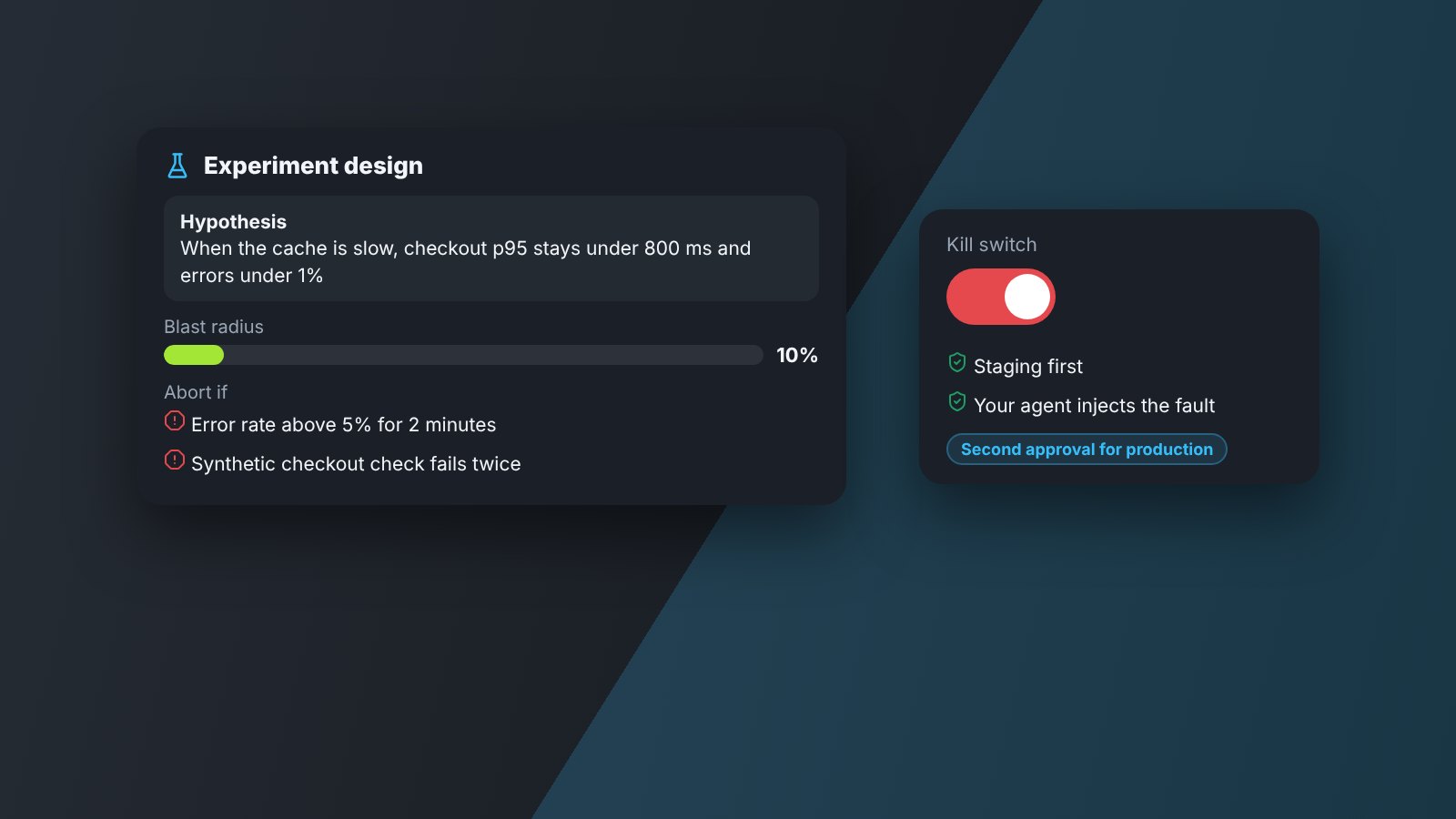
Open Reliability Intelligence → Resilience experiments. Results are measured from your telemetry. No AI model is involved.
TR_OP_CACHE_LATENCY_ON=…) and registered under Remediation → Operations as a change. TicketResolve requests that operation, watches the service, and requests your stop operation when it’s time to end.Safety settings
- Production is off until an administrator allows it. Even then, a production run needs a passed run of the same failure on the same service in another environment within 30 days (you can turn that rule off).
- Allowlist: experiments can run only on the services and environments listed. The list starts empty.
- Limits: by default a fault lasts at most 900 seconds and reaches at most 25% of traffic or instances.
- Kill switch: stops every running experiment at once and blocks new ones until it is turned off.
- Only one experiment runs on a service at a time. Production runs are refused while the service’s error budget is exhausted or an incident is open.
- Every design change, approval, start, stop and setting change is written to the audit log.
Design an experiment
Pick the failure from the catalogue:
| Failure mode | Experiments |
|---|---|
| Slow responses | Add latency to a dependency |
| A dependency fails | Return errors from a dependency; make a dependency unreachable |
| An instance is lost | Terminate an instance |
| CPU, memory or disk run short | CPU pressure; memory pressure; fill a disk |
| Network faults | Packet loss or partition; DNS failure |
| A data store fails over or empties | Database failover; empty a cache |
Then describe the experiment:
- Hypothesis: what should stay true, in words.
- Steady state: the same thing as measurable conditions. The metrics are error rate and p95 latency from the service’s request spans, the success rate of a synthetic check, or an SLO’s burn rate. For example, error rate below 1%.
- Stop immediately if: abort conditions, such as error rate above 5%. Each failure type suggests some.
- Injection and stop operations; the blast radius (described, and as a percentage); how long the fault lasts; the baseline period before; and the recovery window after.
Send the design for review. Someone other than its author must approve it. Editing an approved design withdraws the approval.
What a run does
| Step | What happens |
|---|---|
| Baseline | Measures the steady state over the baseline period. If it doesn’t hold, or there isn’t enough data, nothing is injected. |
| Injection | Requests your injection operation. If it needs approval, a second person approves it in Remediation; then your agent runs it. If it hasn’t started within 30 minutes, the run is stopped. |
| Fault active | Every minute, checks the abort conditions over the last two minutes. A breached condition, or no telemetry at all, stops the run and requests the stop operation. |
| Stop | When the time is up, requests the stop operation. If the stop fails, a critical finding warns that the fault may still be active. |
| Recovery | Measures how long the service takes to return to the steady state, up to the recovery window. |
| Verdict | Held if every steady-state condition held during the fault. Refuted if any was breached. Inconclusive if there wasn’t enough data (at least 30 requests, or 3 check runs). |
Anyone in the workspace can choose Stop now on a running experiment. A run that goes past its overall time limit is stopped automatically.
Findings and the resilience score
A refuted hypothesis and a service that doesn’t recover each raise a high finding for the service owner. A stop that failed raises a critical one. A run stopped by an abort condition is recorded as medium. A later run that holds and recovers resolves them.
The resilience score of a service is the share of failure modes whose latest experiment in the last 90 days held, out of the modes tested. Coverage is how many of the six failure modes were tested. Inconclusive runs count for neither.