
TR Security Intelligence
Part of Security & Trust · Included with Your Company Data Protection
Findings ranked by real risk, fixes proven
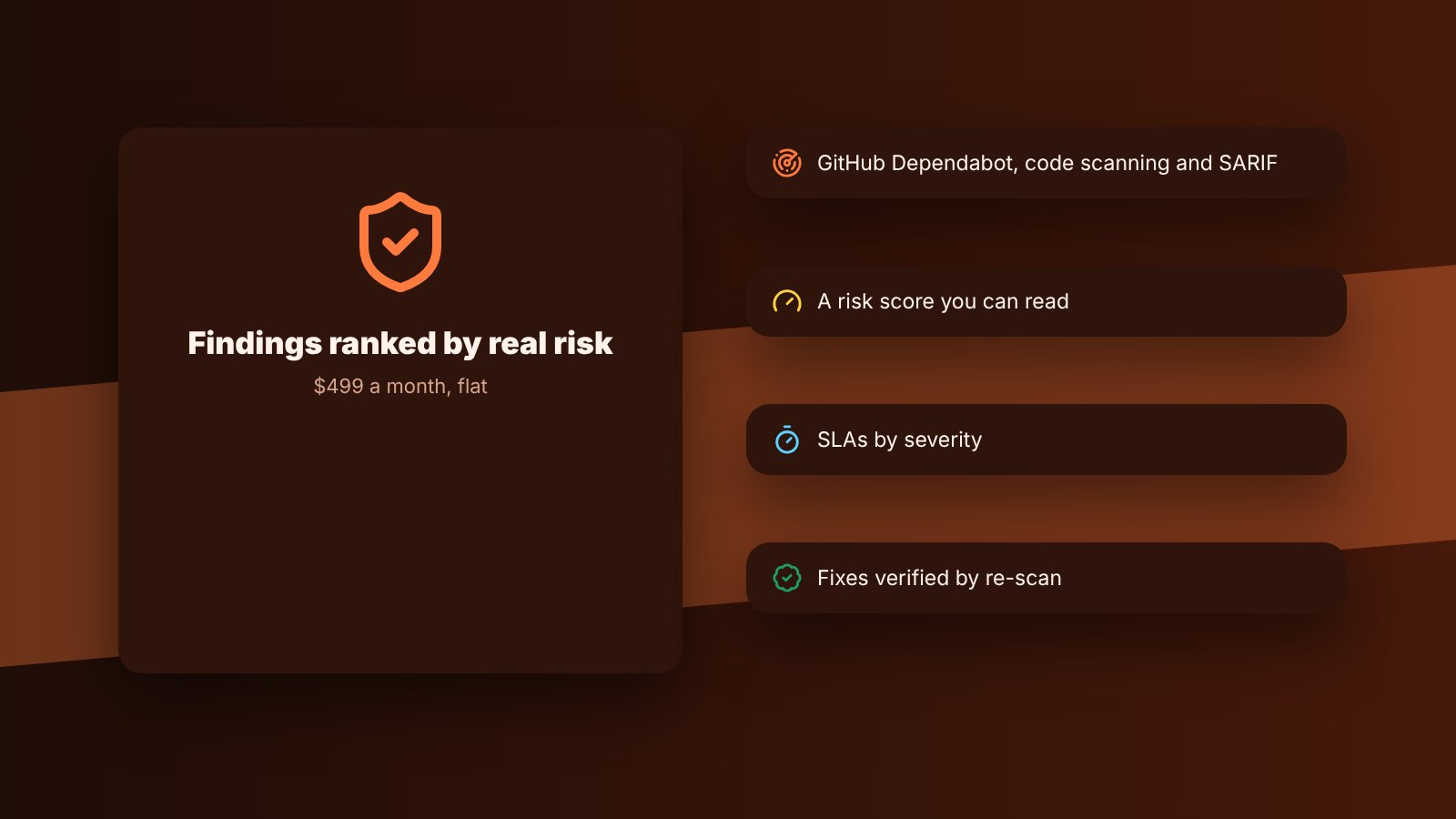
Every vulnerability and code finding in one inventory, ranked by severity, known exploitation, exploit probability and how exposed the asset is — and a fix counts only when a re-scan or a second person proves it.
Design principles
How it works
Proof, not status
A fix counts when a complete scan no longer reports it, or someone other than the fixer verifies it with evidence. A successful deploy is never proof.
A score you can read
Every risk score shows its inputs: severity, known exploitation, EPSS, asset criticality, internet exposure and whether it’s past its SLA.
Read-only, and only what you connect
Alerts are read through your existing GitHub connection or imported from your scanners. Nothing else is scanned.
No secret values
Fields that could hold a secret are removed from every stored record — only that a secret was found, and where.
Capabilities
What it does
Security command center
Open findings by severity, known-exploited and overdue findings, riskiest assets, found versus verified by week, time to verified fix and source health.
How it worksAsset inventory
Applications, APIs, repositories, cloud resources, containers, domains and more, with owners, environment, criticality and exposure.
How it worksFindings from your scanners
GitHub Dependabot and code scanning, plus SARIF from Semgrep, Snyk, Trivy, CodeQL and others, and CSV — normalised and de-duplicated.
How it worksRisk and SLAs
A transparent risk score per finding and SLA due dates by severity that you set.
How it worksVerified remediation
Mark fixed, verify by re-scan or by a second person with evidence, and reopen automatically when a finding comes back.
How it worksEvidence and history
The original scanner record behind each finding, its full history and the same issue on other assets.
How it worksExceptions and remediation plans
Risk acceptances that expire and false positives with evidence, approved by someone else; plans that are done only when every finding is verified.
How it worksAI investigator and assistant
One cited investigation per finding with hypotheses labelled unconfirmed, a cited assistant, the security report and daily alerts.
How it worksSecurity integrations
AWS, Azure, Google Cloud, Entra ID, Okta, Google Workspace, CrowdStrike, Defender, SentinelOne, Microsoft Sentinel, Splunk Enterprise Security, Qualys, InsightVM, Tenable, Snyk, Wiz, Kubernetes, SecurityScorecard, BitSight, Shodan, VirusTotal and GreyNoise — read-only — plus Jira, ServiceNow, Slack, Teams, PagerDuty and a webhook.
How it worksConnected
Works with the scanners you already run
Connect the tools you already run with read-only credentials, or import results from any scanner. Tickets go to Jira or ServiceNow and signals to Slack, Teams or PagerDuty.
- GitHub Dependabot, code scanning and secret scanning; GitLab vulnerability reports
- AWS, Azure and Google Cloud; Entra ID, Okta and Google Workspace
- CrowdStrike, Defender for Endpoint and SentinelOne; Microsoft Sentinel and Splunk ES; Qualys, InsightVM and Tenable; Snyk and Wiz
- SARIF, CSV or a webhook from any other tool
Pricing
Part of Your Company Data Protection
TR Security Intelligence is sold as part of Your Company Data Protection — $500 a month or $4,800 a year per company, added to your plan — which also includes the planned AI security products as they ship. No charge per user, asset, finding or investigation. Enterprise terms are available on request.
Included with Your Company Data Protection — from the price list on the pricing page
- $500 a month or $4,800 a year per company, as part of Your Company Data Protection
- Unlimited users, assets and findings
- Cancel it separately from your plan
- AI investigations within a daily limit you set — no credits
Controls
Built so the numbers can be trusted
Every change to a finding is permissioned and logged.
Safety controls
- Fixers can’t verify their own fix
- A deploy is never evidence
- Original records behind “Security evidence”
- Secret values never stored
Frequently asked questions
Know which findings matter — and which fixes are real
Start the 7-day free trial and read your GitHub security alerts.