
Postmortems and prevention
From understanding an incident to making sure it doesn’t happen again.
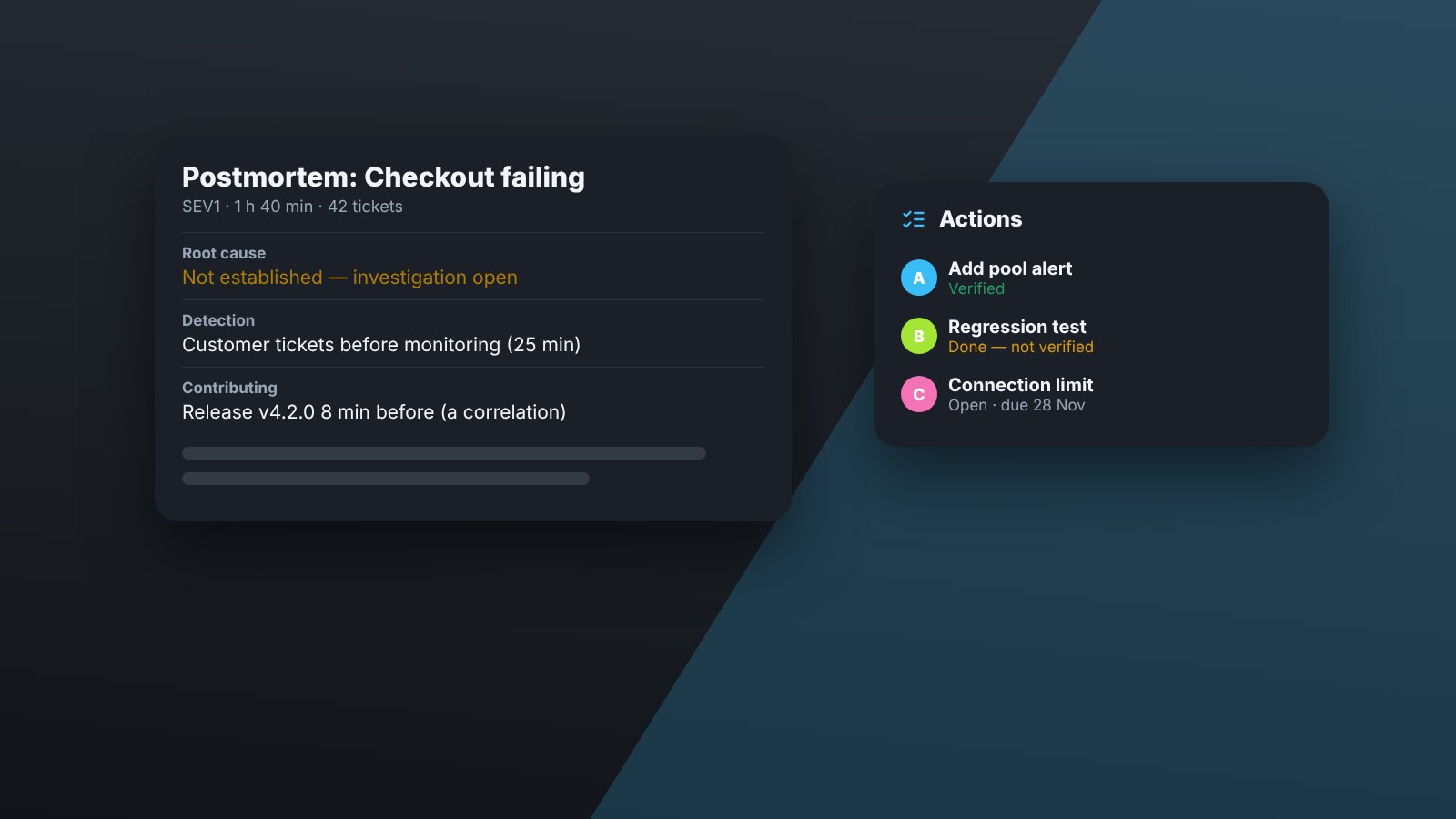
Open Reliability Intelligence → Prevention and pick an incident. Everything is assembled from your records. No AI model writes or guesses anything.
The postmortem
Choose Build the postmortem. It is assembled from the incident’s timeline and impact, its investigation, releases and migrations around it, and the reliability findings open at the time:
- Summary, timeline, customer impact (tickets, customers, duration and error budget spent) and the affected services.
- Detection: how it was found and how long that took. A detection gap is listed when customers noticed before monitoring did, when detection took more than 15 minutes, or when a service has no SLO or synthetic check.
- Root cause: confirmed, a leading possibility (labelled as not confirmed), or not established. It is never guessed.
- Contributing factors: releases, migrations and open findings at the time, labelled as correlations.
- Response: minutes to acknowledge, mitigate and resolve, compared with your median.
- Recovery, evidence links, and remaining uncertainties.
Save to the incident copies the result into the incident’s postmortem field, unless your team has already written one there.
Actions
The postmortem proposes actions in four areas:
- Engineering: confirm the root cause, fix it, address a recurring weakness, add data-integrity checks.
- Operations: monitoring, an SLO, alert thresholds, capacity, the runbook.
- Testing: a regression test, deployment validation, a resilience experiment.
- Support: a knowledge-base update, customer communication.
Each action has a priority, team, owner, due date (14, 30 or 60 days), related incident and service, expected outcome, and a verification criterion. Accept or dismiss each proposal, or add your own.
Done is not prevented
| Criterion | Verified when |
|---|---|
| Investigation | The linked investigation has a confirmed root cause. |
| Deployment | The service is deployed after the action was created, and the deploy verification didn’t fail. |
| Resilience experiment | An experiment on the service holds after the action was created. |
| Monitoring | A synthetic check, or an SLO with data, exists for the service. |
| Knowledge | The known issue has a workaround or resolution. |
| Reliability | No incident with the same signature for 60 days; for alerting, the next incident is detected within 15 minutes; for capacity, the forecast no longer reaches the limit within 30 days. |
| Regression test, configuration, runbook | A link to the evidence, checked by someone other than the owner. |
If the same failure comes back after an action was completed or verified, the action is marked didn’t work, reopened, and raised as a finding. Actions past their due date raise findings too.
Recurrence
The page lists failure patterns that caused two or more incidents in 180 days, actions that didn’t work, overdue actions, and services with unresolved weaknesses: repeated incidents, actions that didn’t work, or several overdue actions. The totals separate actions that are done from risks that are actually mitigated.