
Dependencies and vulnerabilities
What each service runs, what’s vulnerable in it, and what to fix first.
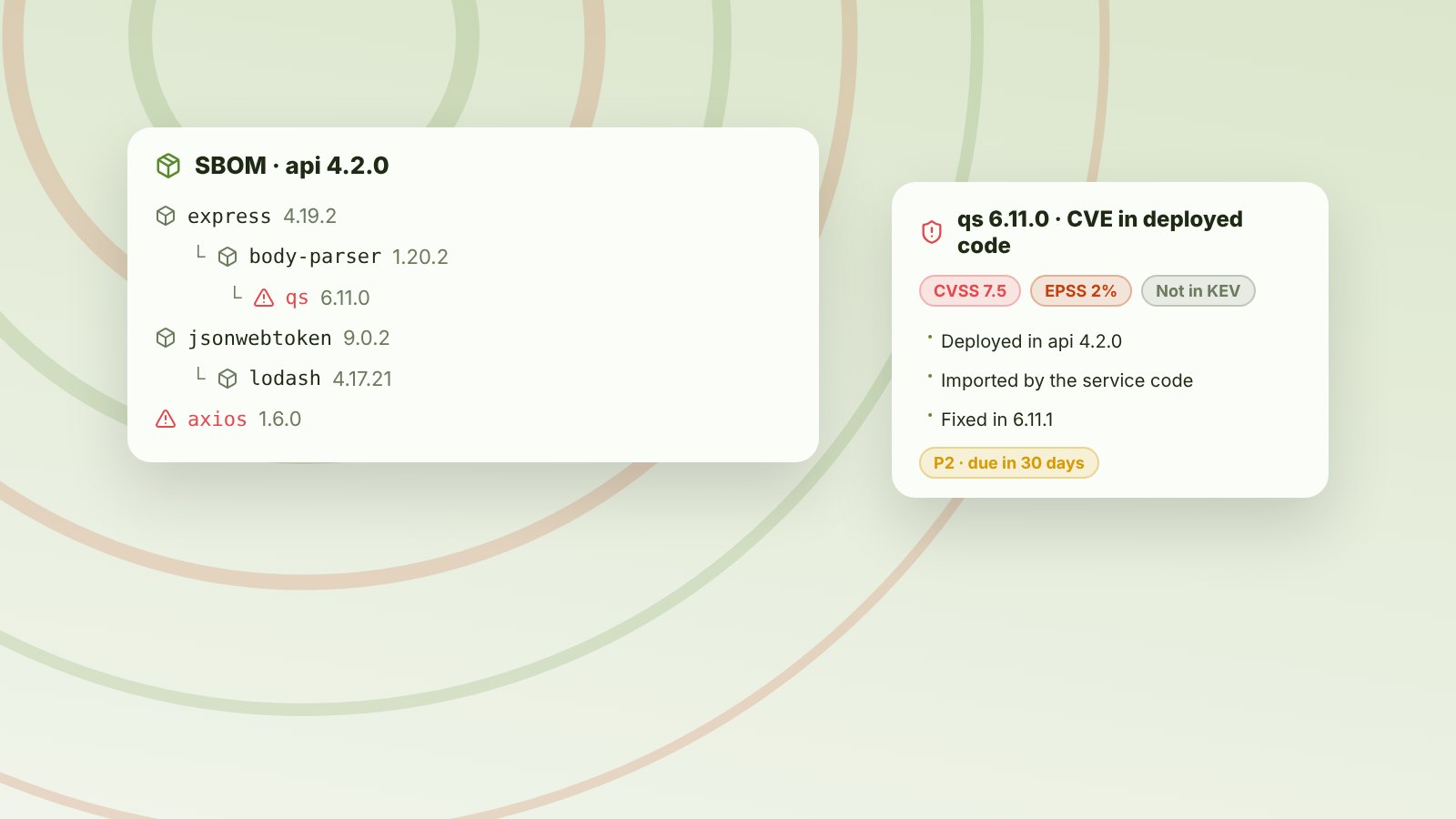
Open Reliability Intelligence → Dependency risk.
What each service runs
- SBOMs: upload a CycloneDX or SPDX file in JSON (up to 8 MB) on the page, or from CI with
POST /v1/reliability/sbomsand{ service, environment, version, sbom }. Components are read from their package URLs (purl). Direct and transitive dependencies are told apart using the SBOM’s dependency graph. - The code index: the dependencies declared in the repository’s manifests (npm, PyPI, Go, Maven, RubyGems, Packagist, NuGet, Cargo) at the commit your deployment events say is live. Repositories that aren’t linked to a deployment are listed under their own name.
- Where a service has both, the SBOM is used, because it includes transitive packages. A version you upload is marked deployed when it matches the latest successful deployment.
- Each inventory can be downloaded as a CycloneDX 1.5 SBOM.
Packages declared with a version range (such as ^4.17.0) aren’t checked, because a range isn’t a version. They are counted as not checked.
Advisory lookups
| Source | Used for |
|---|---|
| OSV.dev (includes GitHub Security Advisories) | Which installed versions are affected, the summary, fixed versions, and the CVSS vector when there is one |
| NVD | The CVSS score when the advisory has no vector (up to 10 lookups a scan) |
| CISA Known Exploited Vulnerabilities | Whether the CVE is known to be exploited |
| FIRST EPSS | The probability of exploitation in the next 30 days |
CVSS v3 scores are calculated from the vector following the FIRST specification. Scans run daily, after a new inventory, or with Scan now.
Priority
Each vulnerability gets a score from 0 to 100, and every factor is listed:
- Severity: CVSS × 4.
- Exploitation: known exploited (CISA KEV) +30; EPSS of 50% or more +20, or 10% or more +10.
- Exposure: in the version deployed to production +10 (not in a deployed version −10); internet-facing +10; critical service +10 (high-criticality +5).
- Use: direct dependency +5; imported by the service’s code +5; not imported −15; development or test dependency only −30.
The score sets the priority: P1 from 70, P2 from 50, P3 from 30, otherwise P4. Exposure comes from the service profile on the Reliability overview. Imports are checked in the code index for npm, Go and Python.
Remediation
| Status | Meaning |
|---|---|
| Open | Found; due in 7 days (P1), 30 (P2), 90 (P3) or 180 (P4). |
| In progress | Someone is on it. |
| Fixed | Set by the scan when the vulnerable version is no longer in the inventory. It reopens if the version comes back. |
| Risk accepted | With a reason and an end date up to 180 days away. Accepting a P1 needs confirmation. It reopens when the date passes. |
| False positive | With a reason. |
P1 and P2 vulnerabilities, and any that are past due, raise findings for the service owner. P1s go to Slack and e-mail. The page shows the mean time to fix over the last 90 days. API: GET /v1/reliability/vulnerabilities?status=&priority=&service=.