
Disaster recovery assurance
Can each service really be recovered in time?
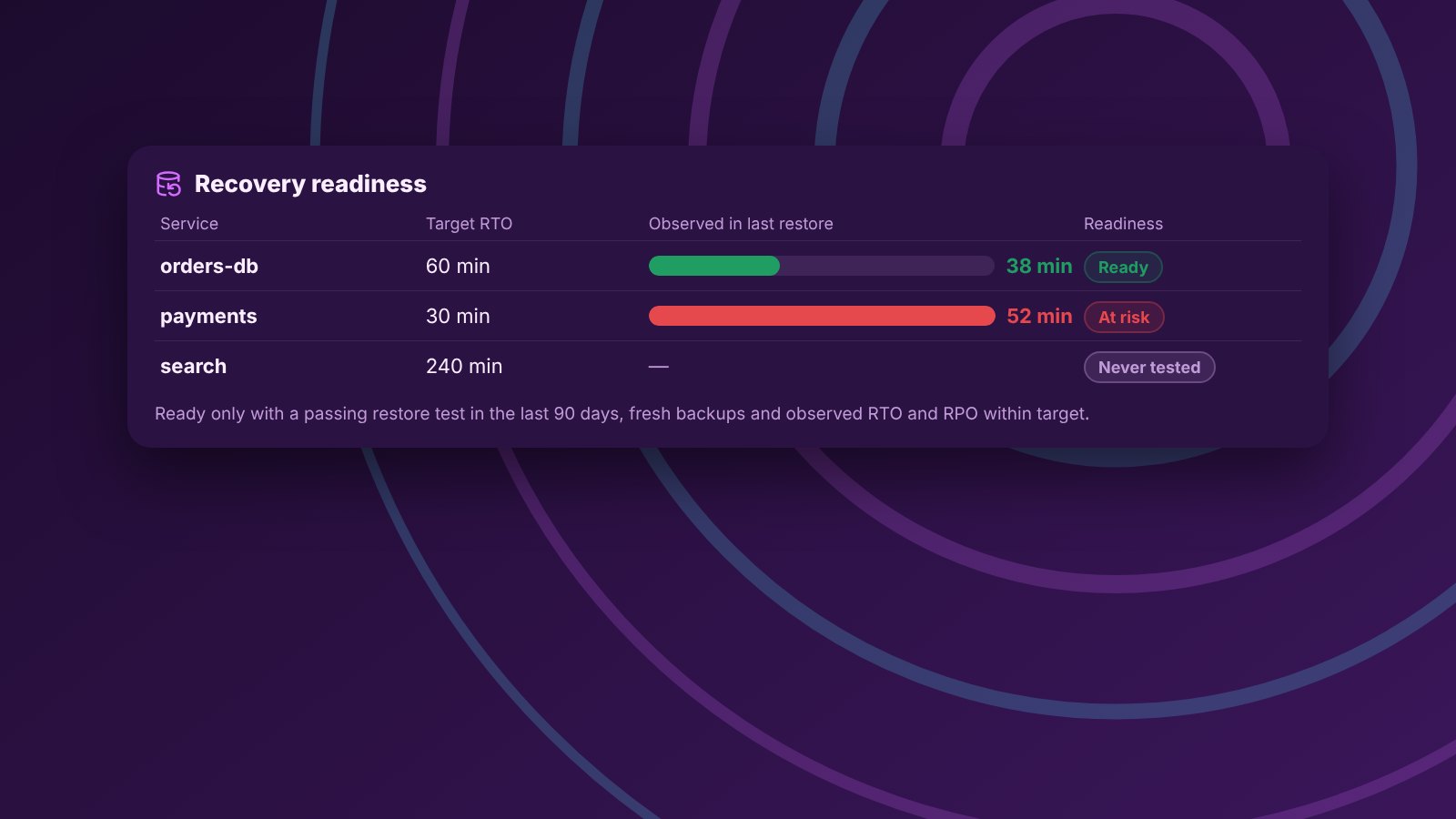
Open Reliability Intelligence → Disaster recovery.
Recovery objectives
For each service and environment, set:
- RTO: how long recovery may take. RPO: how much data, in minutes, may be lost.
- Recovery priority, tier 1 to 4. Tier 1 also needs a failover test.
- The services it depends on, how often it is backed up, how long backups are kept, and whether an off-site copy is required.
- The recovery environment, and a link to the recovery procedure. Someone other than the person who last changed it approves the procedure. A new link needs approval again.
Backup health
Your backup jobs report each backup to POST /v1/reliability/backups, sending { events: [{ service, environment, resource, kind, status, started_at, finished_at, retention_until, checksum, verified, offsite, location }] }. Each service is checked for:
- Freshness: the last successful backup is no older than the RPO.
- Schedule: no gap more than 1.5 times the required interval in the last 7 days.
- Retention and off-site copy.
- Integrity: verified by your tool. A checksum alone counts as unknown.
- Failures in the last 7 days.
A successful backup shows that a copy exists. It isn’t proof the service can be recovered, so readiness also needs a restore test.
Restore and failover tests
| Step | What happens |
|---|---|
| Plan | Kind, service, the environment to run in (isolated by default for restores), the operation, an optional teardown or failback operation, synthetic checks against the recovered service, a time limit and an optional UTC window. |
| Approve | Someone other than the author. Production needs two people, and the production switch. |
| Start | Requests your operation. It runs after a second person approves it in Remediation (if it needs approval) and your agent picks it up. |
| Validate | Restores: two synthetic-check passes in a row after recovery, plus a report from your script to POST /v1/reliability/recovery-runs/:id/report with data_consistent, services_started, dependencies_ok and restored_data_at (the newest data in the restored copy). Failovers: the synthetic check measures downtime. |
| Result | Observed RTO: from the start until validation passed (for failovers, the downtime). Observed RPO: from the start back to restored_data_at. The test passes only if every validation passed and both are within the objectives. Anything that wasn’t measured is a fail, not a pass. |
The teardown or failback operation is requested at the end. Stop now on a run, or the workspace Emergency stop, cancels a waiting operation and requests the teardown for one that may have started. A failed test raises a high finding for the service owner.
Readiness
Each service gets a score out of 100, with every component shown:
- Backups within the RPO (20)
- A restore test passed in the last 90 days (25)
- Observed RTO within target (15)
- Observed RPO within target (15)
- Dependencies ready (10)
- An approved procedure from the last 180 days (10)
- A failover test (5; required for tier 1)
Open recovery findings lower the score. The verdict is ready only when a restore test passed in the last 90 days, backups are fresh, observed RTO and RPO are within target, and the procedure is approved (plus a failover test for tier 1). With no restore test ever, the service is not verified, whatever its configuration says.