
From Interview to Offer With Every Decision on Record
Release 4 of the AI Recruitment Manager completes the hiring loop: structured interviews with independent scorecards, an evidence summary per candidate, hire and reject decisions approved by someone other than the proposer, offers checked against the AI CPO pay band, hand-over into AI CPO People — and a way to validate assessments from real results without overclaiming. How each part works, what it refuses to do, an illustrative worked example, five scenarios and a step-by-step guide.
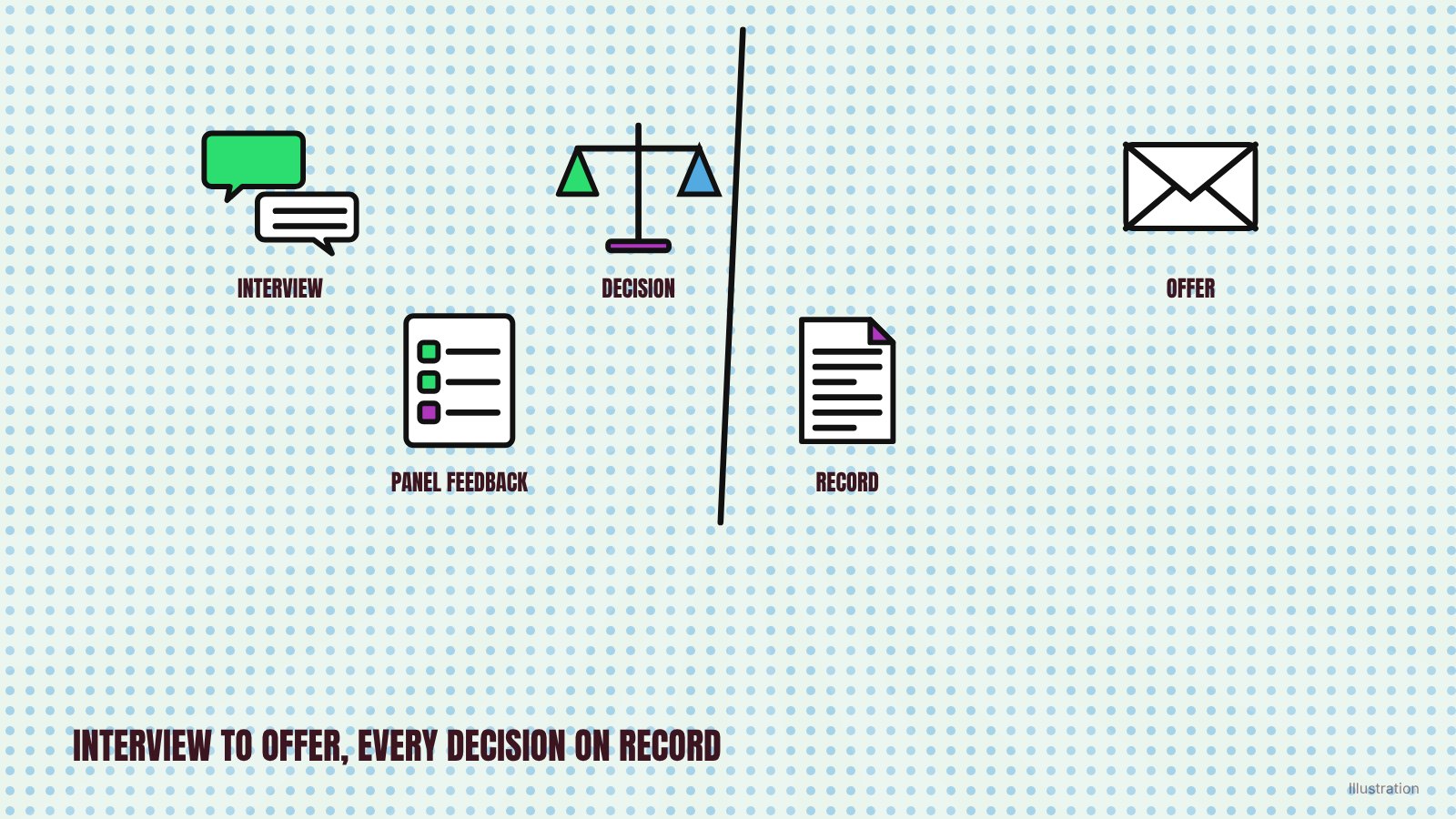
The interview is where most hiring decisions are really made, and it's often the least structured part. Each interviewer asks their own questions. Notes get written after the debrief, once everyone has heard what the most senior person thought. The decision is a conversation nobody wrote down. The offer is a number in an e-mail. And the new hire gets typed into the people system by hand, sometimes with a different title.
Release 4 of the AI Recruitment Manager closes that loop:
- Every candidate gets the same questions per competency.
- Each interviewer scores on their own before seeing anyone else's card.
- Decisions and offers carry written reasons and are approved by a second person.
- Pay is checked against your band.
- An accepted offer becomes an AI CPO person record, with pay and a filled requisition.
It also adds a careful way to validate assessments from real results.
A few terms used in this post:
- Scorecard: one interviewer's ratings (1–4) per competency, with the evidence behind each, plus a recommendation.
- Disagreement: ratings for the same competency that differ by 2 or more points.
- Pay band: the AI CPO's minimum–maximum pay for a level, location and currency.
- Validated for a defined use: the assessment measures consistently and its questions behave as intended, for a use you've written down.
The problem, in plain terms
- Unstructured interviews compare apples with pears. Different questions for different candidates make their answers hard to compare.
- Debriefs anchor on the first opinion. Once someone senior has spoken, later notes drift towards what they said.
- Decisions leave no trail. Months later, nobody can say why one candidate got the job and another didn't.
- Offers drift outside the band without anyone noticing, or one person approves their own exception.
- Re-typing a hire into the people system invites mistakes.
- "Validated" gets used loosely. A test someone liked becomes "our validated assessment".
Part 1: structured interviews
On a candidate's application → Interviews → Plan an interview, you choose:
- the kind of interview: screening, technical, behavioural, panel or final;
- when it is;
- the interviewers;
- which competencies from the approved blueprint it covers, with the question you'll ask for each one.
Every candidate for that role then gets the same questions for the same competency.
Part 2: independent scorecards
Each interviewer fills in their own scorecard:
- a rating per competency, on fixed anchors: 1 = no evidence, 2 = some evidence but below the bar, 3 = meets the bar, 4 = clearly above it;
- what the candidate said or did that supports each rating (required);
- a recommendation, from strong no to strong yes, and a short summary.
Until you submit your own card, you can't see anyone else's on that panel. Once submitted, a card is locked, so the record shows what each person thought before the discussion. After submitting, you see every card, the average per competency and the spread. Where two ratings differ by 2 or more, it says the interviewers disagree and should talk it through before deciding.
Notes that mention age, family, religion, nationality, health and similar characteristics are refused.
Part 3: the evidence summary and comparison
Each application has an evidence summary. Per competency, it shows what the resume evidences and the interview ratings. Alongside that it shows assessment results with their validation status and the number of scorecards.
On the requisition, Compare shows the same for every active candidate. Candidates are listed by how far they've got in the pipeline, then by when they joined. They are never ranked by a single number.
Part 4: decisions, approved by someone else
A recruiter proposes hire, reject or hold, with written reasons that refer to the evidence. The evidence summary is saved with the decision, so you can always see what was in front of people at the time.
Some rules apply:
- A hire needs at least one submitted scorecard.
- Reasons that rest on personal characteristics, "culture fit" or a gut feeling are refused.
- Someone with approval rights who didn't propose the decision approves it or sends it back.
- An approved reject declines the candidate, with the reasons recorded.
- An approved hire opens the offer.
Part 5: offers, checked against the band
The offer has a title, level, department, location, employment type, start date and yearly base pay. It's checked against the AI CPO pay band for that level, location and currency:
- Outside the band, the proposer must explain why, and the approver must record why they're approving the exception.
- No band set, and the offer says so rather than pretending it was checked.
Pay is only visible to people with Compensation in the AI CPO. The same access is needed to propose or approve an offer, and someone other than the proposer approves it.
Then you mark the offer as sent. If it's declined, you record what the candidate said.
Part 6: hand-over into the AI CPO
When the offer is accepted, "Accepted — add to AI CPO" does three things through the AI CPO's own functions and permissions:
- It creates the person in AI CPO People, with title, department, level, location, employment type and start date.
- It records their starting pay, if you have Compensation.
- It marks the requisition filled with that person, if the requisition is open.
The result says exactly what was done and what wasn't, for example "Pay not recorded — that needs Compensation."
Part 7: validating an assessment, carefully
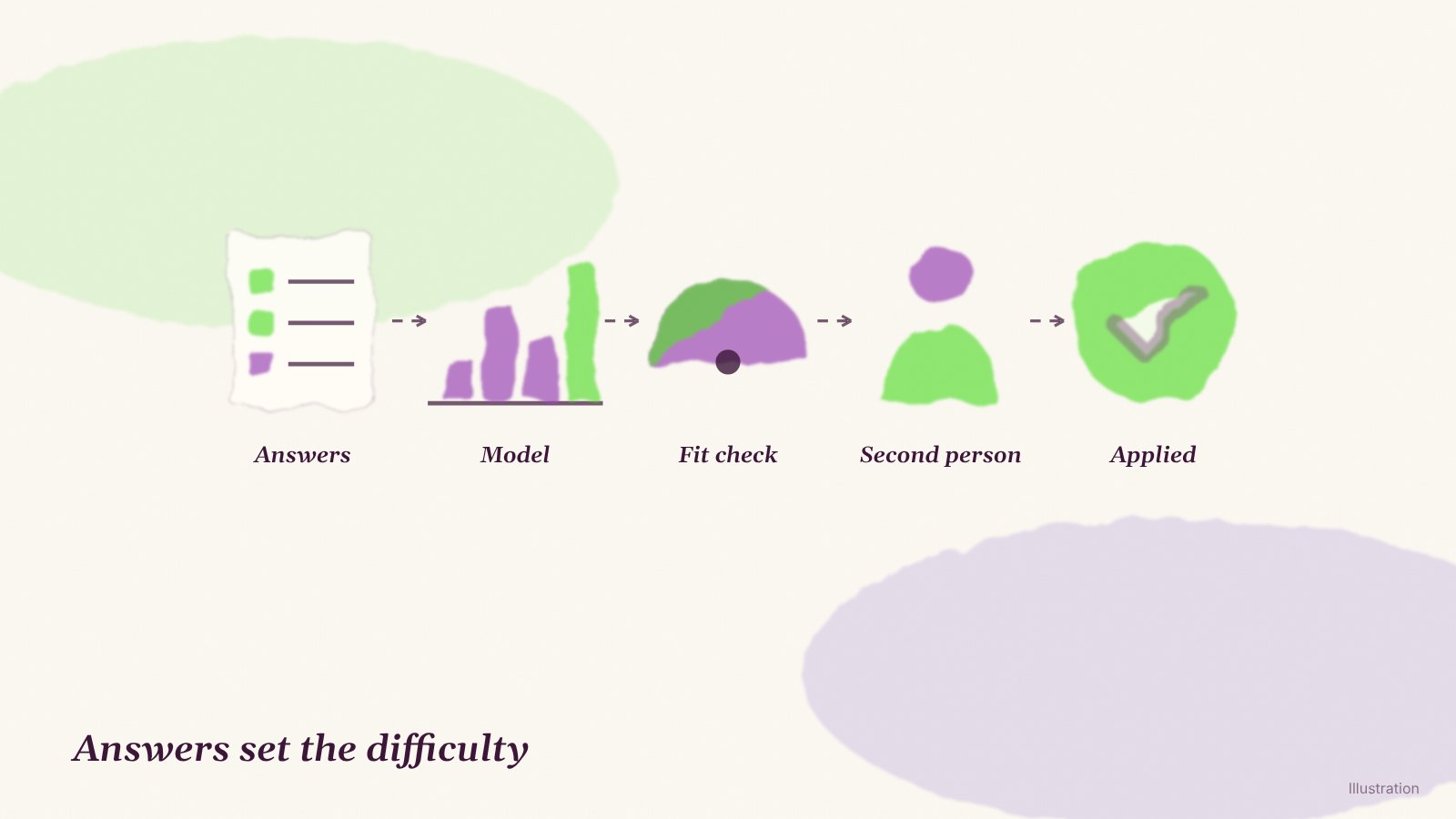
Each approved assessment has a Validation report built from finished, fully scored sittings:
- For each question: how many people answered it, the proportion who got it right, and its discrimination, meaning whether stronger candidates do better on it. This is shown only once the question has 30 answers. Questions that nearly everyone gets right or wrong, or that work backwards, are flagged.
- Reliability (Cronbach's alpha), for a fixed list of questions, from 50 fully scored sittings. Random and balanced forms give candidates different questions, so alpha isn't computed for them.
The validation stages are Not validated, Expert reviewed, In pilot, and Validated for a defined use. Reaching that last stage requires:
- 50 or more fully scored sittings;
- alpha of at least 0.7 for a fixed list, or 30 answers per question for varying forms;
- no questions working backwards;
- a written intended use;
- an approver who didn't build the assessment.
Every change is recorded with its evidence.
Even then, the label says only what it means. The assessment measures consistently, for the use described. It is not evidence that scores predict job performance, and results stay one input among others.
What it does, and what it doesn't
It does: structured interviews and locked, independent scorecards; an evidence summary and comparison that doesn't rank candidates; decisions and offers approved by someone else; band checks; hand-over into AI CPO People with pay and a filled requisition; validation from real results, reported only above minimum samples.
It doesn't, yet: schedule interviews in calendars, send offer letters, or connect to job boards and HR systems. Those are planned, each only after it's tested against a live account.
It never: ranks candidates by a single score, lets someone approve their own decision or offer, shows pay to people without Compensation, or calls an assessment validated without the evidence.
A worked example, start to finish
This is an illustrative scenario, not a customer story.
Monday. A support manager candidate has a panel interview with two interviewers, on troubleshooting and leadership. Each is asked the same question per competency. Both write their scorecards that afternoon, without seeing each other's. Ratings for troubleshooting come out as 4 and 2.
Tuesday. The panel view shows "interviewers disagree" on troubleshooting. They talk it through. The 2 came from a rushed answer about monitoring, and the 4 from a detailed outage walkthrough. Neither card changes, but the recruiter's reasons say how they weighed it. She proposes a hire.
Wednesday. The head of support approves the decision. The recruiter proposes an offer of USD 95,000 at level L2. The L2 band tops out at 90,000, so she has to explain: "Competing offer at 96k; the role covers two regions."
Thursday. The finance-side approver, who has Compensation, approves the exception and records why. The offer is marked sent.
Friday. The candidate accepts. One click adds them to AI CPO People with their title, level and start date, records their starting pay, and marks the requisition filled.
Five more real-world scenarios
Illustrative.
- A rejected candidate asks why. The decision's reasons and the evidence saved with it show what was weighed.
- An interviewer forgets their scorecard. The panel shows who hasn't submitted. Nobody else's card is visible to them until they do.
- No band set for a new level. The offer says it couldn't be checked against a band, and the approver sees that.
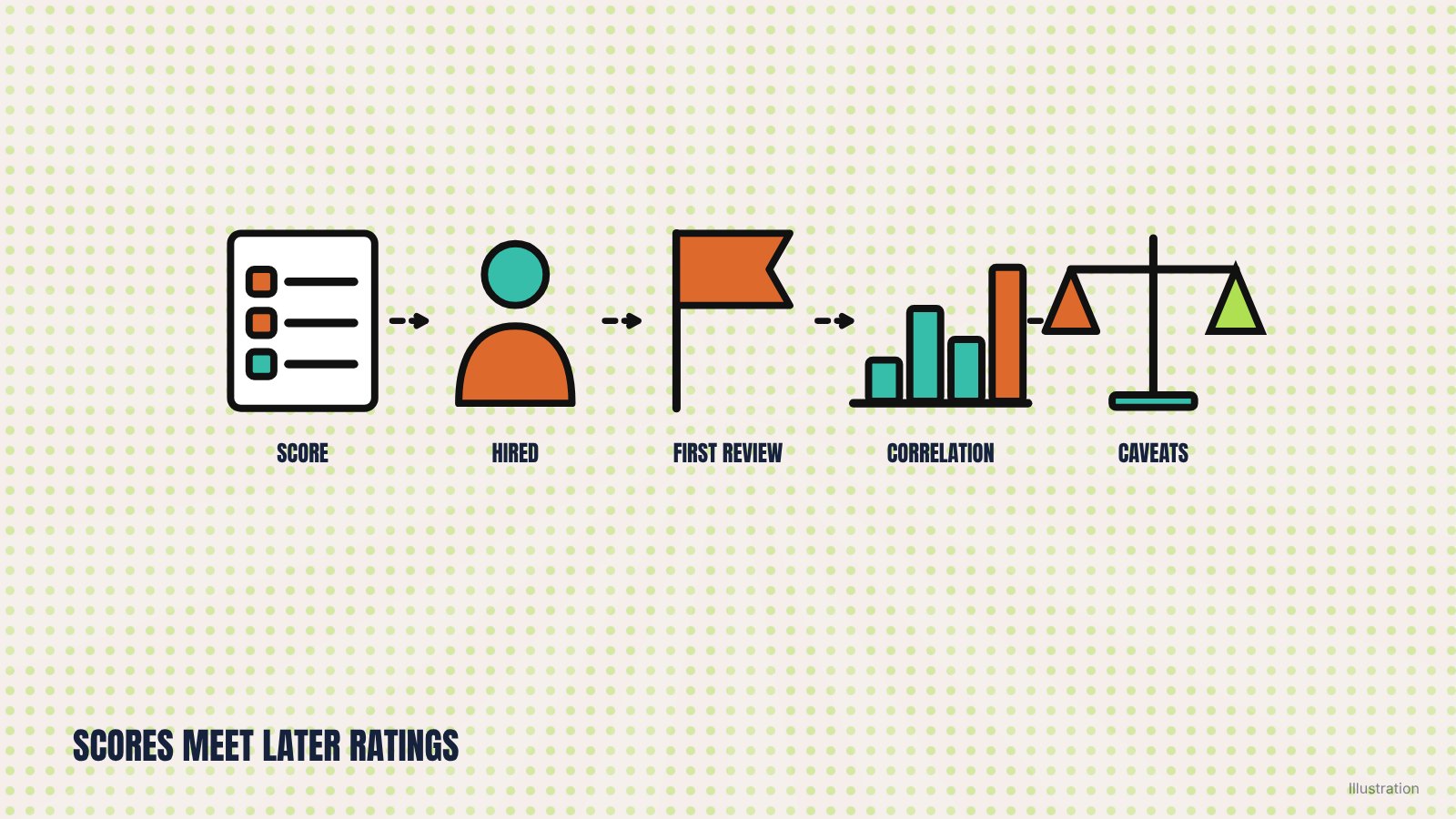
- A graduate assessment after 80 sittings. Alpha is 0.81, but two questions are flagged: one almost everyone gets right, and one that works backwards. The backwards one is fixed before validation.
- A recruiter without AI CPO access. They can run the whole process. At hand-over, the app says someone with "Work in the AI CPO" needs to add the hire.
Do it in TicketResolve, step by step
- Application → Interviews → Plan an interview. Pick the panel, the competencies and one question each. (Structured interviews and scorecards)
- Each interviewer submits their scorecard before the debrief.
- Hiring decision → Propose decision, referring to the evidence summary, then have someone else approve it. (Hiring decisions, offers and hand-over)
- Offer → Propose offer. Explain any band exception and have someone else approve it.
- Mark offer as sent, then Accepted — add to AI CPO.
- Assessments → an approved assessment → Validation, once results build up. (Validating an assessment)
Roles: People · Interviewer submits scorecards. People · Recruiter runs the process. People · Hiring manager approves. Offers also need Compensation, and hand-over needs Work in the AI CPO. The AI Recruitment Manager is part of the AI CPO, with no per-candidate charges. Earlier releases: candidate assessments, the question bank and evidence mapping.
Frequently asked questions
Can interviewers see each other's scores? Not until they've submitted their own. People who aren't on the panel see submitted cards.
Can a scorecard be changed after the debrief? No. Cards are locked once submitted, so the record shows each person's view before the discussion.
Who can approve a hiring decision? Someone with "Approve hiring criteria" who didn't propose it.
What if the offer is above the band? The proposer explains why, and the approver records why they're approving the exception.
Who can see the salary? Only people with Compensation in the AI CPO.
What does "validated" mean here? That the assessment measures consistently and its questions behave as intended, for a use you've described. It doesn't mean scores predict job performance.
Does it send offer letters or calendar invites? Not yet. Those are planned with integrations.
The short version
Ask every candidate the same questions, and have each interviewer score alone before talking. Write down why you decided, and have someone else approve the decision and the offer. Check pay against the band, and hand the hire straight into your people records. Then call an assessment validated only when the data says so, and only for what it says.
Explore Topics
Written by
Ghulam Shabbir
Content creator and writer sharing insights and stories.