
Hiring Tests You Can Defend, Question by Question
Release 2 of the AI Recruitment Manager adds an original question bank and an assessment builder. Every question runs through item-writing checks — personal characteristics, giveaway options, near-copies, culture-bound contexts — and is approved by someone who didn’t write it. Assessments are built from approved questions only, preview their real time, and stay labelled “Not validated” until results exist. How it works, what it refuses to do, an illustrative worked example, five scenarios and a step-by-step guide.
Most hiring tests are put together the night before the first interview. Somebody pastes a few questions from an old test or a website, adds a couple of their own, and sends it out. Nobody checks whether the correct answer stands out because it's the longest option, or whether one question only makes sense if you know the rules of baseball. And nobody can later say which version a candidate actually saw.
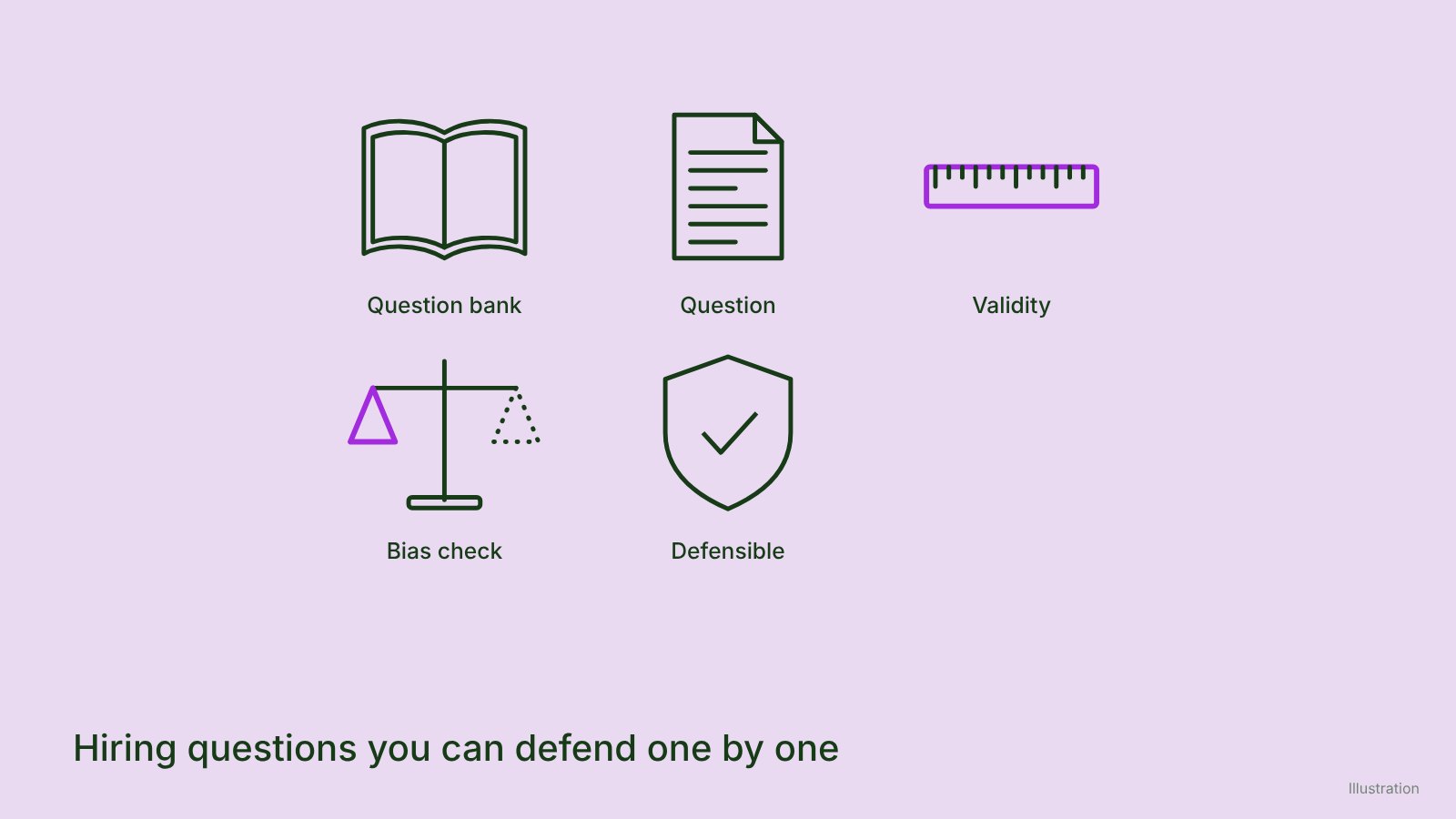
Release 2 of the AI Recruitment Manager turns that into a bank of original questions, each checked by fixed rules and approved by someone who didn't write it. Assessments are assembled from approved questions only. The preview shows what candidates will really get and how long it will take. And every assessment says plainly that it hasn't been validated yet.
A few terms used in this post:
- Question bank: your organisation's own questions, each with a category, type, difficulty and the competencies it measures.
- Item checks: fixed rules that look for common question-writing problems. "Must fix" blocks submission; warnings need a note.
- Form: the actual set of questions one candidate gets.
- Not validated: no results yet show the assessment measures what it should. Use it as one input, never on its own.
The problem, in plain terms
A bad question doesn't look bad. It just quietly measures the wrong thing:
- It gives the answer away. The correct option is the long, careful one, or it's the only option that repeats a word from the question. Test-savvy candidates score well; skilled ones who read carefully don't gain.
- It measures background, not ability. A sport, a holiday or an idiom in the scenario rewards people who share that culture.
- It's ambiguous. A lower-case "not" in the middle of a sentence gets misread under time pressure.
- It isn't yours. It was copied from a published test, which is both a rights problem and a leak: candidates may have seen it before.
AI makes producing questions trivial, which makes all four more likely, not less.
Part 1: the question bank
AI Recruitment Manager → Assessment center → Question bank. A question has:
- a category: numerical, verbal, logical, technical, situational judgement or written response;
- a type: one correct answer; several correct answers; a number answer with an accepted range; situational options each scored 0–3; or a written answer scored by a person against a rubric;
- a difficulty, the competencies it measures, an estimate of the seconds it takes, and an explanation for reviewers.
You can write questions yourself, or use Draft with AI for up to ten at a time. The AI is told to write only original, job-related questions in neutral contexts, never to copy or reword published tests, and to show its working for numerical answers. Drafts land as drafts. Anything that doesn't make a valid question, such as a number question with no number answer, is reported rather than saved.
Part 2: the item checks
Every save runs the checks:
| Check | What happens | Example |
|---|---|---|
| Refers to a personal characteristic | Must fix | "…for women-led teams?" |
| Two options say the same thing | Must fix | "Restart" and "restart" |
| Near-copy of a question in the bank | Must fix | "Almost the same as question #12" |
| Correct option much longer than the rest | Warning | the long, carefully qualified answer |
| Only the correct option repeats a key word from the question | Warning | an echo that gives it away |
| "All of the above" / "none of the above" | Warning | answerable by elimination |
| Lower-case not / except / least / never | Warning | put it in capitals |
| Sport, holiday, idiom contexts | Warning | "At the Super Bowl…" |
| No explanation | Warning | reviewers can't check the key |
| A number answer written by the AI | Warning | work it out yourself |
"Must fix" problems block submission. Warnings can be submitted with a note explaining why the question is fine, and the reviewer sees that note. Ordinary technical words don't trip the personal-characteristics rule: "aged receivables" and "disabled the feature" are fine.
Part 3: approval and change control
A question is approved by someone with approval rights who neither wrote it nor last edited it. That rule applies to workspace owners too. Once approved, a question can't be edited. To change it, you copy it, change the copy, get the copy approved, and retire the original with a reason. That way, any result can always be tied to exactly the question the candidate saw.
Part 4: the assessment builder
Assessments → New assessment. Choose how questions are picked:
- Fixed list: everyone gets the same questions.
- Random: a number of questions per section (category, optionally a competency), drawn from approved questions.
- Balanced: like random, but each section says how many easy, medium and hard questions it needs.
The preview builds a real form from a seed, so the same seed always gives the same form. It shows the questions, the answers (for people who can edit or approve), and the estimated time against the limit. If the bank can't fill a section, it says exactly what's missing, for example "needs 2 hard approved questions, the bank has 1". A short test is never built quietly.
An assessment can be submitted only when the bank can fill it and the questions fit inside the time limit. Someone who didn't build or submit it approves it. If a question it relies on is later retired, the preview shows the gap straight away.
Every assessment carries a Not validated label. That only changes once enough real results exist to check that it measures what it should, which is part of a later release.
What it does, and what it doesn't
It does: keep an original question bank in six categories; check every question with fixed rules; draft with AI as a starting point; require approval by someone else; lock approved questions; build fixed, random and balanced assessments with an honest preview.
It doesn't, yet: send assessments to candidates, time them, score them, or validate them. The candidate portal, with server-side timing and fixed-rule scoring, comes next. Coding questions wait until the code sandbox is validated.
It never: includes copied questions on purpose, lets an author approve their own question, or presents an assessment as validated when it isn't.
A worked example, start to finish
This is an illustrative scenario, not a customer story.
A support team is hiring a support manager. The recruiter drafts five numerical questions with AI for "Data" at medium difficulty. Each arrives flagged: "An AI wrote this answer. Work it out yourself before approving." She works through them. Four are right. One answer was wrong, 26% instead of 25%, so she corrects it, and all five go for review with the note "Worked out by hand."
She writes three situational questions herself. One reads "Which step is not part of a safe rollback?". The check asks for NOT in capitals, and she fixes it. Another mentions a "Thanksgiving sale". It's flagged as culture-bound, so she changes it to "an end-of-quarter sale".
Her manager approves the eight questions. A technical question from last year turns out to be a near-copy of a new one. It's blocked, so she retires the older one with the reason "Superseded by #31".
She builds a balanced assessment with two sections. Numerical has 3 medium and 1 hard; situational has 3 medium. The preview says: "Numerical reasoning: needs 1 hard approved question, the bank has 0." She writes and gets one approved. The preview is now 7 questions, about 9 minutes of a 15-minute limit. The head of support approves it. It's labelled "Not validated", ready for the candidate portal in the next release.
Five more real-world scenarios
Illustrative.
- A team inheriting questions from a test vendor. They don't import them: the bank is for original questions. They write their own on the same competencies.
- Two recruiters writing similar questions. The second gets "Almost the same as question #9" and reuses the first instead.
- A legal review before a big hiring round. Every question shows who wrote it, who approved it, the checks it passed and any notes, and approved questions haven't changed since.
- A question turns out to be wrong after approval. Retire it with a reason. Assessments using it show the gap in their preview until it's replaced.
- Graduate hiring with lots of candidates. A balanced, random assessment gives each candidate a different but comparable form, all built only from approved questions.
Do it in TicketResolve, step by step
- Assessments → Question bank → Write a question or Draft with AI. (The question bank)
- Fix "Must fix" items, and add a note for any warnings you're keeping, then Submit for review.
- Have someone else approve. To change an approved question, Copy it and retire the original.
- Assessments → New assessment. Choose fixed, random or balanced, set the time limit, and check the preview. (Building an assessment)
- Submit once the bank can fill it, and have someone else approve it.
Roles: People · Recruiter writes questions and builds assessments. People · Hiring manager approves. The AI Recruitment Manager is part of the AI CPO, with no per-question or per-assessment charges. It builds on release 1: blueprints, candidates and evidence mapping.
Frequently asked questions
Can I import questions from a published test? No. The bank is for original questions. Copying published tests creates rights problems, and candidates may already know the answers.
Are AI-drafted questions safe to use? Not until a person has checked them and someone else has approved them. AI number answers are flagged until a person has worked them out.
Why can't I edit an approved question? So that results can always be tied to exactly what candidates saw. Copy it instead.
Does "Not validated" mean I shouldn't use the assessment? It means there's no evidence yet that it measures what it should. Use it as one input among others, never on its own to decide.
Can each candidate get different questions? Yes. Random and balanced assessments draw from approved questions per section, and each form can be rebuilt exactly from its seed.
Are there coding questions? Not yet. They need the code sandbox, which hasn't been validated.
When can candidates take assessments? In the next release, through a candidate portal with consent, accommodations, server-side timing and fixed-rule scoring.
The short version
Write your own questions. Let fixed rules catch giveaways, bias and ambiguity before anyone approves them. Have someone else approve each one, and never change an approved question in place. Build assessments only from what's been approved, and say honestly that they haven't been validated yet.
Explore Topics
Written by
Ghulam Shabbir
Content creator and writer sharing insights and stories.