
An Audit Trail You Can Check for Tampering
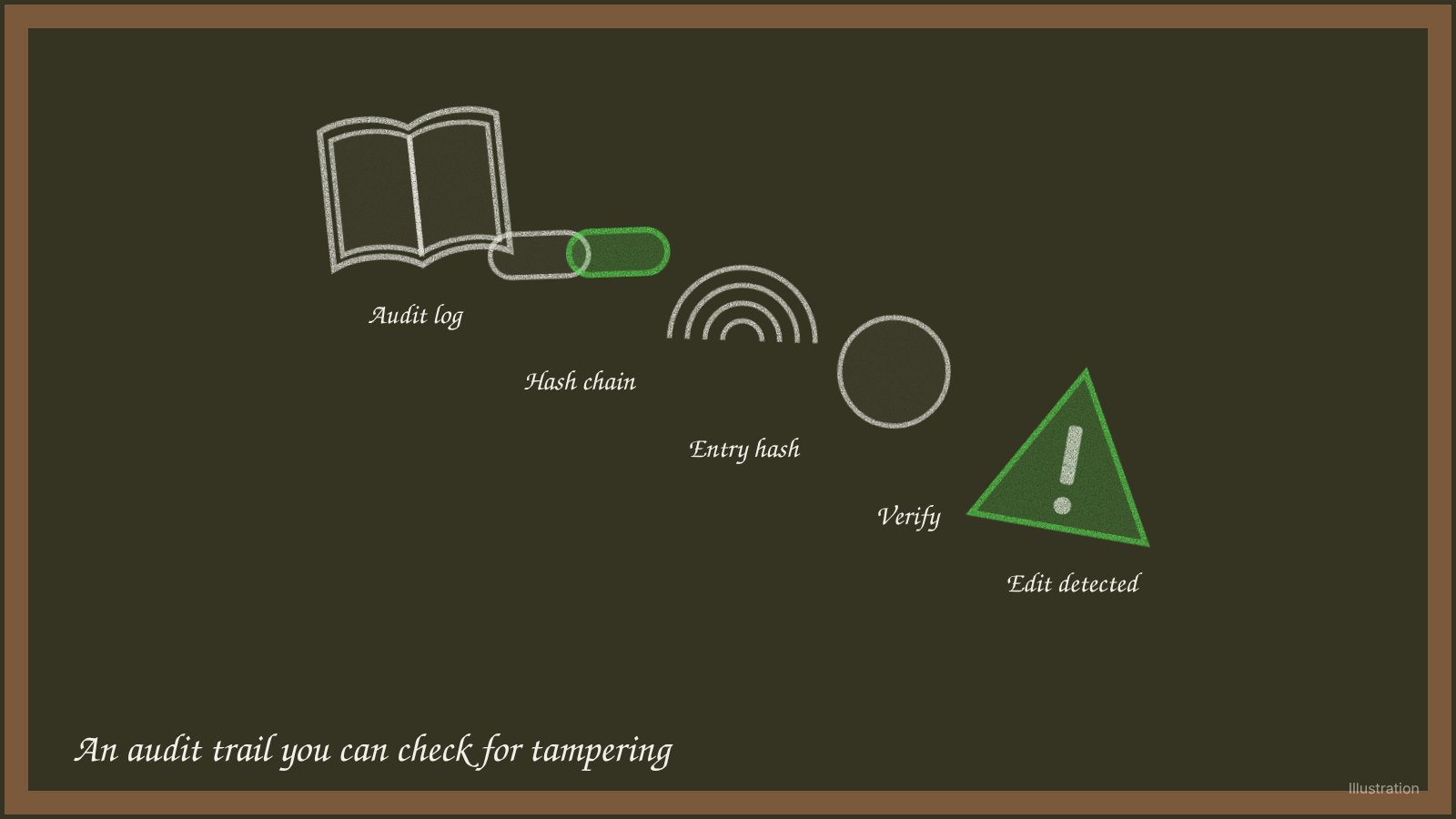
An audit log is only useful if you can trust that nobody rewrote it. TicketResolve seals remediation, engineering-governance and investigation audit records into a hash chain for each workspace, so an edited or deleted record shows up, and says plainly what that does and doesn’t prove.
Every approval, remediation run, policy change and investigation step in TicketResolve is written to an audit table. Those tables are append-only by design. Until now, though, nothing would show it if someone with database access changed a row afterwards.
Here's why that matters. Picture an incident review at a fintech company. A production configuration change took the payments service down for 40 minutes. The audit log says the change was approved by the on-call lead at 14:02. The on-call lead says she never approved it; she was in a meeting. Someone suggests the record might have been edited. Someone else points out that only three people have database access, and one of them made the change.
Nobody can prove the record is genuine, and nobody can prove it isn't. The review stalls on a question the audit log was supposed to answer.
An audit trail is only as useful as the trust in it. If a record could have been changed afterwards without anyone being able to tell, every record is a little less believable.
First, the basics
- An audit log (audit trail) records who did what, to what, and when.
- Append-only means records are only added, never changed or removed, by design. Design alone doesn't stop someone with database access.
- A hash (here SHA-256) is a fixed-length fingerprint of some data. Change one character and the hash changes completely.
- A hash chain links records: each record's hash includes the previous record's hash, so changing one breaks every hash after it.
- Sealing is computing and storing those hashes.
- An integrity check recomputes the chain and compares.
- Tamper-evident means tampering can be detected; tamper-proof would mean it's impossible. This is the first, not the second.
- A workspace is one TicketResolve account.
Why does this matter? Audit logs are evidence in incident reviews, disputes, security investigations and audits. A chain that shows whether records were changed turns "we think it's genuine" into "it's intact up to here".
The problem, in plain terms
- Append-only by design doesn't stop database access.
- Edited records look like real ones.
- Deleted records leave no gap.
- Disputes about the log can't be settled from the log.
How sealing works
Every 10 minutes, a job takes each workspace's new audit records in order. For each one it computes a SHA-256 hash of the previous record's hash plus the record's own content: who, what, the target, the detail and the time. The hashes are stored beside the audit tables, one chain per workspace and per table.
Three trails are covered:
- remediation, keys and integrations
- engineering governance
- every investigation step
Checking the chain
An admin can ask for an integrity check at any time. TicketResolve recomputes each chain from the start and reports:
- whether the chain is intact
- the first record where it breaks, and whether that record was changed or deleted
- how many records are newer than the last seal
Changing one character in a sealed record changes its hash. Every hash after it then stops matching, so the break points at the record that was touched.
What it is and isn't
This makes tampering detectable. It doesn't make it impossible. Someone who can rewrite both the records and the hashes could rebuild a chain. Recording the latest hash somewhere else, such as an export or a ticket, closes that gap. Records also aren't protected in the minutes before they're sealed, and the check shows those records as not sealed yet.
An investigation that is deleted takes its own audit records with it. The check counts those separately rather than reporting them as tampering.
A worked example, start to finish
Here's the fintech incident review again, with sealed audit records. The details are illustrative.
The question. Was the approval at 14:02, attributed to the on-call lead, Mira, genuine?
14:02, the record. The remediation audit trail shows: approved by Mira, operation apply_config, target payments-service, detail "approved after diagnostic", 14:02:17. It was sealed at 14:10 with the rest of that 10-minute batch.
Next day, 10:00, the check. The security lead, Oskar, asks for an integrity check. TicketResolve recomputes the workspace's chains from the start:
- Engineering governance: intact.
- Investigation steps: intact, plus 2 records counted separately because an investigation was deleted last month and took its own records with it. Not reported as tampering.
- Remediation, keys and integrations: break at record 18,442: the 14:02:17 approval. The record was changed. Every hash after it no longer matches.
- Records newer than the last seal: 14 (from the last few minutes, shown as not sealed yet).
10:15, what changed. The stored hash shows the record isn't what was sealed at 14:10. The team restores the database backup from 14:30 the day before (before anyone would have known to edit it) and compares: the original record says approved by Paulo, the engineer's manager, who had approved it from his phone. Someone had later edited the approver's name to Mira's.
What it settled. The approval wasn't Mira's. The record was edited after sealing. The investigation now focuses on who edited it, using database access logs.
What they changed. Oskar sets up a weekly step: copy the latest hash of each chain into a security ticket. With the latest hash recorded somewhere else, someone who rewrote both records and hashes would no longer match it.
Five more real-world scenarios
1. A record deleted
Situation. Someone deletes an approval record.
How TR handles it. The check reports the break at that point and that the record was deleted.
2. A very recent record
Situation. A record was written two minutes ago.
How TR handles it. It isn't sealed yet; the check shows it as newer than the last seal.
3. A deleted investigation
Situation. An investigation is deleted, with its audit records.
How TR handles it. The check counts those separately, not as tampering.
4. Rewriting the chain
Situation. Someone rewrites records and hashes together.
How TR handles it. The chain could be rebuilt, so record the latest hash elsewhere, such as an export or a ticket, to catch it.
5. An auditor's request
Situation. An auditor asks whether remediation records were changed.
How TR handles it. Run an integrity check and share whether each chain is intact.
How a hash chain catches a change, in plain words
Imagine a notebook where, at the bottom of every page, you write a short code made from that page's text plus the previous page's code. Nobody can work backwards from the code to the text, and any change to the text, even a comma, produces a completely different code.
Now someone quietly edits page 40. Its code no longer matches what's written at the bottom. Page 41's code was made from page 40's old code, so it no longer matches either, and neither does page 42's, and so on to the end. A checker who recomputes the codes from page 1 finds everything fine up to page 39 and the first mismatch at page 40. That's exactly where the edit happened.
The same works for a torn-out page: page 41's code was built on a page that's no longer there, so the chain breaks at the gap.
The weak spot is someone who rewrites page 40 and every code after it. That's why copying the last code somewhere else, outside the notebook, matters: a rebuilt chain won't end with the code you wrote down.
Building it into your routine
A few habits make the chain most useful:
- Run an integrity check before relying on the log in an incident review, dispute or audit.
- Record the latest hash of each chain outside TicketResolve on a schedule, such as weekly, in a security ticket or an exported file.
- Stream audit events to your SIEM as an independent copy.
- Note who has database access. Tamper evidence tells you something was changed; access records help tell you who.
Before and after
Before. A disputed approval, three people with database access, and no way to tell from the log whether the record was genuine.
After. Records sealed every 10 minutes into a chain per workspace and table, an integrity check that pointed at the exact record that was changed, deleted investigations counted separately, and the latest hash recorded elsewhere every week.
How to tell it's working
- Integrity checks come back intact.
- Breaks, if any, point at one record.
- The latest hash is recorded outside TicketResolve regularly.
Who it's for
- Security and compliance teams.
- Incident review owners.
- Auditors who need to rely on the log.
How it fits with the rest of TicketResolve
Sealing covers remediation, engineering governance and investigations. Connect sessions' timelines are sealed in the same chain. For external copies, audit streaming sends events to your SIEM.
Mistakes to avoid
- Calling it tamper-proof. It's tamper-evident.
- Never recording the latest hash elsewhere.
- Reading deleted investigations' records as tampering.
Do it in TicketResolve, step by step
Where: Settings → audit trail (/dashboard/settings). You'll need: an admin to run integrity checks. Full guides: Audit trail, data retention and GDPR and Audit streaming to your SIEM.
- Know what's sealed: remediation, keys and integrations; engineering governance; investigation steps.
- Run an integrity check (admins) whenever you need to rely on the log.
- Read the result for each chain: intact, or the first break and whether the record was changed or deleted.
- Note records newer than the last seal; they're sealed within 10 minutes.
- Record the latest hash elsewhere, such as an export or a ticket, on a regular schedule.
- Stream audit events to your SIEM for an independent copy.
How to check it worked: an integrity check reports each chain as intact, with the number of records not yet sealed.
Frequently asked questions
How often are records sealed? Every 10 minutes.
What's hashed? The previous record's hash plus who, what, the target, the detail and the time.
Which trails are covered? Remediation, keys and integrations; engineering governance; every investigation step.
Is it tamper-proof? No. It makes tampering detectable, not impossible.
How do I close the gap? Record the latest hash somewhere else, such as an export or a ticket.
What does a break show? The first record where it breaks, and whether it was changed or deleted.
Are new records protected? Not until they're sealed; the check shows them as not sealed yet.
What about deleted investigations? Their records are counted separately, not as tampering.
How often should we record the latest hash elsewhere? On a regular schedule, such as weekly, in a security ticket or an export.
Does the chain tell us who changed a record? No. It shows which record was changed or deleted; database access records help find who.
Explore Topics
Written by
Ghulam Shabbir
Content creator and writer sharing insights and stories.