
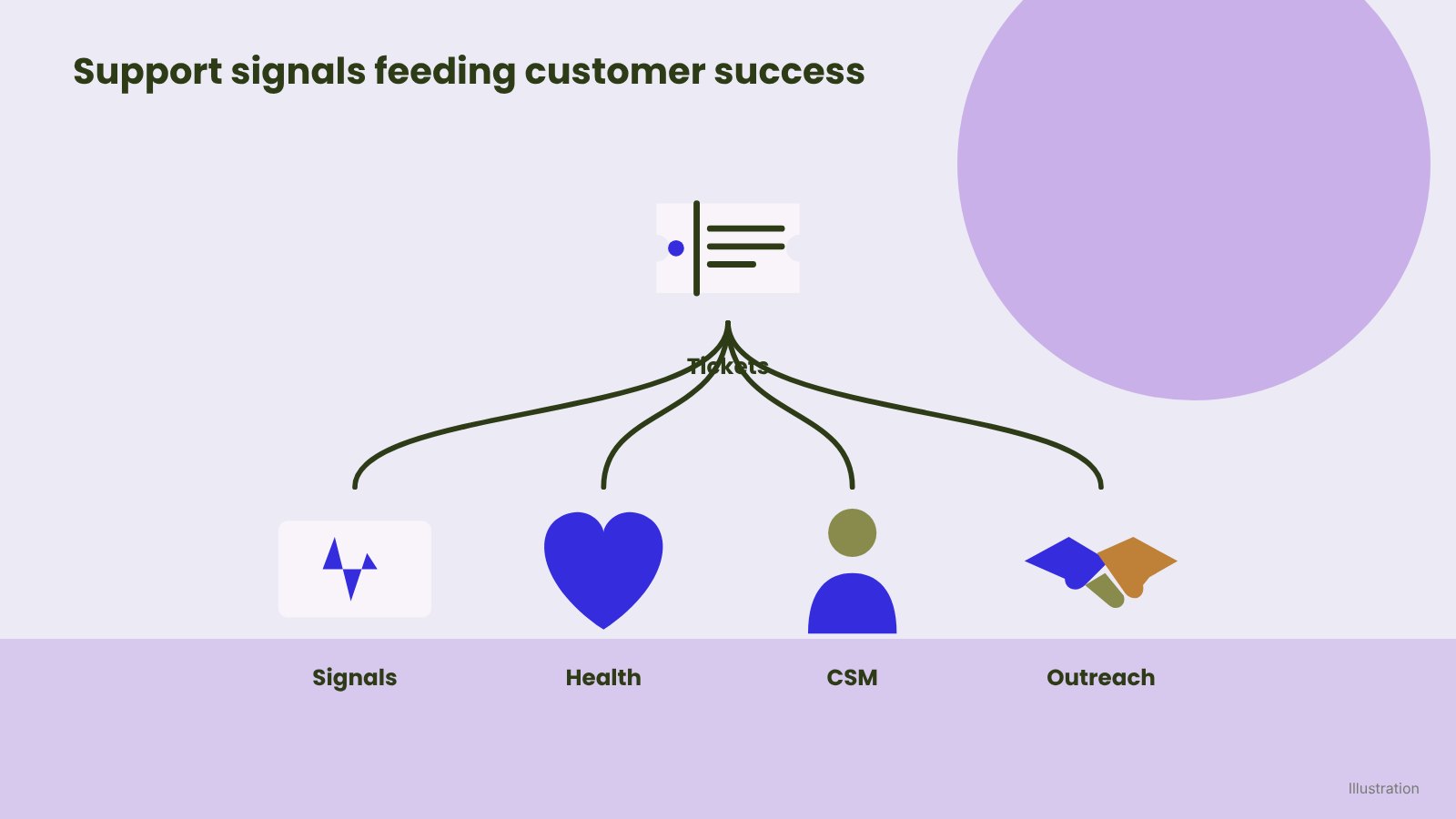
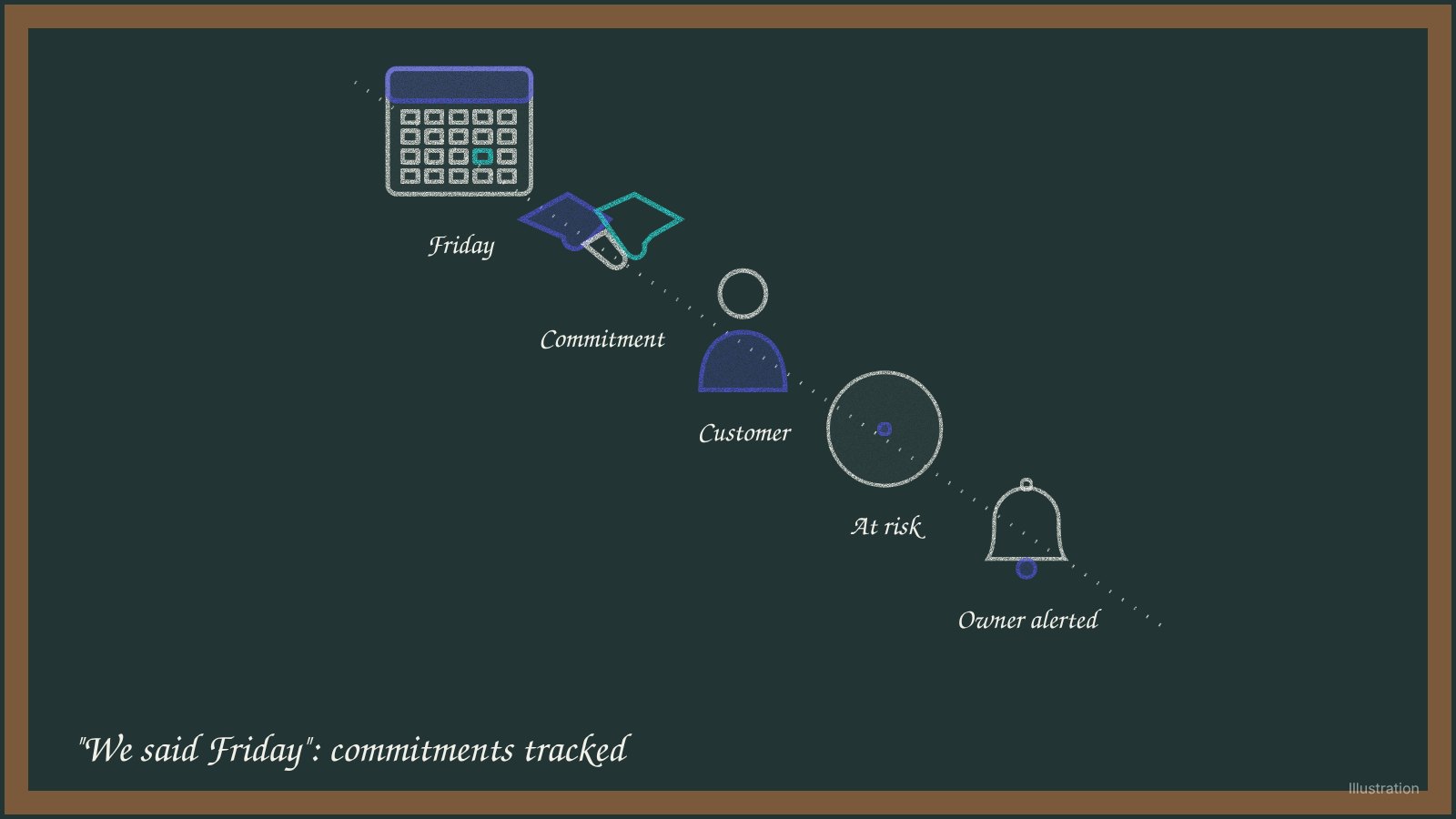
Renewal Intelligence: Renewals That See the Support Behind Them
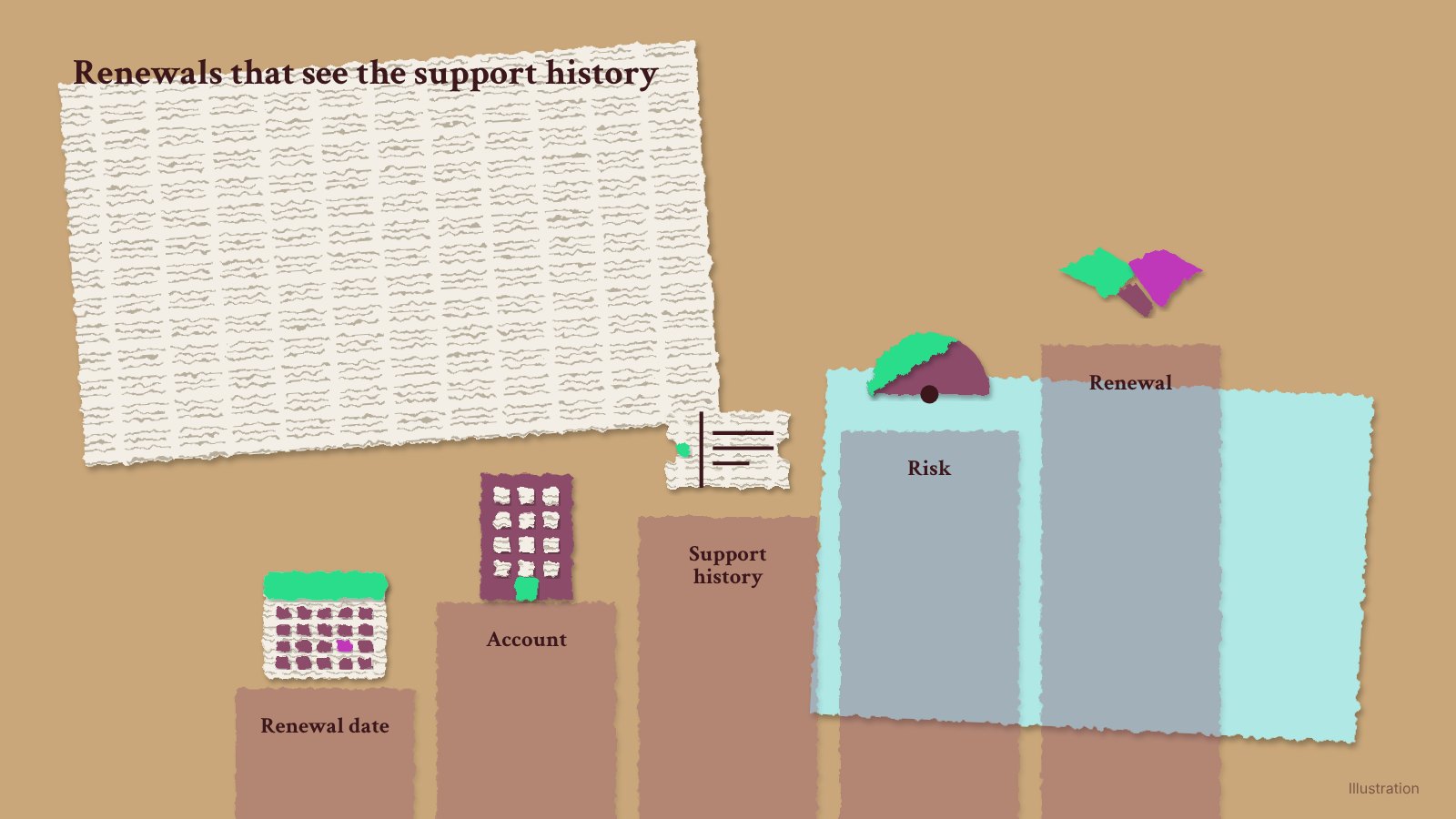
A renewal forecast usually knows the contract value, the close date and the deal stage. It doesn’t know about 54 escalations this month, a recurring integration bug, or a cancellation deadline in eight days with no contact with the economic buyer. Renewal Intelligence puts what TicketResolve knows next to every renewal: a pipeline with stage rules, explainable readiness and risk tied to tickets and health, stakeholders, proposals with approvals, contracts confirmed by a person, forecasting and outcomes.
At a data-integration software company, the renewal manager, Dimitri, is confident about the renewal of a large logistics customer: £180,000 a year, renewing on 30 September. It's in Verbal commitment in the CRM. The champion, their head of data, said on a call in July that "we're definitely renewing".
On 22 September, the customer sends a cancellation notice. Their contract has a 60-day notice period; it was valid. Dimitri's spreadsheet had the notice deadline as 30 days.
In the post-mortem, the pieces come out. The customer had raised 54 escalations in August about an integration that kept dropping records. The same bug had come back three times. Their new CFO, the economic buyer, had joined in June, and nobody from the vendor had ever spoken to him. The champion had left the company in August.
None of this was in the renewal forecast. All of it was in TicketResolve.
First, the basics
- A renewal is a customer signing up again when their contract ends. ARR is what they pay per year.
- A pipeline shows renewals by stage: Upcoming, Preparation, Internal review, Customer engagement, Proposal, Negotiation, Verbal commitment, Renewed or Lost.
- Stage rules say what a renewal needs before it can enter a stage, such as an owner or an approved proposal.
- Readiness is how prepared you are; risk is how likely the renewal is to be lost or reduced. Both are assessed from dimensions such as health, support experience and relationship.
- Stakeholders are the customer's people: the economic buyer (who signs), the executive sponsor, the champion (your advocate).
- A notice deadline is the last day the customer can cancel. Auto-renewal means the contract renews unless cancelled.
- A proposal is the commercial offer. Discount thresholds decide who must approve it.
- Weighted ARR multiplies each renewal's ARR by its probability. Committed and best case are forecast categories.
- An association means two things happen together, not that one caused the other.
Why does this matter? Renewals are where most recurring revenue is won or lost, and the warning signs (support problems, lost champions, missed notice deadlines) are usually visible somewhere. Bringing them into the renewal itself gives the team time to act.
The problem, in plain terms
- Renewal forecasts only see the CRM.
- Support problems are invisible to the renewal team.
- Stakeholder changes go unnoticed: a new economic buyer, a departed champion.
- Notice deadlines are wrong in spreadsheets.
- Proposals are approved by whoever prepared them.
- Contract terms are copied by hand, with mistakes.
A pipeline with rules
Renewals move from Upcoming through Preparation, Internal review, Customer engagement, Proposal, Negotiation and Verbal commitment to Renewed or Lost. You decide what a renewal needs before it enters each stage (an owner, a value, a contract, stakeholders, an approved proposal), and a move that breaks a rule is refused with the reason. Every move is recorded.
Readiness and risk you can explain
Each open renewal is assessed daily from ten dimensions: health, support experience, sentiment, adoption, relationship, success plan, commercial position, stakeholders, technical risks and renewal history. Every factor links to the tickets, problems, investigations or activities behind it. No AI is involved, and a dimension with no data is left out instead of counted against the customer.
Risks you can work
Each risk signal opens a record with an owner, a status from Detected to Resolved, comments, tasks and escalation. If the signal goes away before anyone picks the record up, it closes itself; a record someone is working stays open with a note. A resolved record reopens if the signal returns.
Stakeholders, plans and proposals
Map the economic buyer, executive sponsor and champion and see the gaps. Plans from nine templates have due dates counted back from the renewal date. Proposals route through internal review, finance and management according to your discount and value thresholds, and nobody approves a proposal they prepared.
Contracts read once, confirmed by a person
Upload the signed contract and it's read by AI once per version. Every term (dates, notice period, auto-renewal, value and what kind of value it is) shows the exact words it came from. Nothing applies until someone ticks it and confirms.
A forecast that adds up
Renewal ARR, weighted ARR, committed, best case and at risk by month, owner or segment, with weekly snapshots, the movement since each one, and forecast accuracy once a month closes. Currencies are never added together.
Outcomes that teach
Every closed renewal records its original and final ARR, plus expansion, contraction or loss. A lost renewal also records the reason and what was learned. Analytics then shows renewal rates by health, support experience and engagement, labelled as associations, not causes.
A Copilot that shows its work
Questions such as "which renewals in the next 90 days are at risk?" are calculated from your records with no AI. Briefings, strategies, negotiation notes and e-mail drafts are written from one renewal's evidence, within the daily limit shared with the Success Copilot. Nothing is sent to a customer from here.
A worked example, start to finish
Here's the next year's renewal for a similar customer, with Renewal Intelligence.
Setup. Every account with a renewal date gets a renewal 120 days before it (the default). Dimitri sets stage rules: Customer engagement needs an owner and a value; Proposal needs stakeholders mapped; Verbal commitment needs an approved proposal.
Day −120. A renewal appears for Harbour Logistics: £210,000 ARR, renewing 31 March. Dimitri opens it and presses Edit: owner (Dimitri), current ARR, term, next action. He uploads the signed contract under Contracts & subscriptions. The AI reads it once. Terms are shown with the exact words they came from:
- Notice period: 90 days ("either party may terminate with ninety (90) days' written notice prior to the Renewal Date");
- Auto-renewal: yes;
- Value: £210,000 annual subscription fees.
He ticks them and presses Confirm. The notice deadline becomes 31 December.
Day −110. The Risk tab shows readiness and risk with ten dimensions. Support experience is low: 38 escalations in 30 days, linked to the tickets, and a recurring problem "CDC connector drops records" linked to its problem record. Stakeholders is low: no economic buyer mapped.
Day −110. A risk record opens for support experience. Dimitri presses Work on it: owner (the CSM), status Assigned, a task for the support lead to escalate the connector bug to engineering.
Day −100. On the Stakeholders tab he adds the champion (head of data) and finds the economic buyer: a new CFO, appointed last month. Coverage shows the executive sponsor is missing. He creates the plan from the Enterprise renewal template; milestones get dates counted back from 31 March, including Executive meeting with economic buyer by day −75.
Day −70. The connector fix ships; escalations drop. The support signal goes away, but the risk record stays open, because someone is working it, with a note. After two clean weeks, the CSM resolves it with the note "fix verified; escalations 38 → 4".
Day −60. On the Commercial tab, Dimitri prepares a proposal: 2-year term at 8% discount. Above the 5% threshold, so it routes to finance and management approval. Neither approver is Dimitri. Both approve.
Day −45. The customer agrees verbally; the renewal moves to Verbal commitment (it has an approved proposal, so the rule passes).
Day −20. Signed. Dimitri records the outcome: renewed, original ARR £210,000, final £232,000 (+10.5% expansion for an extra connector).
Forecasting. The weekly snapshots showed Harbour moving from at risk to committed over two months. Analytics later shows renewals with high support experience renew at higher rates, labelled as an association.
Five more real-world scenarios
1. A move that breaks a rule
Situation. Someone drags a renewal to Proposal without stakeholders mapped.
How TR handles it. The move is refused, with the reason.
2. A dimension with no data
Situation. A customer sends no usage data.
How TR handles it. Adoption is left out, lowering confidence, not the score.
3. A risk that resolves itself
Situation. A sentiment dip recovers before anyone picks up the record.
How TR handles it. The record closes itself.
4. A contract term that's wrong
Situation. The AI reads "annual fees" but the value includes one-off services.
How TR handles it. Nothing applies until someone ticks the right terms and confirms; the person corrects it.
5. A lost renewal
Situation. A customer churns to a competitor.
How TR handles it. The outcome records the reason and what was learned.
Before and after
Before. A "definite" renewal lost to a 60-day notice period nobody had right, a bug that kept coming back, a new CFO nobody had met and a champion who'd left.
After. A renewal created 120 days out, contract terms confirmed from the exact words, support risk linked to the tickets and worked to resolution, stakeholder gaps visible, proposals approved by someone else, and an outcome that teaches.
How to tell it's working
- Every renewal has a confirmed notice deadline.
- Risk records are worked, not left at Detected.
- Economic buyers are mapped before Proposal.
- Forecast accuracy improves month by month.
Who it's for
- Renewal managers and account managers.
- Customer success teams whose work affects renewals.
- CROs and finance who forecast renewal revenue.
How it fits with the rest of TicketResolve
Renewal Intelligence works with or without Customer Success, using the same accounts and health scores when you have both. Billing Intelligence adds overdue invoices and failed payments as risk signals. Renewals feed RevOps Intelligence's forecast and the AI Ops Copilot.
Mistakes to avoid
- Trusting a notice deadline you haven't confirmed from the contract.
- Skipping stakeholder mapping. It's often where renewals are lost.
- Resolving risk records without a note. The note is the record of what worked.
Do it in TicketResolve, step by step
Where: Renewals (/dashboard/renewals/pipeline). You'll need: a renewal seat; finance and management approvers for proposals above your thresholds. Full guides: Getting renewals in and working the pipeline, Readiness, risk and risk records, Stakeholders, plans, proposals and contracts and Outcomes, forecast and the Renewal Copilot.
- Add Renewal Intelligence. Start the 7-day free trial, or add it under Billing → Add-ons.
- Let renewals create themselves. Accounts with a renewal date get a renewal 120 days before it by default (change it in Renewals → Settings). Or sync from Salesforce, HubSpot or Stripe, or press New renewal.
- Give it an owner and a value. Open the renewal and press Edit: owner, current ARR, notice deadline, term, next action.
- Upload the contract. Contracts & subscriptions → Upload a document. Tick the terms that are right and press Confirm.
- Read the reasons. The Risk tab lists every dimension with the factors that moved it, linked to the evidence.
- Work a risk record. Work on it: owner, status, comments, tasks or escalation. Resolving needs a note.
- Map stakeholders and create the plan. Stakeholders tab, then Plan tab from a template.
- Prepare the proposal. Commercial tab → New proposal → Submit for approval.
- Move it and record the outcome. Drag cards on the Pipeline; when it closes, record the outcome on the Outcome tab.
How to check it worked: each renewal shows a confirmed notice deadline, its readiness and risk with evidence, and its stage history.
$79 per renewal seat a month, with unlimited renewals. People who only view renewals don't need a seat. See how it works or visit the Renewal Intelligence page.
Frequently asked questions
How are renewals created? Automatically before each account's renewal date (120 days by default), synced from your CRM or Stripe, or added by hand.
What happens if a move breaks a stage rule? It's refused, with the reason.
Is AI used for risk? No. Readiness and risk come from ten dimensions, each linked to evidence.
What if there's no data for a dimension? It's left out, lowering confidence, not the score.
Who approves proposals? Internal review, finance and management by your thresholds. Nobody approves a proposal they prepared.
Are contract terms applied automatically? No. A person ticks the right terms and confirms.
Are currencies added together in the forecast? No.
Can the Copilot send e-mails to customers? No. Nothing is sent to a customer from here.
Explore Topics
Written by
Ghulam Shabbir
Content creator and writer sharing insights and stories.