
Done Is Not Prevented
Three months after the outage, all eleven postmortem actions are ticked. Then the same connection pool runs dry on a Friday evening. TicketResolve builds postmortems from incident evidence, gives every prevention action a real verification criterion, and keeps a clear line between actions completed and risks actually mitigated.
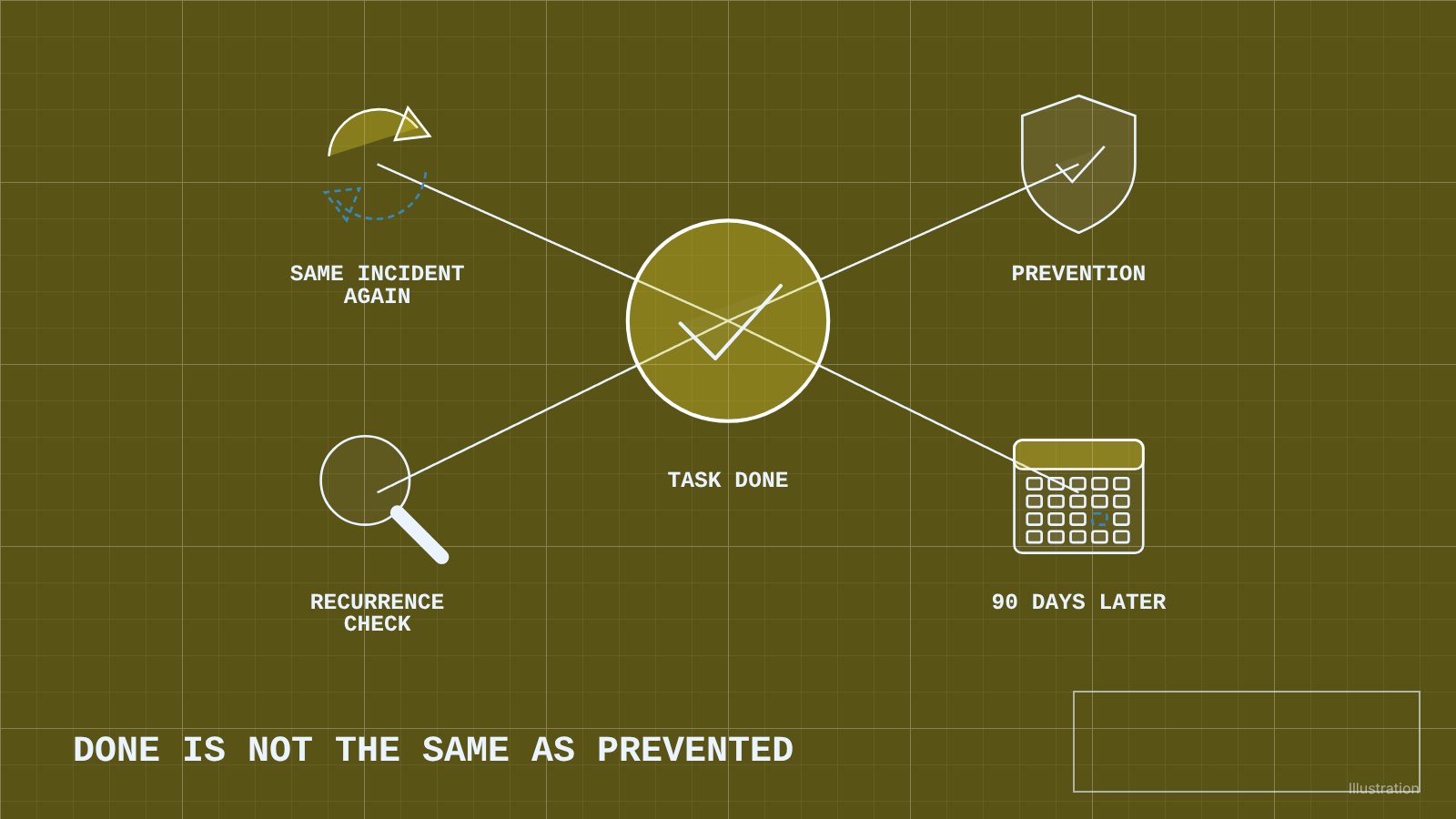
Three months after the outage, the postmortem shows eleven action items, all ticked.
Then the same connection pool runs dry on a Friday evening.
The engineering manager, Sofia, goes back through the eleven items. "Increase pool size": done, but a later deploy reset the setting. "Add alert for pool exhaustion": done, but the alert's threshold was 100%, so it fired at the same moment as the outage. "Investigate the leak": done, meaning someone looked and wrote "possibly the reporting job". "Add regression test": done, for a different code path. "Update runbook": done; nobody on call had opened it.
Every action was done. The incident wasn't prevented.
The gap is in the word done. It means someone closed a task. It doesn't mean the weakness is gone.
First, the basics
- A postmortem (incident review) explains what happened in an incident and what to change.
- An action item is a task from the postmortem, meant to stop the incident recurring.
- A root cause is the underlying reason. Here it's shown as confirmed, a leading possibility that isn't confirmed, or not established.
- A contributing factor made the incident more likely or worse. A correlation means two things happened together; it isn't proof of cause.
- A verification criterion is the evidence that shows an action actually worked.
- Done, not yet verified means the task was closed but its effect isn't proven. Verified means the evidence meets the criterion. Didn't work means the failure came back.
- A failure signature identifies a specific kind of failure, so a recurrence can be recognised.
- Mitigated means the risk is actually reduced.
Why does this matter? Postmortem actions are a team's promise that it won't happen again. If "done" is the only measure, that promise is never checked, and the same incident comes back with a new date.
The problem, in plain terms
- Postmortems are written from memory.
- Root causes are guessed and stated as fact.
- Actions have no definition of "worked".
- Done is counted as mitigated.
- Recurrences don't reopen anything.
Start from what actually happened
The postmortem is assembled from the records, not from memory:
- the incident's timeline and impact;
- the investigation;
- the releases and migrations around it;
- the reliability findings that were already open.
It names how the incident was detected and how long that took. When customers noticed first, it says so. It lists the contributing factors, each labelled as a correlation. It reports response times against your median.
The root cause is shown as it stands: confirmed, a leading possibility that isn't confirmed, or not established. Nothing is guessed, and what nobody knows yet is listed under remaining uncertainties.
Actions that say what "worked" means
From that evidence come proposed actions in four areas:
- Engineering: confirm the cause, fix it, deal with a repeating weakness.
- Operations: monitoring, an SLO, alert thresholds, capacity, the runbook.
- Testing: a regression test, release validation, a resilience experiment.
- Support: the knowledge base and customer communication.
Each action carries an owner, a due date, an expected outcome and, above all, a verification criterion.
The line between done and mitigated
Marking an action done moves it to done, not yet verified. It becomes verified only when the evidence meets its criterion:
- the investigation has a confirmed root cause;
- the fix is deployed and its verification passed;
- an SLO for the service has data;
- a resilience experiment on the service held;
- the known issue has a workaround;
- the failure hasn't come back for 60 days.
For things the records can't see, such as a regression test, a configuration change or a runbook, someone other than the owner checks the linked evidence.
If the same failure signature appears after an action was completed, the action is marked didn't work and reopened, and the owner hears about it.
The overview keeps two numbers apart: actions done and risks mitigated. Only the second one should reassure anyone.
A worked example, start to finish
Here's Sofia's team's next connection-pool incident, a different service, with TicketResolve. The team and figures are illustrative.
Saturday 21:40. orders-api's database connection pool runs dry. The incident is resolved at 22:35 by restarting the service.
Monday, the postmortem. It's assembled from the records:
- Timeline and impact: 55 minutes, checkout failing for 18% of requests.
- Detection: customers noticed first, 12 minutes before the first alert. The postmortem says so.
- Contributing factors: a release 3 hours earlier changed the reporting job's query; traffic was 30% above normal. Each labelled a correlation.
- Response times: time to acknowledge 9 minutes, against a median of 4.
- Root cause: a leading possibility that isn't confirmed: the reporting job holds connections during long queries. Remaining uncertainties: whether the pool size was ever applied in production.
- Open findings already there: a capacity forecast warning for connections, raised two weeks before.
Monday, actions. Proposed from the evidence, each with an owner, due date, expected outcome and verification criterion:
- Engineering: confirm the cause. Verified when the investigation has a confirmed root cause.
- Engineering: fix the reporting job. Verified when the fix is deployed and its verification passed.
- Operations: pool exhaustion alert at 80%. A configuration change the records can't see; someone other than the owner checks the linked evidence.
- Operations: define an SLO for orders-api. Verified when the SLO has data.
- Testing: resilience experiment, slow reporting queries. Verified when the experiment on the service held.
- Support: known issue with workaround. Verified when the known issue has a workaround.
Week 2. The investigation confirms the cause (action 1 verified). The fix deploys and its verification passes (action 2 verified). The alert change is checked by a colleague who reads the linked configuration diff (action 3 verified).
Week 3. Action 5's owner marks it done. It moves to done, not yet verified: the experiment hasn't run yet. It runs in week 4 and holds: verified.
Overview. Actions done: 6. Risks mitigated: 5, with the SLO still waiting for data.
Month 3, a recurrence elsewhere. The same failure signature appears on invoices-api, which uses the same reporting job pattern. On an older postmortem, the action "limit reporting job connections" is marked didn't work and reopened, and its owner hears about it the same day.
Five more real-world scenarios
1. A root cause nobody confirmed
Situation. The team believes it was the cache, but no investigation confirmed it.
How TR handles it. It's shown as a leading possibility that isn't confirmed, with remaining uncertainties listed.
2. A runbook update
Situation. The owner updated the runbook and marks it done.
How TR handles it. Someone other than the owner checks the linked evidence.
3. 60 days without recurrence
Situation. An action's criterion is "the failure hasn't come back".
How TR handles it. It becomes verified after 60 days without the failure.
4. A quarterly report
Situation. Leadership asks how many postmortem actions were completed.
How TR handles it. The overview shows done and mitigated separately.
5. Customers noticed first
Situation. Monitoring didn't catch the incident.
How TR handles it. The postmortem says so, with how long detection took.
Writing a good verification criterion
The criterion is the most important line on an action, and the easiest to write badly. A few patterns help:
- Name the evidence, not the activity. "Alert added" describes work. "Pool exhaustion alert fires at 80% in a load test" describes evidence someone can check.
- Pick something the records can see when you can. A confirmed root cause, a verified fix, an SLO with data, an experiment that held or 60 days without the failure are all checked for you. Anything else needs a second person to look at the linked evidence.
- Make it fail if the weakness is still there. A regression test that covers a different code path passes whether or not the bug is fixed. A criterion should be able to come out "not met".
- Give it a time frame. "No recurrence" without a period never finishes. Sixty days is the built-in window.
- Keep one outcome per action. "Fix the leak and update the runbook" can't be verified as one thing. Split it.
Teams that write criteria this way find the gap between done and mitigated small and explainable, instead of large and surprising.
Before and after
Before. Eleven actions ticked, a pool size that was reset, an alert at 100%, a "possible" cause written down as done, and the same outage on a Friday evening.
After. A postmortem from the records, a root cause shown as it stands, actions with verification criteria, a clear line between done and mitigated, and a reopened action when the same failure came back.
How to tell it's working
- Mitigated catches up with done, not the other way round.
- Recurrences reopen actions automatically.
- Root causes are confirmed before fixes are called verified.
- Detection improves: fewer incidents where customers noticed first.
Who it's for
- Engineering managers and SREs who run postmortems.
- Engineering leaders who report on reliability.
- Support leaders whose actions (knowledge base, communication) are part of the plan.
How it fits with the rest of TicketResolve
Postmortems use incidents, investigations, releases and migrations and open reliability findings. Actions are verified by fix verification, SLOs, resilience experiments and known issues. It's part of Reliability Intelligence.
Mistakes to avoid
- Writing actions without verification criteria.
- Reporting "done" as "mitigated".
- Having owners check their own configuration changes.
Do it in TicketResolve, step by step
Where: Reliability Intelligence → Prevention (/dashboard/reliability/prevention). You'll need: Reliability intelligence; incidents and investigations in TicketResolve; a colleague to check evidence. Full guide: Postmortems and prevention.
- Create the postmortem from the incident. It's assembled from the timeline, investigation, releases, migrations and open findings.
- Read detection and response. How it was detected, how long it took, and response times against your median.
- Check the root cause status: confirmed, leading possibility, or not established, with remaining uncertainties.
- Review proposed actions in engineering, operations, testing and support.
- Set owner, due date, expected outcome and verification criterion for each.
- Mark actions done when the work is finished. They move to done, not yet verified.
- Check evidence for what records can't see. Someone other than the owner checks the linked evidence.
- Watch done and mitigated on the overview, and reopened actions when a failure returns.
How to check it worked: the overview shows actions done and risks mitigated separately, and each action shows its verification state.
The postmortems and prevention guide lists every criterion.
Frequently asked questions
Is a postmortem written by AI from memory? No. It's assembled from the incident's records.
What if the root cause isn't known? It's shown as not established, with remaining uncertainties listed. Nothing is guessed.
What does "done, not yet verified" mean? The task was closed, but the evidence doesn't yet meet its criterion.
What makes an action verified? Its criterion: a confirmed root cause, a verified fix, SLO data, an experiment that held, a workaround, or 60 days without recurrence.
Who checks a runbook update? Someone other than the owner, from the linked evidence.
What happens if the failure comes back? The action is marked didn't work and reopened, and the owner hears about it.
Are contributing factors causes? No. They're labelled as correlations.
Which number should reassure us? Risks mitigated, not actions done.
Can one action have several criteria? Keep one outcome per action, so it can be verified as one thing. Split combined actions.
How long does "no recurrence" wait? 60 days without the same failure.
Explore Topics
Written by
Ghulam Shabbir
Content creator and writer sharing insights and stories.