
Break It on Purpose, With a Seatbelt On
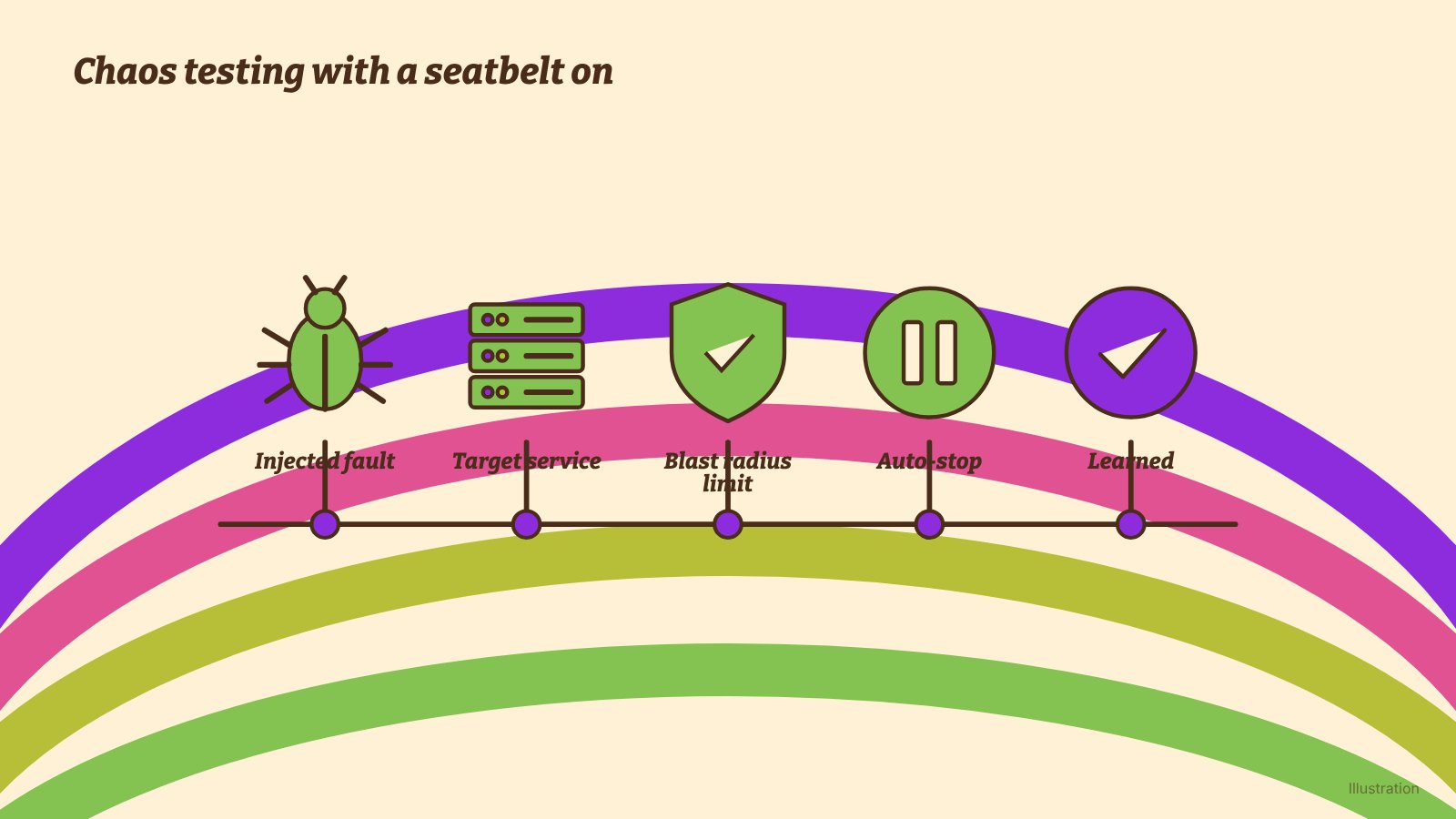
Every team believes its API copes when the cache gets slow, until the cache gets slow. Resilience experiments in TicketResolve test that belief on a day you choose: a hypothesis you can measure, failures injected only by your own agent, abort conditions checked every minute, a kill switch, and a resilience score that admits what you haven’t tested.
Every team believes its API copes when the cache gets slow. The retry logic is there, and the timeouts look sensible.
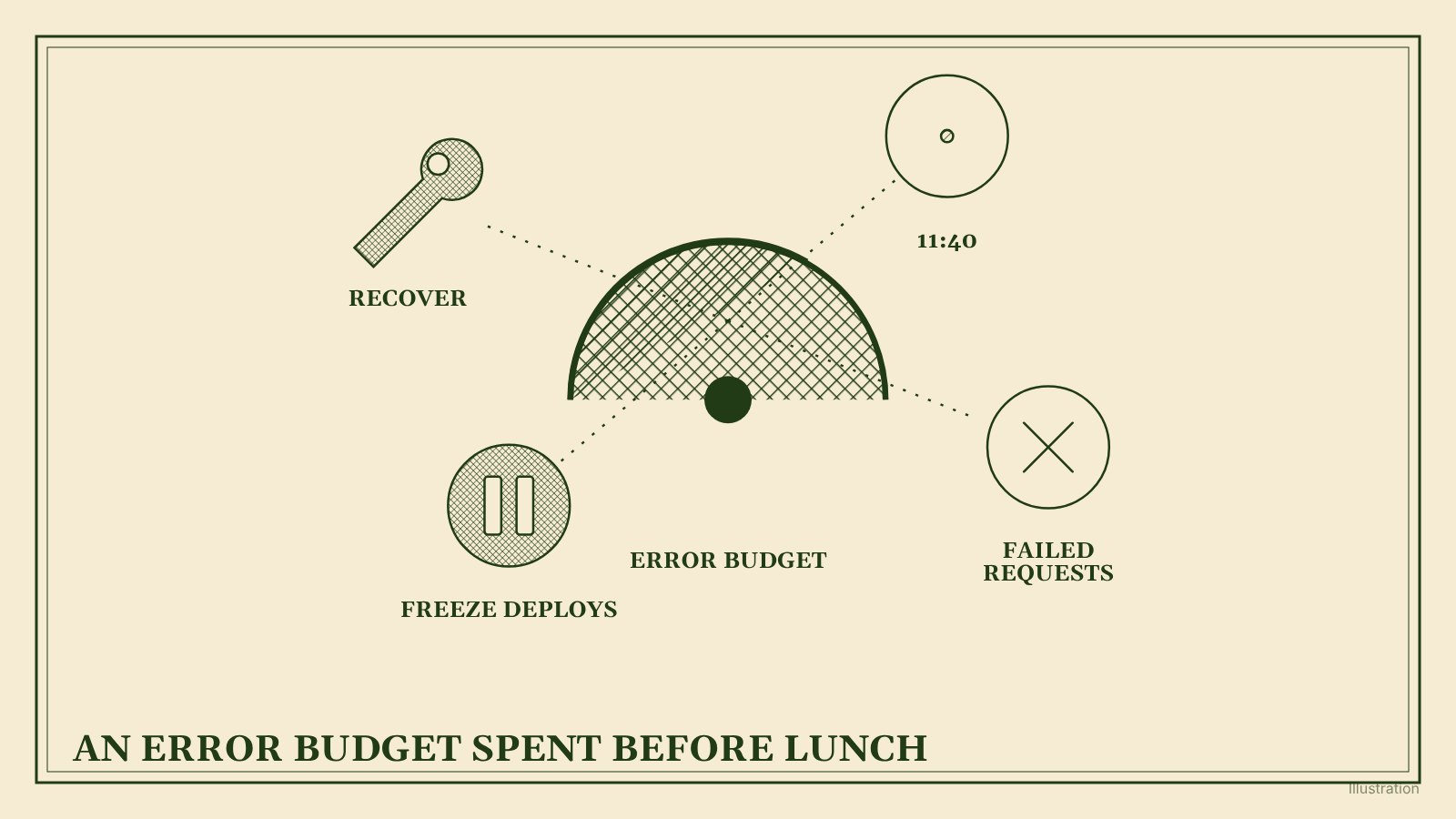
Then one Tuesday at 11:20 the cache slows down. Here's what happens at a food-delivery company:
- 11:20. The cache's response time goes from 2 ms to 300 ms.
- 11:22. The orders API waits on each slow call. Requests start queuing.
- 11:24. Retries kick in, each one adding another call to the slow cache. Database connections run out.
- 11:26. The error rate climbs to 12%. Customers can't check out during the lunchtime rush.
The retry logic was there. Nobody had tested what it did under a slow cache, as opposed to a dead one.
A resilience experiment tests that belief on a day you choose, with a way out at every step.
First, the basics
- Resilience is a service's ability to keep working, perhaps in a reduced way, when something it depends on fails.
- A resilience experiment (chaos experiment) injects a failure on purpose to see what happens.
- A hypothesis is the belief you're testing, stated so it can be measured.
- Steady state is what "working normally" looks like in numbers: error rate, latency, a check passing. p95 latency is the time 95% of requests finish within.
- An abort condition stops the experiment if things go too far.
- Blast radius is how much the failure can affect: one instance, one region, a share of traffic.
- An agent is a program on your own infrastructure that runs operations you declared.
- A kill switch stops every experiment at once.
- An error budget is how much failure an SLO allows; exhausted means it's used up.
- Held, refuted and inconclusive are the possible verdicts.
Why does this matter? Failures you've never tested behave in ways you haven't predicted. Testing them deliberately, with strict limits and a way out, turns an unknown into a measured result, on a quiet Tuesday morning rather than during the lunchtime rush.
The problem, in plain terms
- Resilience is assumed, not tested.
- Chaos testing feels dangerous, so it's never done.
- Experiments without clear criteria end in "seemed fine".
- Scores hide what wasn't tested.
Start with a sentence you can check
Each experiment starts with a hypothesis. For example: with 300 ms extra latency to the cache, the orders API keeps its error rate under 1%. TicketResolve turns that into steady-state conditions it can measure from your own telemetry: error rate and p95 latency from the service's request spans, the success rate of a synthetic check, or an SLO's burn rate.
It also needs abort conditions, such as stop immediately if the error rate goes above 5%. Every failure in the catalogue suggests some.
We don't hold the hammer
TicketResolve never injects a failure itself. You declare the operations on your own agent, for example TR_OP_CACHE_LATENCY_ON and TR_OP_CACHE_LATENCY_OFF, and register them as changes. An experiment can only request those. If the injection needs approval, a second person gives it, and then your agent runs it on your infrastructure.
The seatbelt
Some rules apply before anything starts:
- Production is off until an administrator turns it on. Even then, the same failure must have passed on the same service in another environment in the last 30 days.
- Experiments run only on allowlisted services and environments, which start empty.
- The fault's duration and blast radius have workspace limits.
- Someone other than the author approves the design.
- Only one experiment per service runs at a time.
- No production experiment runs while the error budget is exhausted or an incident is open.
During the run, more checks apply:
- If the steady state doesn't hold in the baseline before the run, nothing is injected.
- While the fault is active, the abort conditions are checked every minute. A breach stops the run and requests your stop operation.
- If telemetry goes quiet, the run stops too. If you can't see the service, you shouldn't be breaking it.
- The kill switch stops every experiment at once. Stop now is one click for anyone in the workspace.
A verdict, not a vibe
When the fault ends, TicketResolve compares the fault window against the steady-state conditions. The hypothesis held, was refuted, or the run was inconclusive because there wasn't enough data. It doesn't round inconclusive up to a pass. It also measures how long the service took to return to normal after the stop.
A refuted hypothesis, or a service that doesn't recover, opens a finding for the service owner with the measurements attached. When a later run passes, that finding is resolved.
A score that admits what it doesn't know
The resilience score of a service is the share of failure modes whose latest experiment held. Coverage sits next to it: how many of the six failure modes you actually tested. A service with a 100% score and 17% coverage passed the one thing you tried. The page says so instead of calling it resilient.
A worked example, start to finish
Here's the food-delivery company, a month after that Tuesday, with resilience experiments. The company and figures are illustrative.
Week 1, preparation. The platform team declares two operations on their own agent: TR_OP_CACHE_LATENCY_ON (adds 300 ms to cache calls for the orders API) and TR_OP_CACHE_LATENCY_OFF. They register them as changes. An administrator allowlists orders-api in staging. Production stays off.
Week 1, design. The SRE, Hana, opens Reliability Intelligence → Experiments and creates one from the catalogue's dependency latency failure:
- Hypothesis: with 300 ms extra latency to the cache, the orders API keeps its error rate under 1%.
- Steady state: error rate below 1% and p95 latency below 800 ms from orders-api's request spans; the checkout synthetic check succeeding.
- Abort conditions: error rate above 5%; p95 above 3 s (suggested by the catalogue).
- Blast radius: one instance; duration: 10 minutes, within workspace limits.
Her colleague Leo approves the design; Hana can't approve her own.
Week 1, staging run, 10:00. Baseline: steady state holds. The fault is injected by their agent.
10:04. Error rate 3.8%. 10:05: the minute check finds 5.4%. Abort condition breached: the run stops and requests TR_OP_CACHE_LATENCY_OFF. The service returns to normal in 2 minutes 10 seconds.
Verdict: refuted. A finding opens for orders-api's owner with the measurements attached: retries without backoff multiply calls to the slow cache.
Week 2, fix. The team adds a 100 ms timeout on cache calls with a fallback to the database, and exponential backoff on retries.
Week 3, staging re-run. Steady state holds throughout; error rate peaks at 0.4%. Verdict: held. The finding is resolved.
Week 4, production. An administrator turns production on for orders-api. The rule is met: the same failure passed on the same service in another environment in the last 30 days. The error budget isn't exhausted and no incident is open. Two people are involved: Hana requests, and a second person approves the injection. One instance, 10 minutes, Tuesday 10:00. Held, recovery 30 seconds.
Score. orders-api's resilience score: 100%, coverage: 1 of 6 failure modes (17%). The page says it passed the one thing they tried. Next on the list: dependency unavailable and instance loss.
Five more real-world scenarios
1. The baseline doesn't hold
Situation. Before the run, the error rate is already 2%.
How TR handles it. Nothing is injected.
2. Telemetry goes quiet
Situation. The metrics pipeline stops during a run.
How TR handles it. The run stops. If you can't see the service, you shouldn't be breaking it.
3. Not enough data
Situation. A low-traffic service has too few requests in the fault window.
How TR handles it. The verdict is inconclusive, not rounded up to a pass.
4. An incident starts elsewhere
Situation. An unrelated incident is open on the service.
How TR handles it. No production experiment runs while an incident is open.
5. Something feels wrong
Situation. Someone in support sees odd behaviour during a run.
How TR handles it. Stop now is one click for anyone in the workspace; the kill switch stops every experiment.
Before and after
Before. Retry logic everyone trusted, a slow cache on a Tuesday lunchtime, and a 12% error rate.
After. A measurable hypothesis, a refuted run in staging stopped by an abort condition, a fix, a held re-run, a production run allowed only after that, and a score that says it covers one failure mode of six.
How to tell it's working
- Refuted hypotheses become fixes before incidents.
- Coverage grows across failure modes for critical services.
- Every run stays within its limits, and aborts work.
Who it's for
- SREs and platform teams.
- Service owners who receive findings.
- Engineering leaders who want resilience measured, not assumed.
How it fits with the rest of TicketResolve
Experiments are part of Reliability Intelligence. They read steady state from your telemetry and SLOs, and passing experiments verify postmortem actions and architecture fixes. Experiment metrics appear in reliability metrics.
Mistakes to avoid
- Starting in production. The rules won't let you, and they're right.
- Hypotheses you can't measure.
- Reading a 100% score without its coverage.
Do it in TicketResolve, step by step
Where: Reliability Intelligence → Experiments (/dashboard/reliability/experiments). You'll need: Reliability intelligence; your own agent with fault operations declared; an administrator to allowlist services; a colleague to approve. Full guide: Resilience experiments.
- Declare operations on your agent, such as
TR_OP_CACHE_LATENCY_ONand_OFF, and register them as changes. - Allowlist services and environments (administrators). The list starts empty.
- Create an experiment from the catalogue: a hypothesis, steady-state conditions and abort conditions.
- Set the blast radius and duration, within workspace limits.
- Have someone else approve the design.
- Run it. The baseline must hold; abort conditions are checked every minute; Stop now and the kill switch are always there.
- Read the verdict: held, refuted or inconclusive, with recovery time.
- Fix and re-run. A later passing run resolves the finding. Production needs the same failure to have passed elsewhere in the last 30 days.
How to check it worked: an experiment shows its verdict and recovery time, and the service shows its score with coverage.
Read the resilience experiments guide and pick the failure you'd least like to find out about in production.
Frequently asked questions
Does TicketResolve inject failures? No. Your own agent runs operations you declared.
Can experiments run in production? Only when an administrator turns it on, and only after the same failure passed on the same service elsewhere in the last 30 days.
Who approves an experiment? Someone other than the author approves the design; a second person approves the injection when needed.
How often are abort conditions checked? Every minute while the fault is active.
What if telemetry stops? The run stops.
Is inconclusive a pass? No.
What does the resilience score mean? The share of failure modes whose latest experiment held, shown with coverage out of six.
How do I stop everything? The kill switch, or Stop now, one click for anyone in the workspace.
Explore Topics
Written by
Ghulam Shabbir
Content creator and writer sharing insights and stories.