
Demos, Objections and Proposals You Can Stand Behind
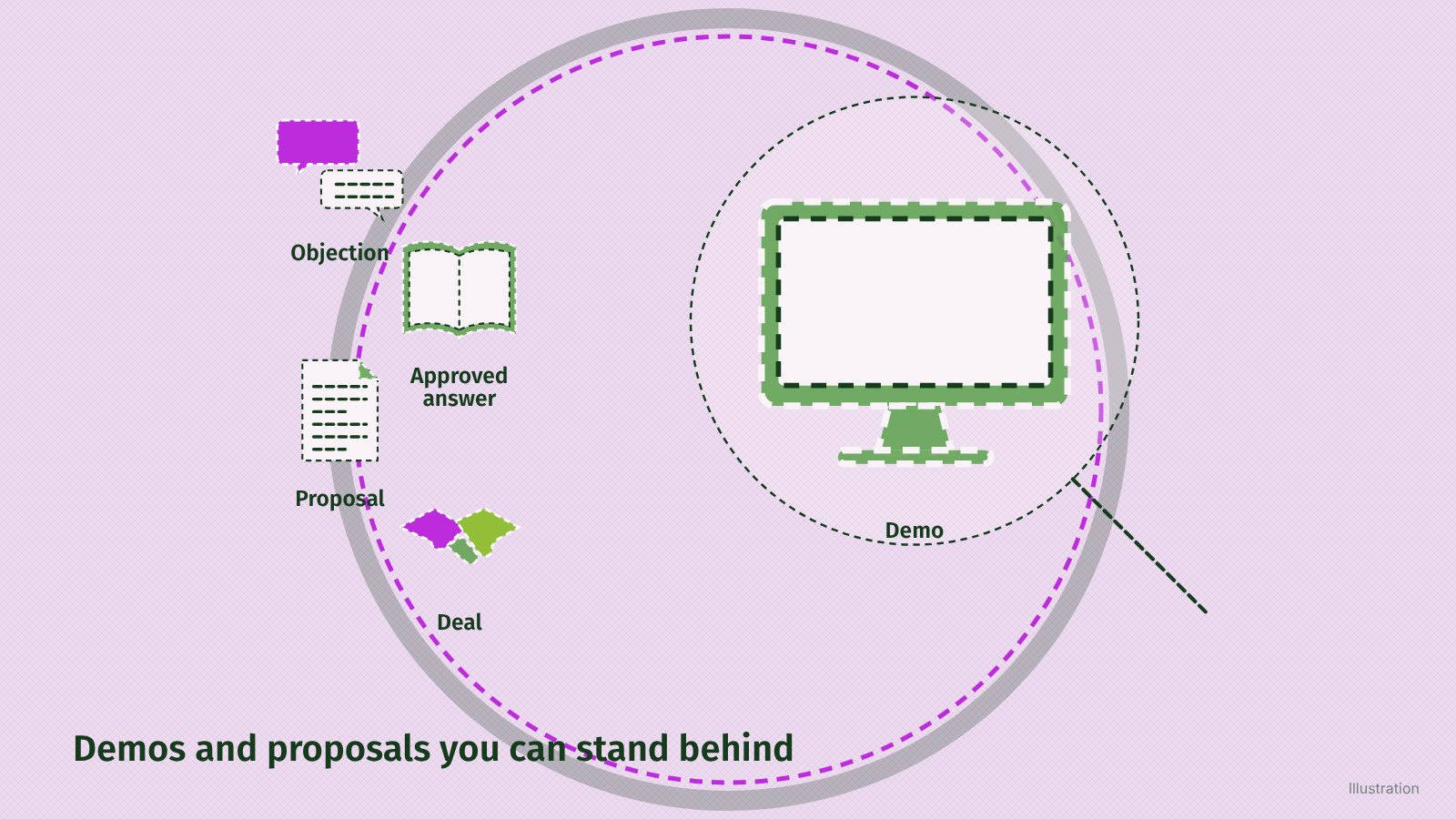
Sales engineers get caught out in four places: the demo, the objection, the competitor and the proposal. Sales Engineering Intelligence builds demo plans that show only what approved documentation backs, objection answers with approval for the sensitive ones, sourced competitive intelligence, and proposals with a calculated capability map.
Halfway through a demo for a large insurer, the customer's QA lead asks: "Can we run these UI tests on our Linux build agents?" The sales engineer, Mateo, says, "Yes, I believe so," and moves on, because saying no in the middle of a demo feels like losing the room.
The customer's architect asks about pricing for 40 parallel test runs. Mateo quotes the number a colleague used on another deal. When the competitor comes up, he repeats something he heard at a conference: "They don't support mobile testing at all."
Three weeks later, the proposal goes out. It's a copy of the last one, with the customer's name changed. It says Linux build agents are supported, because Mateo said so in the demo.
None of it is true. The product's documentation doesn't support Linux build agents for UI tests. The parallel-run price was a one-off discount nobody approved for this deal. The competitor added mobile testing last year. The insurer's architect finds all three in a week, and the deal stalls while the account executive tries to rebuild trust.
Sales engineers get caught out in four places: the demo, the objection, the competitor and the proposal.
First, the basics
- A sales engineer (SE) is the technical expert on a sales team. They run demos, answer technical questions and write the technical part of proposals.
- Approved knowledge is product information checked against a source, such as official documentation, and approved by an administrator.
- A demo plan is the script for a product demonstration: agenda, scenarios, steps and sample data.
- An objection is a concern a buyer raises, such as "why not use the free alternative?"
- Competitive intelligence is information about competitors. A battlecard is a short guide on how to position against one competitor. A differentiator is something you do that they don't (or do better).
- A proposal is the written offer. A capability map shows which requirement is covered by which product capability.
- Success criteria are how the customer will judge whether the product worked. Assumptions and exclusions list what the proposal depends on and what it doesn't cover.
- A named approver is a specific person who signs off something sensitive.
Why does this matter? Customers buy based on what sales engineers say. A promise made in a demo becomes an expectation, and a claim in a proposal becomes part of the contract. When everything an SE shows or writes is backed by approved knowledge, deals move faster and stay won.
The problem, in plain terms
- Demos improvise. Under pressure, SEs say yes to things the product doesn't do.
- Objection answers are tribal knowledge, and sensitive ones (pricing, licensing, roadmap) are given by whoever's asked.
- Competitive notes go stale and get exaggerated.
- Proposals are copied, carrying claims from one deal to the next.
- Nobody can tell which statements are backed by a source and which aren't.
Demos that know what not to show
A demo plan is built for one opportunity and one product.
- Built from the records, it has one scenario for each requirement the product covers, listing the approved items each one shows.
- Written by AI, it adds the agenda, steps and sample data, and any scenario that can't cite approved knowledge is dropped.
The most useful part is often the shortest: Do not demonstrate. Requirements that approved knowledge doesn't back ("run UI tests on Linux build agents", say) are listed there, so nobody improvises them live.
After the demo you record the customer's feedback and the outcome; good plans become templates.
Objections, with approval where it matters
The objection library starts with the questions every team hears: Why Ranorex instead of Selenium? How does obfuscation affect performance? How does licensing work? Each answer names the underlying issue, the response, the limitations to state, the follow-up questions and what to show, and links the approved knowledge behind it.
Answers that touch pricing, licensing, contracts, the roadmap or certifications are detected and go to a named approver, never the person who wrote them, before anyone can use them.
Competitive intelligence with sources
Here every statement about a competitor has a source link and is approved by a second person. The comparison matrix puts our approved knowledge beside their approved statements, and an empty cell says "no sourced information", not "they can't".
A battlecard drops any line about the competitor that doesn't cite a source, and any differentiator that doesn't cite both sides.
Proposals with a calculated core
A technical proposal has eighteen sections. The ones that must be exact are calculated from the records:
- the requirements;
- a capability map showing which approved items back each one;
- success criteria from the must-haves;
- assumptions and exclusions that list the gaps and items still to verify.
The narrative is drafted by AI with citations; commercial terms are always written by a person. A named approver signs it off, and it downloads as Word or prints to PDF.
And a Copilot
The SE Copilot answers what it recognises by calculation (Does Ranorex support Flutter? Compare TestRail and Testmo. Which opportunities are at risk?) and writes longer answers from the same approved material, citing every fact.
A worked example, start to finish
Here's Mateo's next insurer deal, with Sales Engineering Intelligence.
Week 1, Monday. The opportunity has 14 confirmed requirements from discovery. Mateo opens Demos and chooses the test-automation product. He clicks Build from the records: 11 scenarios, one for each requirement the product covers, each listing the approved items it shows.
Monday, 10:00. The Do not demonstrate list has three items:
- Run UI tests on Linux build agents: no approved knowledge backs it.
- Visual testing of PDF reports: an open "to verify" item.
- Native integration with the customer's in-house test manager: no approved knowledge.
Monday, 10:30. He clicks Write a demo plan for the agenda, steps and sample data. One AI scenario, "cross-platform UI testing", couldn't cite approved knowledge and was dropped.
Thursday, demo. The QA lead asks about Linux build agents. Mateo, having read the list, says: "Not for UI tests today. Windows agents are supported; I'll confirm whether anything is planned." After the demo, he records the feedback ("strong interest in the recorder; Linux agents a concern") and the outcome.
Friday. The architect asks about pricing for 40 parallel runs. Mateo opens Objections, finds "How does licensing work for parallel execution?", and drafts an answer with AI, linking the approved licensing item. Because it touches licensing and pricing, it goes to the sales director, the named approver. She approves it with the correct list price and a note that discounts come from the deal desk.
Week 2. The insurer mentions a competitor. In Competitive, the comparison matrix shows our approved knowledge beside the competitor's approved statements. The mobile-testing cell for the competitor cites the competitor's own release notes from last year: they do support it. Mateo's battlecard drops a line from an old note that said otherwise, because it had no source.
Week 3. He opens Proposals → Draft the proposal. The capability map shows each of the 14 requirements with the approved items that back it, three marked as gaps. Success criteria come from the must-haves. Assumptions and exclusions list the three gaps and one item still to verify, including "UI tests on Linux build agents are not supported". The AI drafts the narrative with citations. Mateo fills the sections marked "needs input". The account executive writes the commercial terms.
Week 3, Friday. The sales director approves the proposal. It downloads as Word and goes to the customer. Every claim in it can be traced to approved knowledge.
Five more real-world scenarios
1. A quick capability question
Situation. An account executive asks the Copilot whether the product supports Flutter.
How TR handles it. It's answered by calculation from approved knowledge, with the source.
2. A roadmap promise
Situation. An SE drafts an objection answer that says a feature is "coming next quarter".
How TR handles it. Roadmap answers are detected and go to a named approver before anyone can use them.
3. An unsourced competitor claim
Situation. A battlecard line says "their support is slow".
How TR handles it. It has no source, so it's dropped.
4. An empty matrix cell
Situation. There's no sourced information about a competitor's SSO support.
How TR handles it. The cell says "no sourced information", not "they can't".
5. A demo plan worth reusing
Situation. Mateo's insurer demo went well.
How TR handles it. He saves it as a template for the next insurance prospect.
Before and after
Before. "Yes, I believe so" in a demo, an unapproved price, a stale competitor claim and a copied proposal that put all three in writing.
After. A Do not demonstrate list, objection answers approved where it matters, competitor statements with sources, and a proposal whose capability map is calculated from approved knowledge.
How to tell it's working
- Do not demonstrate lists are read before every demo.
- Sensitive objection answers have an approver.
- Every competitor statement has a source.
- Proposals' capability maps match approved knowledge, with gaps stated as exclusions.
Who it's for
- Sales engineers who demo, answer objections and write proposals.
- Sales leaders who approve sensitive answers.
- Product marketing teams who own competitive intelligence.
How it fits with the rest of TicketResolve
This was phase 2 of Sales Engineering Intelligence, built on phase 1's approved product knowledge, opportunities, discovery and solution fit. Next came proofs of concept judged against agreed criteria, then RFPs, questionnaires, CRM sync and hand-offs.
Mistakes to avoid
- Ignoring Do not demonstrate under pressure. "Not today" is better than a broken promise.
- Approving your own sensitive answer. It goes to a named approver.
- Letting AI write commercial terms. A person always writes them.
Do it in TicketResolve, step by step
Where: Sales Engineering → Demos, Objections and Proposals (/dashboard/sales-engineering/demos). You'll need: an SE seat, approved product knowledge, and named approvers for sensitive answers and proposals. Full guides: Preparing a demo and Objections and proposals that need approval.
- Open the opportunity. Opportunities → open one → Demos, and choose a product under evaluation.
- Build or write the plan. Build from the records (no AI) or Write a demo plan (AI, one output). Every scenario lists the approved items it shows.
- Read "Do not demonstrate". Requirements that approved knowledge doesn't back are listed there; don't show them as product features.
- Schedule and deliver. Set the date; afterwards record the customer's feedback and the outcome. Save good plans as templates.
- Answer an objection. Objections → open a concern → Edit or Draft with AI. Link at least one approved knowledge item.
- Mark ready or send for approval. Ordinary answers are marked ready by you. Pricing, licensing, contract, roadmap and certification answers go to a named approver.
- Draft the proposal. Opportunity → Proposals → Draft the proposal. The capability map, success criteria, assumptions and risks are calculated; check the AI sections and fill in those marked "needs input".
- Add commercial terms and approve. Commercial information is always written by a person. Send it to an approver; download Word or print to PDF once approved.
How to check it worked: the demo plan lists its Do not demonstrate items, sensitive answers show an approver, and every row of the proposal's capability map links to approved knowledge or is marked as a gap.
Frequently asked questions
What's "Do not demonstrate"? Requirements that approved knowledge doesn't back. Don't show them as features.
Can the AI add demo scenarios without a source? No. Scenarios that can't cite approved knowledge are dropped.
Which objection answers need approval? Those that touch pricing, licensing, contracts, the roadmap or certifications.
Can I approve my own sensitive answer? No. It goes to a named approver.
What if we have no information about a competitor's feature? The matrix says "no sourced information", not "they can't".
Which parts of the proposal are calculated? The requirements, capability map, success criteria, and assumptions and exclusions.
Who writes commercial terms? Always a person.
How does the proposal download? As Word, or print to PDF.
Explore Topics
Written by
Ghulam Shabbir
Content creator and writer sharing insights and stories.