
Sales Engineering on Approved Knowledge: Discovery, Requirements and Solution Fit
A sales engineer’s worst moment isn’t a hard question. It’s answering “yes” to one and finding out during the proof of concept that it isn’t true. Sales Engineering Intelligence starts with knowing which product claims you can stand behind: opportunities, discovery, governed product knowledge and solution fit.
A medical-device software company is evaluating a test-automation tool. In the first call, their QA lead asks the vendor's sales engineer, Hiroshi: "Does it run on our Linux build agents?" Hiroshi has heard colleagues say yes. He says yes.
The evaluation goes well. Three weeks later, in the proof of concept, the customer's DevOps engineer sets up the Linux agents. The UI tests won't run: the product's desktop UI testing needs Windows agents. Linux agents work for some other test types, but not the one the customer cared about.
The customer isn't angry about the limitation. They're angry about the "yes". The QA lead has to explain to her director why the evaluation plan was built on something that wasn't true. The deal survives, but slowly, and on worse terms.
A sales engineer's worst moment isn't a hard question. It's answering "yes" to one and finding out during the proof of concept that it isn't true.
First, the basics
- A sales engineer (SE) is the technical expert on a sales team: they run discovery, demos and proofs of concept, and answer technical questions.
- An opportunity is a potential deal with a specific customer.
- Discovery is finding out what the customer needs: their environment, problems, requirements and decision process.
- A requirement is something the customer needs. A must-have is essential; a nice-to-have isn't.
- Product knowledge is what's known about the product: supported technologies, integrations, deployment options, licensing and limitations.
- A draft is unapproved knowledge. Approved knowledge has been checked against its source by someone allowed to approve it.
- A "to verify" item records something the research couldn't confirm.
- Solution fit compares requirements with approved knowledge: covered, partly covered, to verify or gap.
- Tags label requirements and knowledge by topic, so they can be matched.
Why does this matter? In technical sales, trust is the product before the product is. Every "yes" an SE gives becomes something the customer plans around. When product claims come only from approved, sourced knowledge, SEs can answer confidently, and say "let me check" when they should.
The problem, in plain terms
- Product knowledge lives in people's heads, and changes as it's passed on.
- Vendor pages are read once and remembered loosely.
- Nobody records what's uncertain, so uncertainty becomes "yes".
- Discovery depends on the SE's memory of what to ask.
- Meeting notes turn into requirements without the customer's own words.
- Fit is a feeling, not a comparison.
Product knowledge, with its source
Each workspace starts with five product families: Ranorex, Kiuwan, TestRail, Testmo and PreEmptive. Their knowledge was researched from the vendors' public pages and arrives as drafts, each with its source link and the date it was read. Supported technologies, integrations, deployment options, licensing notes and known limitations are separate items, so they can be checked one by one.
Where the research couldn't confirm something, it says so instead of guessing. Kiuwan's pages describe cloud analysis with a local analyzer, but not a fully on-premises edition, so there's a "to verify" item, not a claim. PreEmptive's current product overview lists Dotfuscator, JSDefender and DashO, and no runtime-analytics product, so usage analytics is a question for the vendor, not a feature.
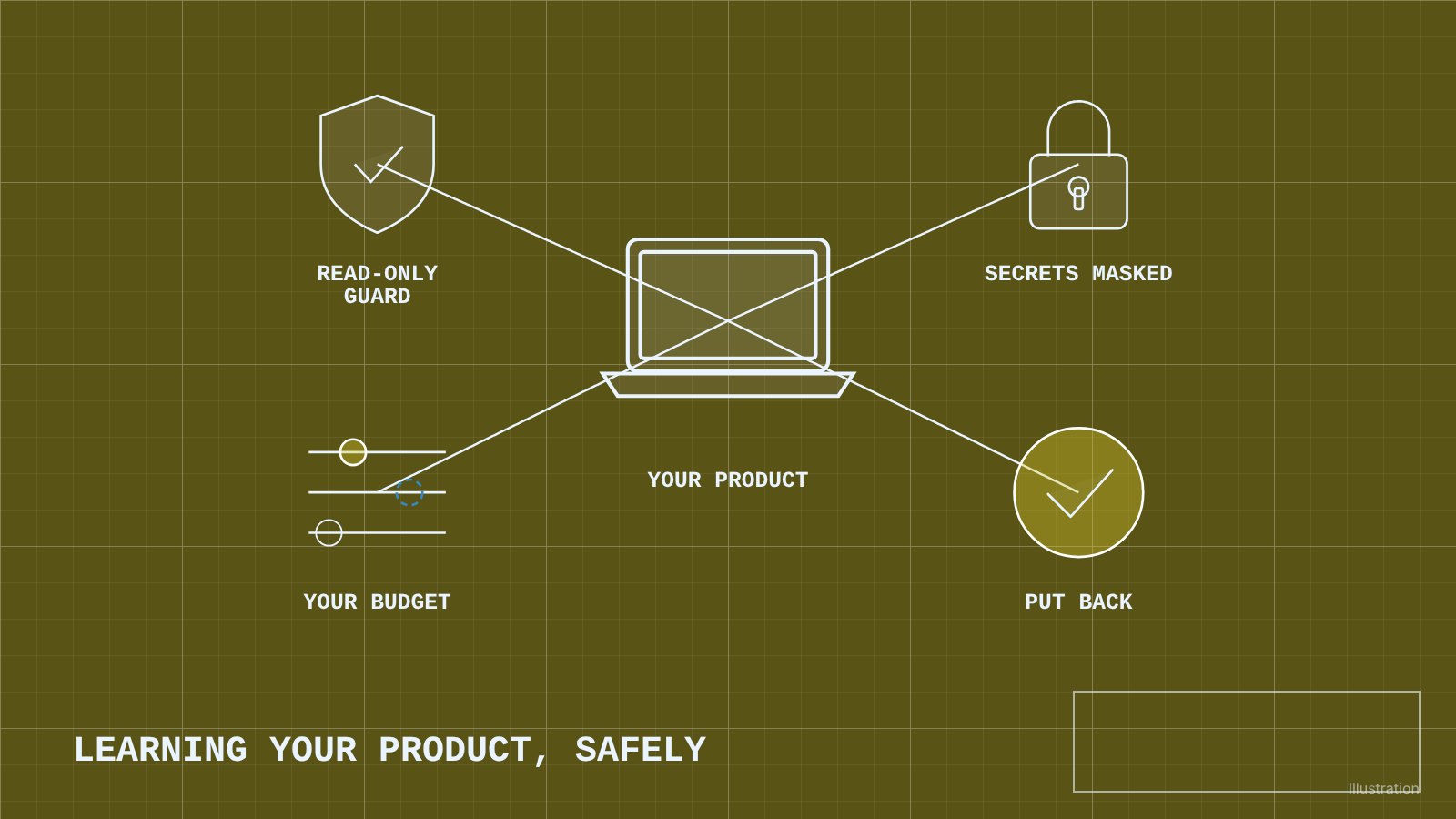
Someone with the right to approve knowledge reviews each draft against its source.
- Nobody approves their own item.
- Nothing is approved without a source.
- Edits create a new version; the old one stays in use until the new one is approved.
- Items get flagged when they're old, conflict with another, or share a topic with an open question.
Discovery that knows what to ask next
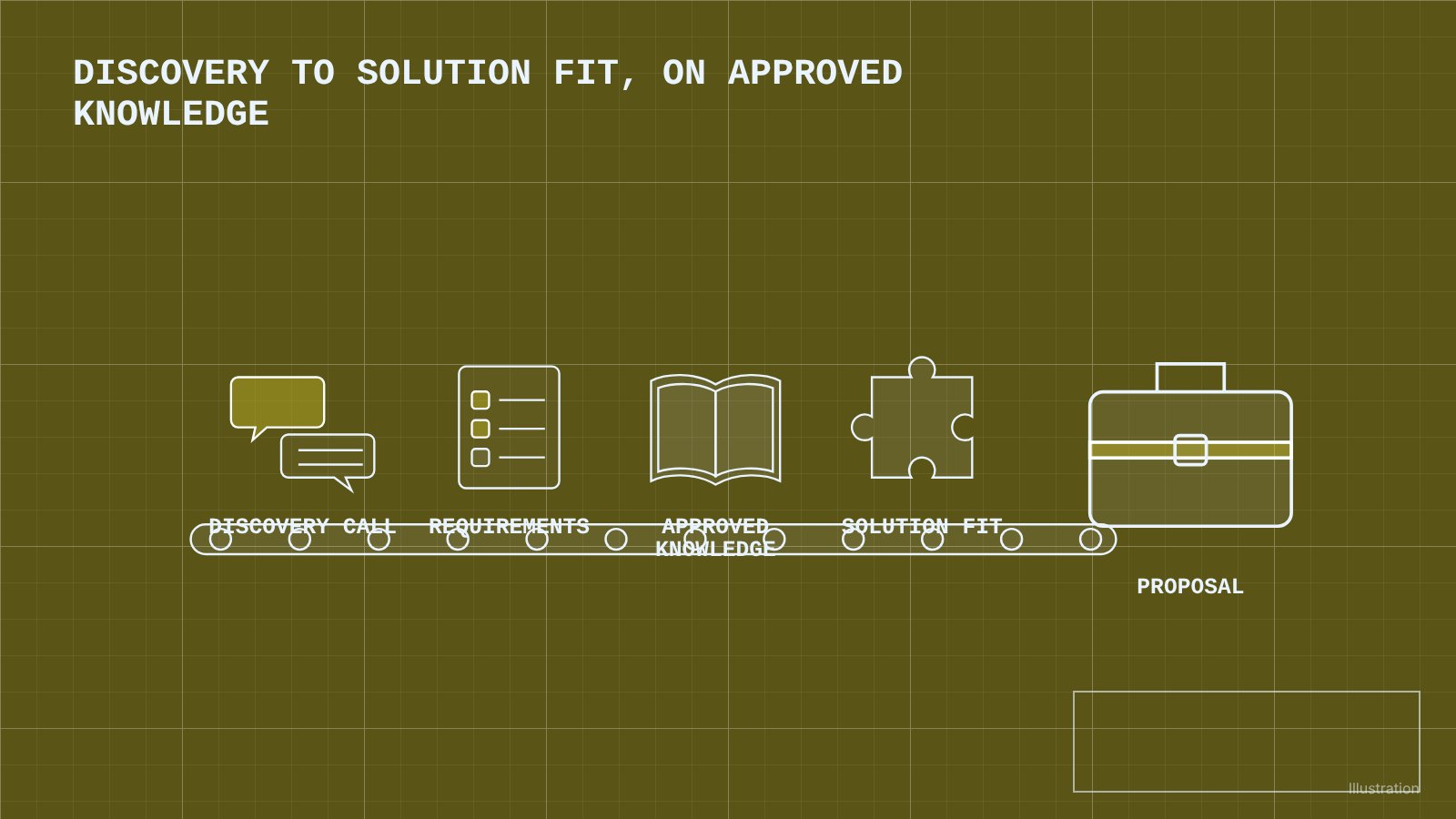
Choosing the products under evaluation brings in their discovery questions: test frameworks and CI for Ranorex, languages and repositories for Kiuwan, what must stay unobfuscated for PreEmptive. Answers trigger follow-ups: mention Selenium and it asks whether you want to keep those tests; mention Android for a .NET MAUI app and it asks about rooted-device detection.
The page keeps score as you go: how much is answered, what the next meeting should cover, and what's still missing (no decision maker named, no decision criteria, open follow-ups). None of that uses AI.
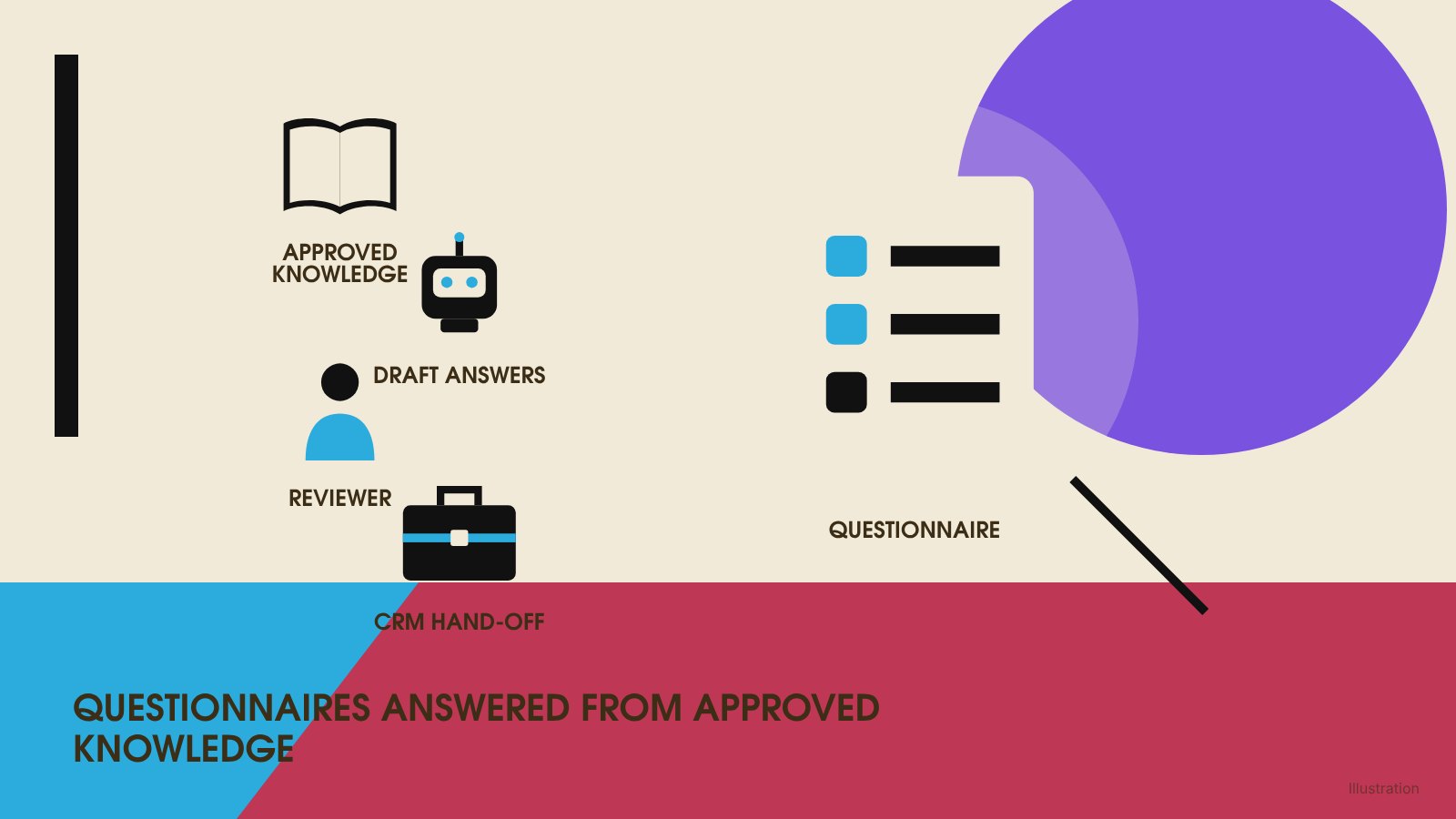
Meeting notes can be pasted in. The AI proposes requirements, each with the customer's own words; a proposal whose words aren't in the notes is dropped, and the rest wait for a person to confirm them.
Solution fit that shows its gaps
Every confirmed requirement has tags, and solution fit matches them against approved knowledge for every product: covered, partly covered, to verify or gap, with the items behind each. Must-haves weigh more than nice-to-haves.
Two products are suggested together only when an approved integration item links them (Ranorex and TestRail, for example); otherwise the combination is marked "not validated".
An optional written explanation cites the requirements and knowledge it uses and can't change the calculation. Written outputs come from Sales Engineering's own allowance: 30 a day by default.
A worked example, start to finish
Here's Hiroshi's next evaluation, with Sales Engineering Intelligence.
Before the deal. The SE lead, Grace, reviewed the Ranorex drafts against their sources. She approved most, edited two, and noticed the "Linux build agents" item said: "Linux agents: supported for API and web tests; desktop UI tests require Windows." She approved it, with the vendor page as its source. Hiroshi drafted one item himself; he couldn't approve it, so Grace did after checking.
Monday. Hiroshi opens Opportunities → New opportunity for a medical-device company: people, products under evaluation (Ranorex and TestRail), value, environment and challenges.
Monday, first call. Discovery shows Ranorex's and TestRail's questions. Hiroshi records answers as the call goes:
- Test frameworks: Selenium for web, nothing for desktop. A follow-up appears: Do you want to keep the Selenium tests? (Yes.)
- CI: Jenkins on Linux agents. A follow-up appears about which test types must run there.
- Platform: .NET MAUI app on Android. A follow-up appears about rooted-device detection.
The completeness score is 58%. Missing: no decision maker named, no decision criteria. Next meeting: confirm who decides and how.
Monday, after the call. He pastes the meeting notes. The AI proposes six requirements, each with the customer's words, such as "desktop UI tests must run in Jenkins on our Linux agents". One proposal, "must support SAP", isn't in the notes and is dropped. Hiroshi confirms five, marks two as must-haves and checks their tags.
Monday, 15:00. Solution fit:
- Keep Selenium tests: covered (approved item).
- Desktop UI tests on Linux agents (must-have): gap. The approved item says desktop UI tests require Windows.
- Test management with traceability: covered by TestRail.
- Ranorex + TestRail together: suggested, because an approved integration item links them.
Tuesday, second call. The QA lead asks the same question: Linux build agents? Hiroshi says: "For API and web tests, yes. For desktop UI tests, Ranorex needs Windows agents. Could you add one Windows agent to Jenkins for those?" The customer's DevOps engineer says that's easy. The requirement is updated.
Wednesday. Hiroshi sets Technical qualification to Technically qualified; the timeline records the change. The proof of concept is planned on accurate assumptions.
Five more real-world scenarios
1. A "to verify" topic
Situation. A customer asks whether Kiuwan can run fully on-premises.
How TR handles it. Solution fit shows to verify, because an open verification item covers the topic. The SE confirms with the vendor before promising it.
2. Approving your own item
Situation. An SE writes a knowledge item and tries to approve it.
How TR handles it. Nobody approves their own item.
3. A product combination with no integration item
Situation. A customer wants Kiuwan and Testmo together.
How TR handles it. The combination is marked "not validated" unless an approved integration item links them.
4. A duplicate opportunity
Situation. Two SEs create an opportunity with the same name for the same company.
How TR handles it. The second is refused as a duplicate.
5. An old knowledge item
Situation. A licensing item was read from the vendor's page 14 months ago.
How TR handles it. It's flagged as old, so someone re-checks the source.
Before and after
Before. A "yes" based on hallway knowledge, an evaluation plan built on it, and a proof of concept that revealed the truth three weeks later.
After. Approved, sourced knowledge that says exactly what's supported; discovery that asks the right follow-ups; requirements in the customer's words; and solution fit that shows the gap on day one.
How to tell it's working
- Every product claim an SE makes can be traced to an approved item.
- "To verify" items get resolved with the vendor.
- Discovery completeness rises before demos and PoCs.
- Gaps are found in discovery, not in proofs of concept.
Who it's for
- Sales engineers who need to answer technical questions confidently.
- SE leads who govern product knowledge.
- Sales leaders who want fewer surprises in proofs of concept.
How it fits with the rest of TicketResolve
This was phase 1 of Sales Engineering Intelligence. Approved knowledge also feeds the AI Technical Writer. Three more phases followed: demo plans, objections, competitive intelligence, the SE Copilot and proposals; proofs of concept judged against agreed criteria; then RFPs, CRM sync, hand-offs to delivery and product feedback.
Mistakes to avoid
- Approving drafts without opening the source. The source is the point.
- Treating "to verify" as "probably yes". It means ask the vendor.
- Confirming AI-proposed requirements without reading the customer's words.
Do it in TicketResolve, step by step
Where: Sales Engineering → Product Intelligence, Opportunities and Solution fit (/dashboard/sales-engineering/opportunities). You'll need: an SE seat, and someone with Approve product knowledge to approve items. Full guides: Approving product knowledge, Opportunities and discovery and Reading solution fit.
- Open a product. Sales Engineering → Product Intelligence, choose the product and filter by Draft.
- Check each draft against its source. Open the item, follow the source link, and edit the text or tags if the documentation says something different.
- Approve or reject. Approve needs Approve product knowledge and a source; someone other than the author approves. Rejecting needs a reason.
- Resolve items to verify. Ask the vendor, add a sourced item, and retire the verify item.
- Create the opportunity. Opportunities → New opportunity: company, people, products under evaluation, value, environment and challenges.
- Run discovery. Discovery shows each product's questions; follow-ups appear when an answer calls for them.
- Record requirements. Record an answer as a requirement, add one by hand, or import meeting notes. Imported requirements are proposed with the customer's words until you confirm them. Check their tags.
- Read solution fit. Solution fit shows each product's score and counts; Details lists every requirement and the items that back it.
- Qualify. Set Technical qualification to Technically qualified once at least one requirement is confirmed.
How to check it worked: every requirement in solution fit shows the approved items behind it, and gaps and "to verify" topics are visible before the first demo.
Sales Engineering Intelligence is $99 per SE seat a month and part of the 7-day free trial.
Frequently asked questions
Where does the starting product knowledge come from? From the vendors' public pages, as drafts with source links and the date read.
Can knowledge be approved without a source? No.
Can I approve my own item? No.
What happens when an approved item is edited? A new version is created; the old one stays in use until the new one is approved.
Does discovery use AI? No. Questions, follow-ups and scoring are rules. Only proposing requirements from notes uses AI.
What happens to AI-proposed requirements not in the notes? They're dropped.
When are two products suggested together? Only when an approved integration item links them.
Can the written explanation change solution fit? No.
Explore Topics
Written by
Ghulam Shabbir
Content creator and writer sharing insights and stories.