
Staging Works, Production Doesn’t: Configuration Drift, API Contracts and Blast Radius
Many “it works for us” failures come down to three questions: what’s configured differently, what changed in the API contract, and what else depends on the broken service? TicketResolve 6.0 phase 2 answers each one from evidence, fingerprints secrets instead of storing them, and keeps guesses labelled as guesses.
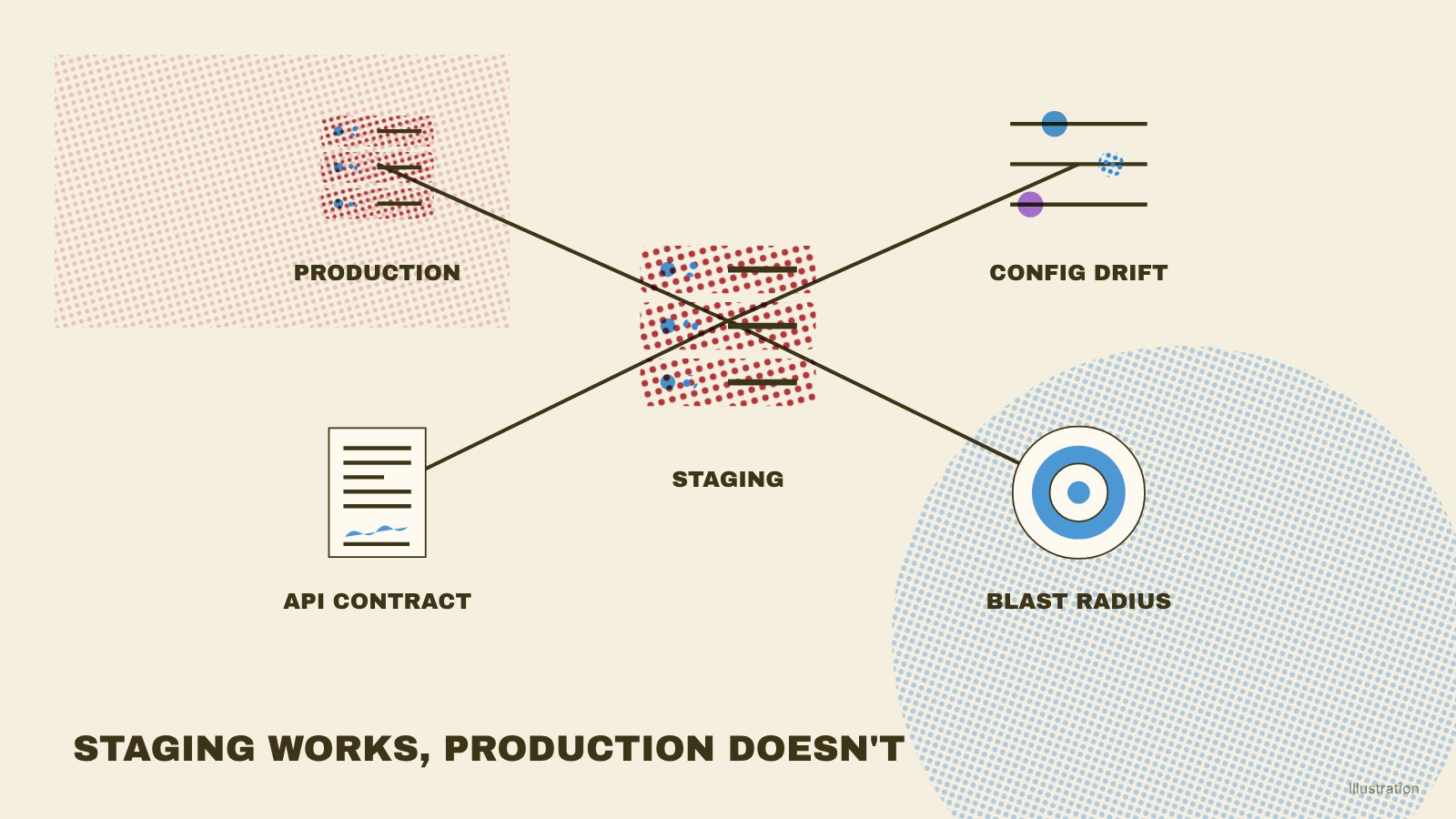
"It works in staging." "It worked yesterday." "It works with my test key." Each of these is a comparison waiting to be made. The working case and the failing case differ somewhere, and the job is to find the difference that matters.
Here's a week of those comparisons at a company that runs a delivery-tracking platform:
- Monday. Production checkout is slow; staging is fine. Two engineers diff the two environments' config files by eye. They miss that the production database pool was lowered from 50 to 5 in a hotfix three weeks ago.
- Wednesday. A customer's integration fails; their colleague's identical call works. Support spends an afternoon comparing two requests in a spreadsheet: one sends
weightas"2.5", the other as2.5. - Friday. The tracking service fails. Nobody knows which other services call it, so nobody warns the teams whose features break next.
Each answer was in the data. Each comparison was done by hand, if at all.
The second phase of TicketResolve 6.0 makes three of those comparisons first-class.
First, the basics
- Configuration is the settings that control software: pool sizes, flags, versions, credentials. Drift is environments' settings slowly diverging.
- A snapshot is a copy of an environment's configuration at a point in time.
- A fingerprint is a short code derived from a value, so you can tell two values differ without seeing either.
- An API contract is the agreed shape of requests and responses. Breaking changes break existing clients; safe additions don't.
- Idempotency makes a repeated request safe; an
Idempotency-Keyheader identifies repeats. - Serialisation is how data is encoded (JSON, form data, dates).
- Deprecation means a feature is being retired;
Sunsetsays when. - A webhook signature proves a webhook came from who it says.
- Blast radius is what else a failure affects. Confirmed impact is customers with open work on an affected service; estimated exposure is customers whose recent tickets touched one.
Why does this matter? Most "works here, fails there" problems are a single difference. Finding it by comparison, with the difference ranked by relevance and secrets never exposed, is faster and safer than reading two files side by side.
The problem, in plain terms
- Config files are compared by eye.
- Secrets end up in diffs and tickets.
- Request differences are spotted by luck.
- Contract problems (idempotency, serialisation, deprecation) are easy to miss.
- Nobody knows what depends on a failing service.
Configuration drift
Configuration is where many production-only failures live: a connection pool sized differently, a feature flag switched on in one region, a runtime a major version behind, a credential rotated in one place and not the other.
TicketResolve keeps configuration snapshots per environment. You can paste or upload JSON, YAML, .env or properties files, or send them from your pipeline with POST /v1/config-snapshots. An unchanged snapshot isn't saved twice, so sending one on every deploy costs nothing.
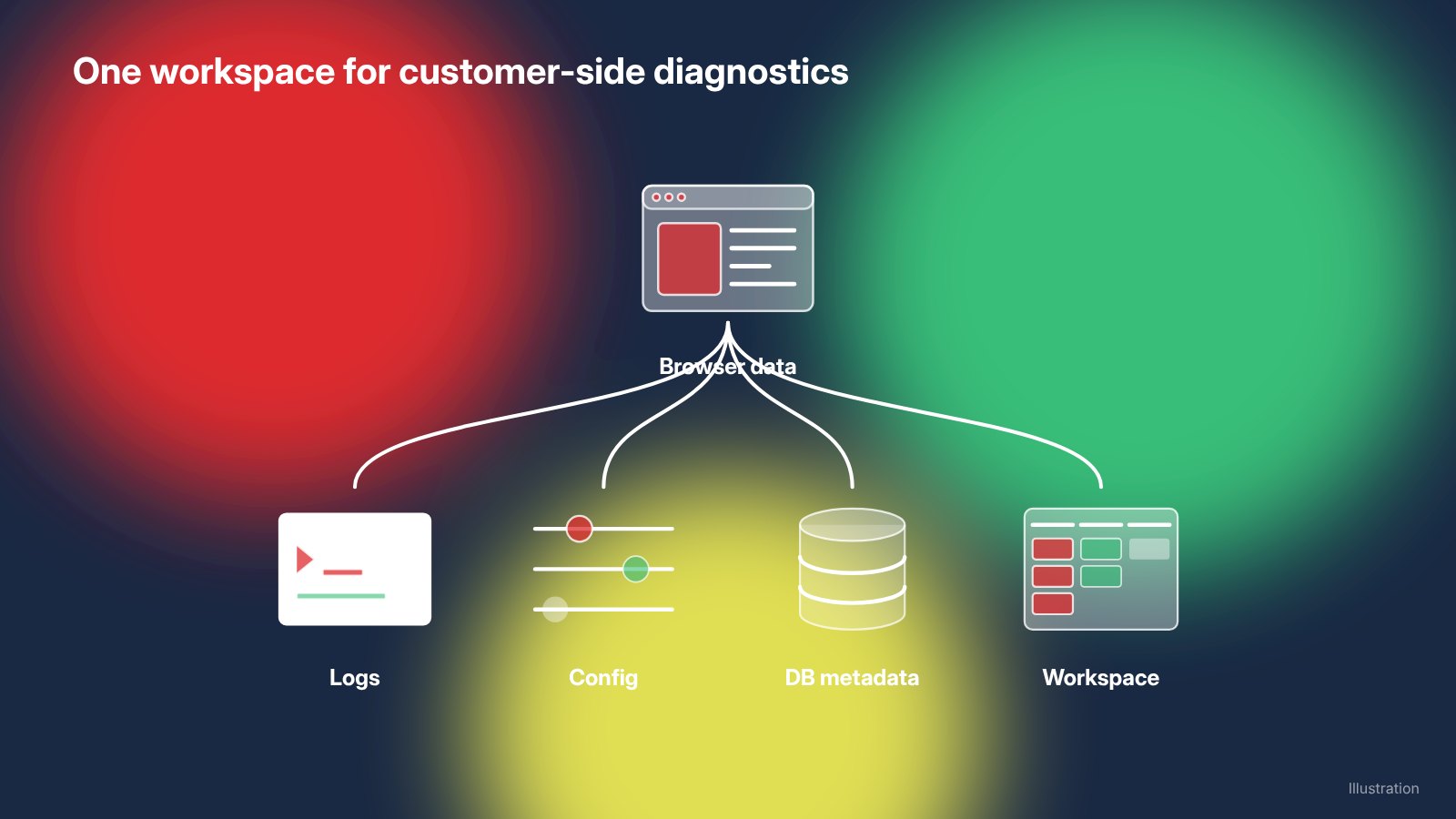
Before anything is stored, settings are flattened (db.pool.max) and sorted into categories: feature flags, database, authentication, network, runtime, dependencies, containers, deployment, integrations and API settings. Secret values never reach the database. Passwords, tokens, keys, connection strings, and anything that looks like a credential become a short fingerprint. You can still see that production's signing secret differs from staging's, but nobody, including TicketResolve, can see what it is.
Compare any two snapshots and each difference comes with a reason: missing in one environment, a major version apart, a value halved, a flag switched. Inside an investigation the ranking goes further. Differences that match the error's terms, the failing service, or a hypothesis the root-cause engine is still weighing move to the top. A pool size matters more when the leading hypothesis is database exhaustion.
Two things it doesn't do. It doesn't treat a difference as the cause: a difference is a lead to test, and the investigation says so. And it never changes your configuration. Each difference gets a suggested action for a person to review and apply.
API contracts
When one API call fails and another succeeds, the fastest route to the answer is a field-by-field comparison. Open a failing request in the API workbench and TicketResolve finds the nearest successful call to the same operation. It then shows what differs: a missing Authorization header, a different auth scheme, an omitted query parameter, a body field sent as a string instead of a number, or an HTML page coming back where JSON should be (usually a proxy or login redirect, not the API).
The same view flags three classes of contract problem that are easy to miss:
- Idempotency: repeated identical POSTs with no
Idempotency-Key, or conflicts that point to a retried request. - Serialisation: a JSON body with the wrong
Content-Type, a form-encoded body labelled JSON, invalid JSON, non-ISO dates, type mismatches against the API file. - Deprecation:
DeprecationandSunsetheaders,Warning: 299,410 Gone, operations marked deprecated in the spec.
Each call can become a sanitised test case: a curl command or a downloadable Postman collection with {{API_TOKEN}}, {{EMAIL}} and similar placeholders in place of every credential and personal detail. It's safe to attach to an engineering ticket.
Two contract tools sit alongside it. A GraphQL schema diff sorts changes into breaking ones (removed fields, changed types, new required arguments, removed enum values, input fields that became required) and safe additions. A webhook signature checker covers Stripe, GitHub, Slack, Shopify and generic HMAC. When the signature doesn't match, it tries the usual culprits: a body that was parsed and re-encoded, changed line endings, an added or stripped trailing newline, a stale timestamp. If none of those explains it, the secret is probably wrong. The secret is used for that one check in memory, never stored, and the field clears itself.
For the root-cause engine there's a new experiment, API contract changes. It looks for API file versions with breaking changes that landed before the problem, and checks whether they touch the operation the investigation tested.
Dependencies and blast radius
The third comparison is between the failing service and everything around it. From the traces you already sync, TicketResolve builds a service map from observed calls only. If service A's span has a parent in service B, B calls A. Nothing is inferred from names.
For the failing service the Root cause tab then shows:
- what it depends on, and which of those dependencies are failing too. That's a hint that the problem may start further down, labelled as an inference.
- what calls it: the services it can affect.
- deployments to any of those services in the three days before, and open known issues on them.
Customer figures are split deliberately. Confirmed impact counts customers with open work on an affected service. Estimated exposure counts customers whose recent tickets touched one. The two are shown side by side and never added together. MRR appears only where your billing tool or CRM has verified it. Missing tiers and unverified revenue are listed as missing rather than filled in.
What stays the same
Everything here is read-only and uses no model calls. Configuration secrets are fingerprinted, webhook secrets are used once in memory, test cases carry placeholders, and correlation is labelled as correlation. Each comparison narrows the search, and the root-cause engine still has to show which difference explains the failure.
A worked example, start to finish
Here's the delivery-tracking platform's week, with phase 2. The details are illustrative.
Monday, drift. Their pipeline sends a snapshot on every deploy with POST /v1/config-snapshots. An investigation opens on slow production checkout. Comparing production with staging:
DATABASE_POOL_MAX: 5 vs 50: a value cut to a tenth. Ranked first, because the root-cause engine's leading hypothesis is database exhaustion.PAYMENTS_SIGNING_SECRET: differs (two fingerprints). Values never stored.feature.new_checkout: on vs off.
Suggested action for the first: revert DATABASE_POOL_MAX to 50, for a person to review. Labelled a lead to test, not the cause. They revert it; latency drops.
Wednesday, contracts. The failing integration call opens in the API workbench. TicketResolve finds the nearest successful call to the same operation: the difference is weight sent as a string ("2.5") instead of a number, a type mismatch against the API file. It also flags serialisation: the failing client sends dates as 03/11/2026, not ISO. Support exports a sanitised Postman collection with {{API_TOKEN}} placeholders and attaches it to the engineering ticket.
Wednesday, webhooks. Another customer reports their webhook signature check fails. The webhook signature checker (Stripe) tries the usual culprits: their framework parsed and re-encoded the body before verifying. The secret was used once in memory and the field cleared.
Friday, blast radius. The tracking service fails. From observed calls only:
- Depends on: the geocoding service, also failing: a hint the problem starts there, labelled an inference.
- Called by: notifications, the customer portal, the driver app.
- Deployments to geocoding two days earlier; one open known issue on the portal.
- Confirmed impact: 14 customers with open work on affected services. Estimated exposure: 230 customers whose recent tickets touched one. Shown side by side, never added. MRR shown only for the 9 with verified billing; the rest listed as unverified.
The incident lead pages the geocoding team first and warns notifications and portal.
Five more real-world scenarios
1. A secret that differs
Situation. Production's signing secret differs from staging's.
How TR handles it. Both are fingerprints; you see that they differ, never what they are.
2. HTML instead of JSON
Situation. A failing call returns an HTML page.
How TR handles it. Flagged: usually a proxy or login redirect, not the API.
3. A GraphQL change
Situation. A field became required on an input type.
How TR handles it. The schema diff marks it breaking.
4. A retried POST
Situation. Identical POSTs without an Idempotency-Key.
How TR handles it. Flagged as an idempotency problem.
5. Revenue not verified
Situation. Some affected customers have no billing data.
How TR handles it. Their MRR is listed as missing, not filled in.
Before and after
Before. Config files compared by eye, a string-versus-number difference found after an afternoon, and no idea which teams a failing service would affect.
After. A pool size cut to a tenth ranked first, a type mismatch found from the nearest successful call, a webhook problem explained, and a blast radius from observed calls with confirmed and estimated impact kept apart.
How to tell it's working
- Production-only problems are found by comparison, quickly.
- Engineering tickets carry sanitised test cases.
- Blast radius is known before other teams are hit.
Who it's for
- Support and platform engineers.
- Integration and API teams.
- Incident leads who need to know who else is affected.
How it fits with the rest of TicketResolve
Phase 2 of TicketResolve 6.0 feeds the root-cause engine (the API contract changes experiment), remediation plans (phase 3) and the service dependency graph. The API workbench hosts contract comparisons.
Mistakes to avoid
- Treating a difference as the cause without testing it.
- Pasting real credentials into engineering tickets; use sanitised test cases.
- Adding confirmed impact and estimated exposure together.
Do it in TicketResolve, step by step
Where: configuration snapshots and the investigation's Root cause tab (/dashboard/investigate); the API workbench (/dashboard/api-workbench). You'll need: snapshots from your pipeline or uploads; traces for the service map. Full guides: API workbench: reproduce a customer's API call and TR Investigate: from a ticket to a verified fix.
- Send configuration snapshots with
POST /v1/config-snapshots, or paste and upload. - Compare two snapshots; read each difference's reason.
- Open a failing request in the API workbench to compare with the nearest success.
- Check idempotency, serialisation and deprecation flags.
- Export a sanitised test case for engineering.
- Use the GraphQL schema diff and webhook signature checker when relevant.
- Read blast radius on the Root cause tab: dependencies, callers, recent deployments, known issues, confirmed and estimated impact.
How to check it worked: differences show reasons and fingerprints, and blast radius shows confirmed impact and estimated exposure side by side.
Frequently asked questions
Which config formats are supported?
JSON, YAML, .env and properties files, or POST /v1/config-snapshots.
Are secrets stored? No. They become fingerprints; you see that they differ, not what they are.
Does a difference mean the cause? No. It's a lead to test.
Does it change our configuration? No. A person reviews and applies suggested actions.
How are failing and succeeding calls compared? Against the nearest successful call to the same operation, field by field.
Are webhook secrets kept? No. Used once in memory; the field clears itself.
How is the service map built? From observed calls in your traces only.
Are confirmed and estimated impact added together? No. They're shown side by side.
Explore Topics
Written by
Ghulam Shabbir
Content creator and writer sharing insights and stories.