
An AI Product Manager That Shows Its Evidence
“What should we build next?” is the question every product leader asks, and the one an AI is most tempted to answer with confidence it hasn’t earned. Product Management Intelligence adds an AI Product Manager that answers from your records, cites every statement, proposes draft work for people to carry out and writes reports leadership can check.
The head of product at a 200-person accounting software company is preparing for the quarterly planning offsite. She asks a general AI assistant, with the last quarter's feedback export pasted in: "What should we build next?"
The answer is persuasive. "Your top priority should be a mobile app. 40% of customers are asking for it, it would reduce churn by 15%, and competitors are moving fast. Second, invest in AI-powered bookkeeping."
At the offsite, the CFO asks where 40% came from. The export had 31 mobile-app mentions out of 2,100 feedback records, from 19 customers. The churn figure had no source at all. "Competitors are moving fast" was the assistant's own flourish. And AI bookkeeping wasn't in the feedback; it was in the news.
Meanwhile, the theme that had grown fastest that month (bank-feed reconciliation errors, from 44 customers, 9 of them in the top 50) wasn't mentioned at all.
"What should we build next?" is the question every product leader asks, and the one an AI is most tempted to answer with confidence it hasn't earned.
First, the basics
- Product management decides what a product should do next and why.
- A theme groups feedback about the same need. Unique customers count each company once.
- An opportunity is a problem worth solving, with its evidence.
- Prioritisation ranks opportunities using a model (such as RICE: reach, impact, confidence, effort).
- A roadmap shows planned work over time. A PRD (product requirements document) describes what to build.
- A success metric measures whether a feature worked. An experiment tests a change on some users.
- An objective is a business goal the work should support.
- Agent mode lets the AI look for work worth doing and propose it.
- Citing means pointing to the record that supports a statement.
Why does this matter? Product decisions commit months of engineering time. An assistant that invents percentages, ignores the fastest-growing problem and borrows ideas from the news can push a company in the wrong direction with a straight face. One that answers from your own records, cites everything and proposes drafts rather than decisions helps leaders move faster without losing the evidence.
The problem, in plain terms
- AI answers "what to build" from impressions, not records.
- Numbers are invented, or mentions confused with customers.
- Rising problems get missed because they're not yet big.
- Plans and estimates get stated as facts.
- AI wants to act: approve, commit dates, change strategy.
- Leadership reports are rebuilt by hand each quarter.
Most answers are calculated
- What to build next is your default prioritisation model's ranking.
- Rising problems are themes with more customers this month than last.
- Product gaps are themes with several customers and no opportunity.
- What blocks the roadmap is items with a late dependency, a passed date or an overloaded quarter, plus PRDs waiting on approval or on engineering.
- Off-target metrics, experiments waiting for a decision, gaps Sales Engineering recorded: all calculated, all linking to the records behind them.
None of it uses AI.
Written answers cite everything
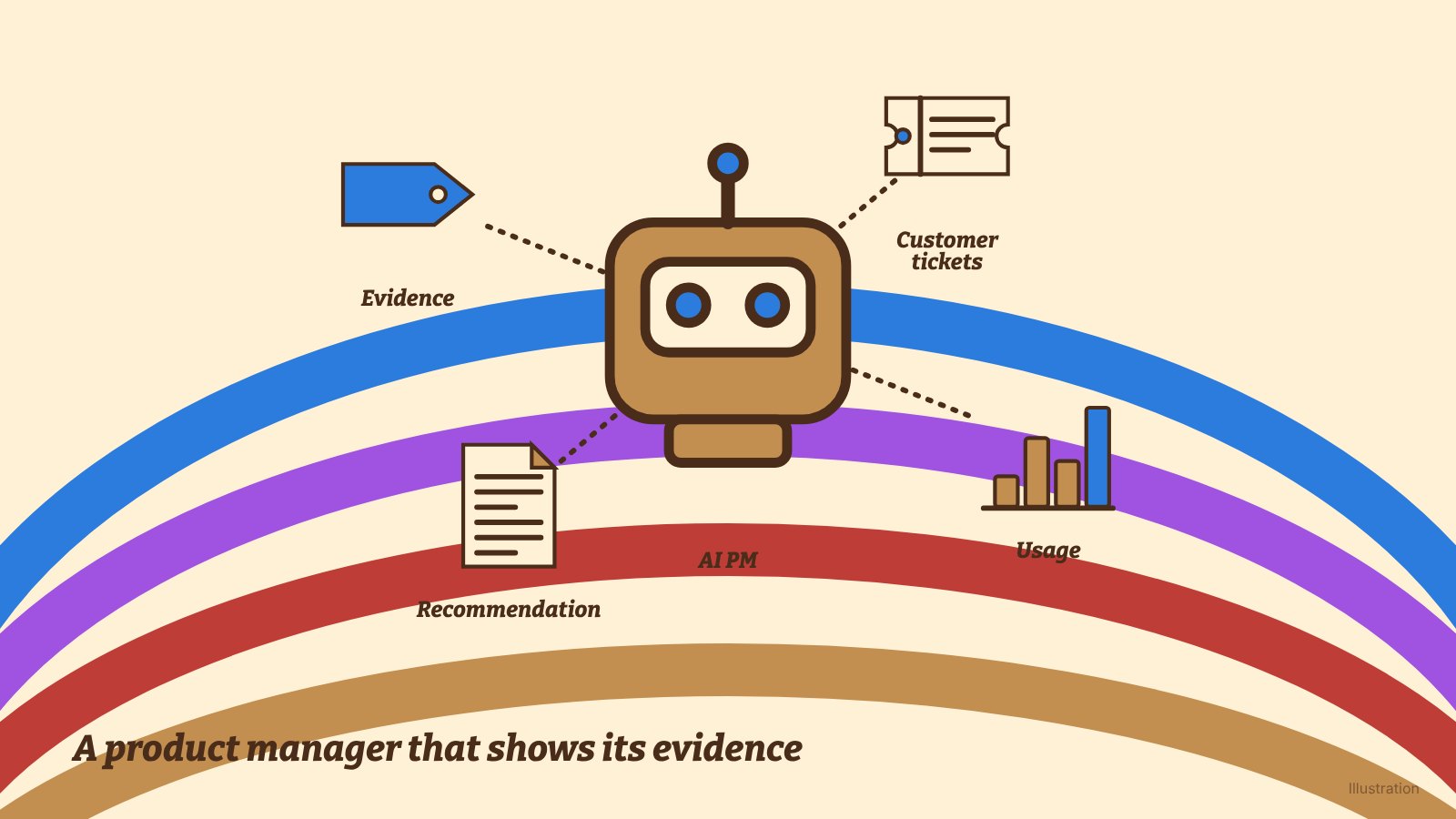
For anything else, the AI Product Manager writes an answer from evidence built from your themes, opportunities, roadmap, metrics, experiments, decisions and objectives.
- Every statement has to cite that evidence.
- A statement that doesn't is removed, and the answer says what the evidence couldn't cover.
- Target dates stay plans, estimates stay estimates, before/after stays before/after.
It proposes; people do
In agent mode it looks for work worth doing:
- an opportunity for a theme three customers raised;
- a PRD for an approved opportunity;
- a score for a ready one;
- a success metric for a released feature.
Each proposal creates only a draft, and a person carries it out with their own permissions or dismisses it. Approving, committing dates, publishing and changing strategy are never on the list.
Reports leadership can check
Executive reports and quarterly reviews are built from the same calculated figures, with an optional written summary that cites them, and download as Word. Product questions also work in the Business Operations Copilot.
A worked example, start to finish
Here's the same head of product, Anjali, preparing for the next offsite.
Monday, 09:00. She opens AI Product Manager → Ask and picks "What should we build next?". It's calculated: the default model's ranking (RICE), linking to each opportunity and its score:
- Bank-feed reconciliation errors: reach 44 customers, confidence high.
- Multi-currency invoices: reach 28 customers.
- Mobile receipt capture: reach 19 customers.
09:05. "Rising problems?": calculated. Bank-feed reconciliation errors: 44 customers this month, 17 last month. Payroll export to pensions provider: 12 customers, up from 4.
09:10. "Product gaps?": themes with several customers and no opportunity. Payroll export to pensions provider has no opportunity yet.
09:15. She asks for a written answer: "Why is bank-feed reconciliation rising, and what should we consider?"
- 44 customers raised it this month against 17 last month [theme 3].
- 9 of them are among the 50 largest accounts [theme 3, segment breakdown].
- Most records mention one bank's new feed format, introduced in early October [feedback records 112–140].
- The opportunity is scored but has no PRD [opportunity 21].
- The evidence doesn't cover how many customers have churned over this.
A sentence suggesting "this could reduce churn by 20%" cited nothing and was removed.
09:30. Agent mode, refreshed. Proposals:
- Create an opportunity for "Payroll export to pensions provider" (12 customers raised it).
- Draft a PRD for "Bank-feed reconciliation errors" (approved opportunity).
- Define a success metric for "Recurring invoices", released last month with no metric.
She clicks Do it on the first two. Each creates a draft, with her permissions. She dismisses the third, because the metric already exists in the analytics tool.
Tuesday. The PRD draft goes through the usual process: Anjali fills the gaps and sends it for approval by someone with Approve product decisions.
Thursday, offsite. She downloads the quarterly review as Word: calculated figures and a written summary citing them. When the CFO asks where a number came from, Anjali opens the record.
Friday. The COO asks the Business Operations Copilot: "What's blocking the product roadmap?" It answers from the same calculated figures: two items with late dependencies, and one PRD waiting on engineering.
Five more real-world scenarios
1. Asking it to approve an opportunity
Situation. A PM asks the AI to approve their opportunity.
How TR handles it. Approving isn't on the list. A person with the right permission approves.
2. A target date stated as a commitment
Situation. A draft answer says "the feature ships in March".
How TR handles it. Target dates stay plans. It says "targeted for March".
3. An experiment waiting
Situation. An A/B test reached enough data two weeks ago.
How TR handles it. It appears under experiments waiting for a decision.
4. A gap from Sales Engineering
Situation. Sales engineers recorded a missing integration in four deals.
How TR handles it. It's listed among gaps Sales Engineering recorded, linking to the deals.
5. A question the evidence can't answer
Situation. Someone asks about a competitor's pricing.
How TR handles it. The answer says what the evidence couldn't cover.
Calculated or written: which to use when
A simple rule of thumb for getting the most out of the AI Product Manager:
- Use calculated answers for "what" questions. What to build next, what's rising, what's blocked, what's off target. They're instant, exact, link to the records and use none of the PM limit.
- Use written answers for "why" and "what should we consider" questions. They pull evidence together across themes, opportunities, metrics and decisions, and cite each statement.
- Use agent mode once a week. It finds the small, easy-to-miss jobs: an opportunity nobody created, a PRD nobody started, a metric nobody defined.
- Use reports for leadership. They're calculated from the same figures, so the numbers in the room match the numbers in the product.
If a written answer says the evidence couldn't cover something, that's useful too: it's a gap in what you know, and often the next interview or experiment to run.
Before and after
Before. "40% want a mobile app", a churn figure from nowhere, an idea from the news, and the fastest-growing problem missed.
After. Rankings, rising problems and gaps calculated from records, written answers that cite every statement and say what they can't cover, drafts proposed for people to carry out, and reports leadership can check.
How to tell it's working
- Planning discussions start from calculated rankings and rising themes.
- Every number in a written answer can be opened.
- Proposals become drafts people complete, or are dismissed with reason.
- Quarterly reviews are downloaded, not rebuilt.
Who it's for
- Heads of product and product managers.
- Executives who review product strategy.
- Engineering and sales leaders who need to see what product is planning and why.
How it fits with the rest of TicketResolve
With this release, all five phases of Product Management Intelligence are available: feedback and themes, opportunities and discovery, prioritisation and roadmaps, PRDs and engineering hand-off, metrics and experiments, and now the AI Product Manager. Product questions also work in the Business Operations Copilot.
Mistakes to avoid
- Treating the written answer as a decision. It's evidence-backed input.
- Leaving the default model unset. "What to build next" uses it.
- Accepting every agent proposal. Dismiss what doesn't fit.
Do it in TicketResolve, step by step
Where: Product Management → AI Product Manager (/dashboard/product-management/assistant). You'll need: a PM seat, feedback and opportunities in place, and a default prioritisation model. Full guide: Working with the AI Product Manager.
- Ask. AI Product Manager → Ask, or pick an example. Common questions are calculated and link to the records.
- Get a written answer. Written answer uses one output from the PM limit. Check the evidence list; uncited statements are already removed.
- Review proposed work. Refresh proposals, then Do it or Dismiss. Drafts are created with your permissions; approvals stay with people.
- Report. Create an executive report or a quarterly review and download it as Word.
- Ask across the business. Product questions also work in the Business Operations Copilot.
How to check it worked: "What should we build next?" shows your model's ranking with links, and a written answer lists the evidence for every statement.
Product Management Intelligence is $99 per PM seat a month, in the 7-day free trial.
Frequently asked questions
Does "what to build next" use AI? No. It's your default prioritisation model's ranking.
What's a rising problem? A theme with more customers this month than last.
What happens to uncited statements? They're removed, and the answer says what the evidence couldn't cover.
Can the AI approve or commit dates? No. Approving, committing dates, publishing and changing strategy are never on its list.
What does a proposal create? Only a draft, which a person carries out with their own permissions or dismisses.
How do reports download? As Word.
Are estimates stated as facts? No. Target dates stay plans and estimates stay estimates.
Can leaders ask product questions elsewhere? Yes, in the Business Operations Copilot.
When should I use a written answer instead of a calculated one? For "why" and "what should we consider" questions. Use calculated answers for "what" questions.
Explore Topics
Written by
Ghulam Shabbir
Content creator and writer sharing insights and stories.