
A 15-Minute Reasoning Test Built From Original Questions
The AI Recruitment Manager (formerly TR Talent Intelligence) now has a cognitive test engine. Its default test is 50 questions in one 15-minute countdown, drawn from an original library of verbal, numerical, logical, abstract, spatial, attention-to-detail and working-memory questions. Every question is approved by someone who didn''t install it, and every score is labelled "Not validated" until the evidence says otherwise.
Short, timed reasoning tests are one of the most common steps in skills-based hiring, and one of the easiest to get wrong. Teams copy questions from test-prep sites, borrow a famous test's name, set a pass mark nobody measured, and treat the score as a verdict.
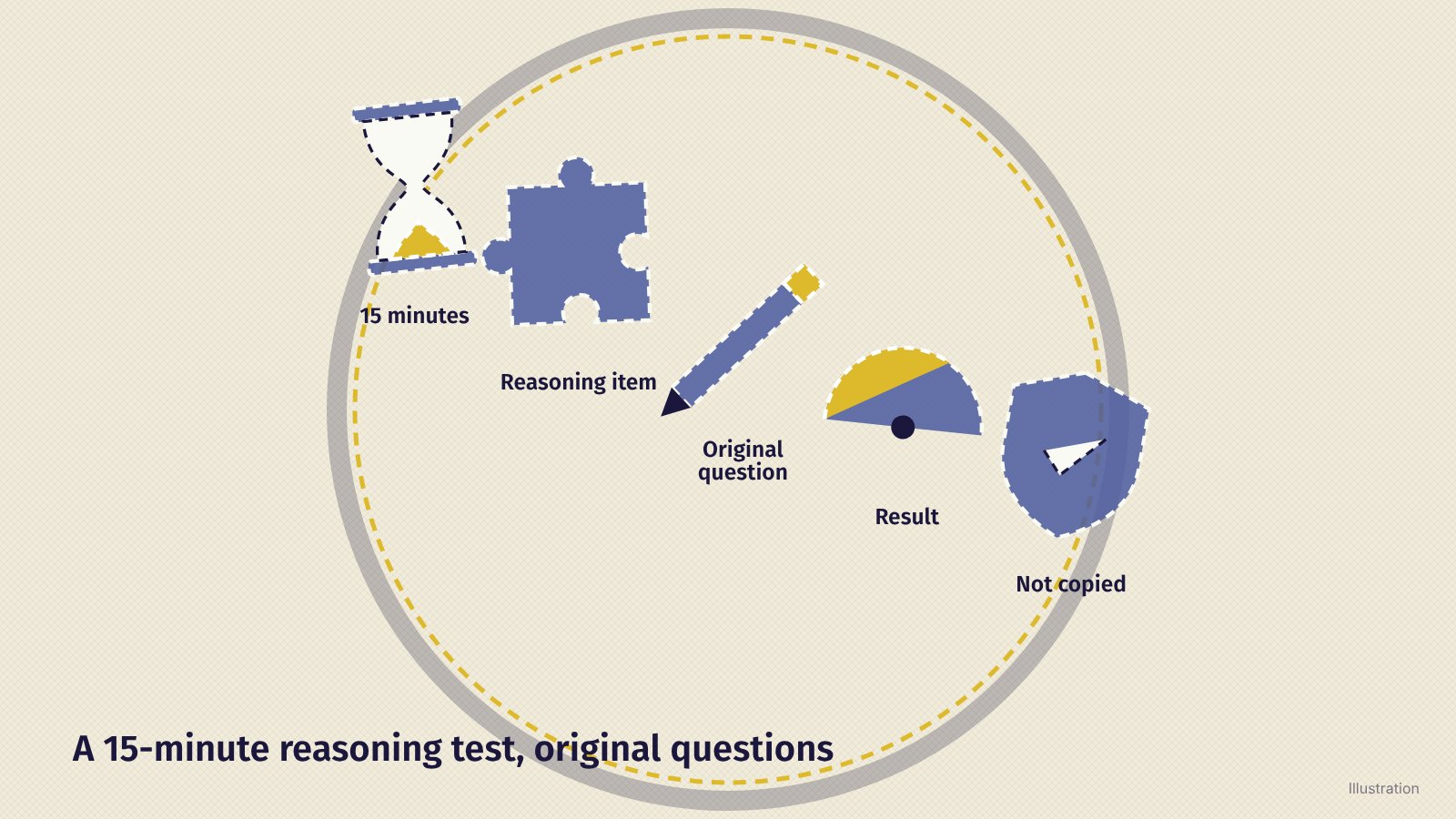
The AI Recruitment Manager takes a stricter route. It has an original question library, a default 50-question, 15-minute test, and an exam screen built for fairness. Approval and calibration rules stop the score from claiming more than it can show.
The AI Recruitment Manager is the new name for TR Talent Intelligence. It's still part of the AI CPO and included in the same seat.
A few terms used in this post:
- Cognitive test: short questions on words, numbers, logic and shapes, answered against the clock.
- Profile: a test's time limit, number of questions and the share of each category.
- Calibration: measuring how hard a question really is, from real candidates' answers.
- Not validated: no one has yet shown that the test measures consistently for a defined use.
The problem, in plain terms
Teams usually reach for a reasoning test because it's quick and covers every applicant equally. The trouble is in the details:
- Borrowed questions leak. Questions copied from a published test or a prep site are often already online with their answers. They may also be someone else's copyright.
- Borrowed names mislead. Calling a home-made test by a licensed test's name suggests evidence it doesn't have.
- Pass marks are guessed. A cut-off of "30 out of 50" sounds precise. Without data on how candidates actually score, it's a number someone made up.
- The screen gets in the way. A dropped connection loses answers. Candidates can't mark a question to come back to. The same option order for everyone makes sharing answers easy.
Part 1: the original library
The library is a set of questions written or generated for TicketResolve. Generated questions come from our own templates with a fixed seed, so every install gets the same set. It covers seven areas:
| Area | What it asks |
|---|---|
| Verbal | Closest and opposite meanings, analogies, sentence completion |
| Numerical | Percentages, ratios, fractions, averages, profit and loss, rates, a small data table |
| Logical | Number sequences, "which statement must be true", if-then rules |
| Abstract | Figure sequences, the odd one out, 3×3 grids with a missing figure |
| Spatial | A block shape turned versus flipped over |
| Attention to detail | The same record copied into two systems: which fields differ? |
| Working memory | A list shown once for a few seconds, then a question about it |
Nothing is copied or reworded from a published or licensed test.
Before the library ships, every question goes through the same automatic checks as a question your team writes:
- references to personal characteristics
- duplicate or near-duplicate questions
- an answer that gives itself away
- culture-bound contexts
The library's own tests check the answers. They confirm that:
- every spatial answer is a true rotation and every wrong option a mirror image
- every attention-to-detail answer matches the two records
- the default test can be filled twice over, so a candidate could get a second, different form
Part 2: installing and approving it
Installing the library puts its questions in your question bank in review. The default test comes too, also in review. Questions too similar to one already in your bank are left out and counted, never forced in.
Someone with approval rights who didn't install it reviews the library. They sample questions in the bank and approve it with a note on what they checked. That publishes the questions and the default test. Any single question can still be retired later, with a reason.
Part 3: the default test and other profiles
The default test is 50 questions in one continuous 15-minute countdown, about 18 seconds a question:
- 13 verbal
- 13 numerical
- 12 logical
- 6 abstract
- 6 spatial
About 30% of each section is easy, 45% medium and 25% hard. The format is inspired by publicly described timed aptitude tests, but it isn't the CCAT or any licensed test, and we don't claim it's equivalent to one.
The test is speeded on purpose, and candidates are told so: most people won't finish, wrong answers cost nothing, and it's better to answer than to skip.
Other profiles are one click away: 10 minutes (33 questions), 20 (66) or 30 (100). You can also set your own time and number. Each category's share is adjustable, including attention to detail and working memory, which the default leaves out. A profile is built as a draft, then submitted and approved like any assessment.
Part 4: the exam screen
- One countdown, kept on the server. Closing the page doesn't stop it, and answers are submitted automatically when time runs out.
- Saved as they go, even offline. If the connection drops, answers wait on the candidate's device and are sent, in order, when it's back.
- Flag and come back. A numbered map shows each question as answered, unanswered or flagged.
- Shuffled options. Each candidate gets their own option order, the same on every reload. Questions whose options name positions in a figure keep their order.
- An optional no-going-back rule. If a test is set up this way, earlier questions are locked by the server, not just the page.
- Working-memory questions show their information once, for a set number of seconds. The server never sends it again.
- Proctoring works as before: two cameras, the whole screen and the desktop helper. Every flag goes to a person.
Part 5: what results show
For each question you see:
- the answer and whether it was right
- the seconds spent on it
- how many times the answer changed
- whether the candidate flagged or skipped it
These describe how the test was taken. They never change a score. A quick answer or a changed answer isn't evidence of anything on its own.
Each question has a scoring weight (default 1). If any weight isn't 1, a weighted percentage appears next to the raw score, never instead of it. Both are calculated from the stored answers and keys, so anyone can reproduce them.
Each question also shows a version (a copy is the next version) and a calibration status:
- Uncalibrated: nobody has answered it yet.
- Calibrating: candidates have answered it, but not enough of them.
- Calibrated: there are enough answers for a stable difficulty figure.
What it does, and what it doesn't
It does:
- give you an original, reviewed question library and a ready-made timed test
- let you set time, length and category weighting
- record how each question was answered, without letting that change the score
It never:
- copies or names a licensed test
- sets a pass mark, a percentile or a norm before validation evidence exists
- treats speed, answer changes or flags as proof of anything
- makes a hiring decision, which is always a person's, approved by a second person
A worked example, start to finish
This scenario is illustrative. The company and numbers are made up.
A support team is hiring two analysts and has 40 applicants.
- Priya, a recruiter, installs the library. Marcus, the hiring manager, samples 25 questions across the seven areas. He retires one analogy he finds ambiguous, and approves the library with a note.
- Priya sends the default test to all 40 applicants. Each gets their own draw of 50 questions and their own option order.
- One applicant's connection drops for two minutes. Their answers are kept on their device and sent when it reconnects.
- Results come in as raw scores out of 50, with time per question. Priya sees that nobody answered one hard numerical question correctly. She leaves it for the validation report to judge, rather than guessing.
- The test is still "Not validated", so there is no pass mark. The team uses scores alongside the real-work assignment and structured interviews, and a second person approves each decision.
Five more real-world scenarios
- A shorter screen for high-volume roles. A 10-minute profile (33 questions) for the first stage, with the 15-minute default later for a shortlist.
- Detail-heavy roles. Billing and data-entry roles add attention-to-detail questions to the profile's category shares.
- Strict test conditions. A team turns off going back, so candidates answer in order. The server enforces it.
- A candidate who needs more time. Extra minutes are agreed before the start and recorded with the result.
- A question that behaves oddly. The validation report shows that a question nobody gets right doesn't separate strong and weak scorers. It's retired with a reason, and a copy is fixed as the next version.
Do it in TicketResolve, step by step
- AI Recruitment Manager → Assessment center → Cognitive tests → Install for review. (Cognitive tests and the question library)
- Someone else approves it. Sample questions under Question bank (filter: In review), then approve with a note.
- Use the default test, or build a profile. Choose the time, the number of questions and each category's share, then submit it for approval. (Building an assessment)
- Send it from a candidate's application. (Sending an assessment to a candidate)
- Read the results. You'll see each question's time, answer changes and flags, the raw and weighted scores, and later the item statistics. (Scores and results)
Frequently asked questions
Is this the CCAT? No. The default format is inspired by publicly described timed aptitude tests, but every question is original. It isn't equivalent to, or a substitute for, any licensed or validated instrument.
Can I set a pass mark? Not until the test is validated for a defined use. Until then, compare candidates on the same profile only, and use scores as one input among others.
Why do so few candidates finish? The test is speeded on purpose: there's more to do than time allows, so it measures how much someone gets right under time pressure. Candidates are told this before they start.
Does a candidate see the same questions as another? Not usually. Each candidate gets their own draw from the approved questions, balanced by category and difficulty, and their own option order.
What happens if the internet drops? Answers are kept on the candidate's device and sent, in order, when the connection is back. The timer is kept on the server, so the deadline doesn't change.
Do speed or answer changes count against a candidate? No. They're shown to help you understand how the test was taken, never as a score or proof of anything.
What's the AI Recruitment Manager? The new name for TR Talent Intelligence. It's part of the AI CPO and included in the AI CPO seat.
The short version
The AI Recruitment Manager now has a cognitive test engine: an original seven-area library, a 50-question, 15-minute default test, and an exam screen built for fairness. People approve the content. Scores stay labelled "Not validated" until the evidence supports more, and a person makes every decision.
Explore Topics
Written by
Ghulam Shabbir
Content creator and writer sharing insights and stories.