
The API Nobody Documented: Shadow Endpoints and What Your Software Is Made Of
Your API list is the OpenAPI spec, but the APIs you run are whatever your services answer, including the debug route added last spring. TR Security Intelligence now compares served endpoints with your specs, flags shadow and zombie APIs, and shows vulnerable components and licences from your SBOMs on the same inventory Reliability Intelligence uses.
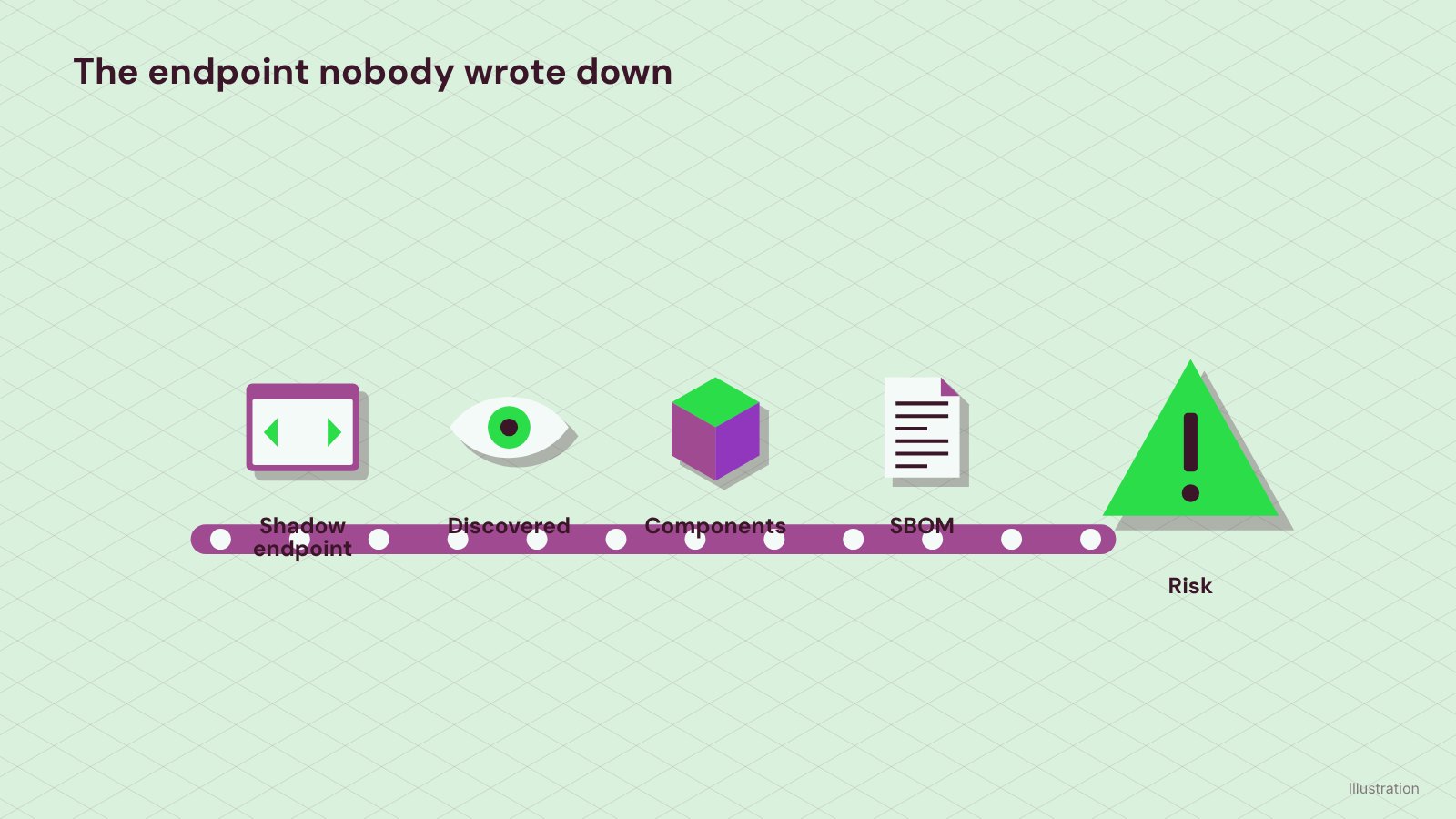
A penetration tester sends the findings report for a fintech's customer API. Most of it is expected, except item 4: "Unauthenticated endpoint GET /internal/debug/accounts/{id} returns account metadata."
The security lead checks the OpenAPI spec the team maintains. The route isn't there. Nobody on the current team knows it exists. It turns out a developer added it during an incident eighteen months ago to inspect account state, meant to remove it, and moved teams. It has been answering requests in production ever since.
Every security review asks for "the list of APIs". The list you have is the spec. The APIs you actually run are whatever your services answer.
First, the basics
- An API is a doorway through which software talks to other software: the mobile app asks the server for your orders through an API. Each specific doorway is an endpoint, such as
GET /orders. - OpenAPI is a standard format for documenting which endpoints exist and what they do, the official map of your doorways.
- A shadow API is an endpoint that works but isn't on the official map, like a back door nobody wrote down.
- A zombie API is an endpoint on the map that nobody uses any more, but that still exists and still needs protecting.
- Traces are records your systems keep of the requests they handle, which show what's really being used.
- An SBOM (software bill of materials) is an ingredients list of all the open-source components inside your software. A licence says how each component may legally be used.
Why does this matter? Attackers look for doors you forgot about, and every open-source ingredient can carry a vulnerability or a legal obligation. Knowing exactly what you run, and what it's made of, is the basis of application security.
The problem, in plain terms
There are three gaps between documentation and reality:
- Shadow APIs. Endpoints that are served but not documented: debug routes, internal helpers, a v2 nobody announced. They're rarely reviewed, rarely tested and often less protected.
- Zombie APIs. Endpoints that are documented, and possibly still deployed, but nobody calls any more. They still carry risk, and they still need patching.
- Unknown ingredients. Your services are built from hundreds of open-source components. When a critical vulnerability is announced, or a licence question comes up in due diligence, "which services use that library?" can take days to answer.
Served vs documented
The API inventory in TR Security Intelligence takes the endpoints your services actually served in the last 7 days, from trace spans named like GET /orders/42. It compares them with the OpenAPI specs you upload for each service.
IDs and path parameters are grouped, so /orders/42, /orders/77 and /orders/{id} are treated as one endpoint. Otherwise every customer ID would look like a new API.
Every endpoint gets one of four states:
- Documented: in the spec, and served. This is what you want.
- Shadow: served, but not in the spec. Look at these first.
- Documented, no traffic: in the spec, but not called while the service was busy. It might be a zombie API. Check before you remove it, because some endpoints are only called monthly or by one partner.
- No telemetry: the service sent no traces, so nothing can be said. This state is never shown as "fine".
Deprecated operations that are still being called are counted too, so you can see which clients still depend on something you want to retire.
What your software is made of
Supply chain uses the dependency inventory Reliability Intelligence already keeps: the SBOMs you upload and the manifests from the code index. There's one inventory, so security and reliability teams see the same components and never argue about whose list is right.
From it you get:
- Vulnerable components, matched to open findings from your scanners and to open advisory matches on the same package and version. Known exploited ones come first.
- Licences, as the SBOM states them, classed as permissive, weak copyleft, strong copyleft or unknown. The classes are there to guide a review; they aren't legal advice.
SBOMs now keep their licences in the inventory and in CycloneDX exports, so what you export says what you imported.
Four real-world scenarios
1. The debug route, found before the pen test
Situation. The fintech's debug endpoint has been live for eighteen months.
How TR handles it. With traces flowing and the spec uploaded, the inventory lists GET /internal/debug/accounts/{id} as Shadow: served in the last 7 days, not in the spec, along with its traffic. The team removes the route, or documents and protects it properly, before an outsider finds it.
2. Retiring v1 without breaking a partner
Situation. Engineering wants to delete the v1 orders API. "Nobody uses it any more."
How TR handles it. The inventory shows GET /v1/orders/{id} as a deprecated operation still being called. One partner integration still uses it every night. The team contacts the partner first, then retires the endpoint without an outage.
3. "Are we affected?" on announcement day
Situation. A critical vulnerability is announced in a popular logging library, and it's added to the known-exploited catalogue the same week.
How TR handles it. Supply chain matches the advisory to the package and version in the SBOMs and manifests and lists the three services that ship the affected version, with known-exploited items first. The answer to "are we affected?" takes minutes, and it's the same answer the reliability team sees.
4. Licence questions in due diligence
Situation. An acquirer's lawyers ask whether any strong-copyleft components ship in the product.
How TR handles it. The licence view lists components by class as the SBOMs state them, with the unknowns called out separately. The legal team reviews the strong-copyleft and unknown entries; the classes help them focus, and the final judgement is theirs.
Before and after
Before. The API list is a spec last updated two quarters ago. Shadow endpoints are found by pen testers, or attackers. "Which services use this library?" means asking every team to grep their repositories.
After. Served and documented endpoints are compared every week from real traffic. Shadow, zombie and no-telemetry endpoints are separate lists with clear next steps. Vulnerable components and licences come from one inventory shared with Reliability Intelligence.
Who it's for
- AppSec teams get a factual list of what's exposed and undocumented.
- API owners see who still calls what before they deprecate it.
- Engineering leaders and legal get component and licence answers without a fire drill.
Mistakes to avoid
- Deleting "no traffic" endpoints immediately. Some are called rarely, by one client. Check, then retire.
- Uploading a spec that isn't the one you deploy. Compare against the spec that matches production, or everything looks like a shadow API.
- Ignoring "no telemetry". It isn't a clean result. It means a service is invisible; fix the tracing first.
What it needs
- Traces from OpenTelemetry or another tracing source.
- An OpenAPI 3 or Swagger 2 spec per service, in JSON or YAML.
- SBOMs in CycloneDX or SPDX JSON.
Uploads need Security settings, and each one is audited with the document's SHA-256.
How it fits with the rest of TicketResolve
The API inventory doesn't stand alone. Shadow endpoints and vulnerable components become findings in TR Security Intelligence, with owners and SLAs like any other. When an exploitable component sits on an internet-facing service that a tier 1 business service depends on, it shows up in attack paths, ranked by what's at stake. The dependency inventory is the one Reliability Intelligence uses for dependency risk, so a library upgrade planned for reliability reasons and one demanded by security are the same piece of work, tracked once. And because uploads are audited with their SHA-256, you can show exactly which spec or SBOM a conclusion was drawn from, months later, when someone asks.
A worked example, start to finish
Here's how the fintech's security lead closes item 4, and finds the rest before the next pen test.
Monday, 10:00. The platform team confirms that customer-api sends OpenTelemetry traces with spans named like GET /accounts/42.
10:20. The security lead opens Security → Apps and APIs → OpenAPI specs, names the service exactly customer-api, as it appears in the traces, and uploads the YAML spec the service is deployed with. The upload is audited with its SHA-256.
10:25. The comparison appears. Served and documented: 64 endpoints. Shadow (served, not documented): 3. One is GET /internal/debug/accounts/{id}, the pen tester's item 4, called 1,900 times in the last week. Another is an old /v1/payments route. The third is a health check nobody documented.
10:40. The debug route is removed in an emergency change. The /v1/payments route is still called by one partner, so it's documented, protected and given a retirement date. The health check is added to the spec.
11:00. Under deprecated endpoints still called, one deprecated route is used by a mobile app version still on 3% of devices. The team holds off removing it.
11:15. Under no traffic, two documented endpoints haven't been called for 30 days. One is a month-end export, so it stays. The other is genuinely dead and is scheduled for removal.
Afternoon. The build pipeline is changed to produce a CycloneDX SBOM for each service, and the latest ones are imported under Supply chain. A known-exploited vulnerability in an XML library appears in two services, first in the list.
A week later. The debug route has disappeared from the served list. When a new vulnerability in a popular logging library is announced on Friday, the security lead knows within a minute which three services ship it.
How to tell it's working
- Shadow endpoints trend to zero, each documented or removed.
- Every service has telemetry, so none is left uncompared.
- SBOMs are imported from the build, not by hand.
- New vulnerability announcements are matched to services within minutes.
Do it in TicketResolve, step by step
Where: Security → Apps and APIs (/dashboard/security/apps). You'll need: tracing connected (OpenTelemetry or another source) and Security settings rights for uploads. Full guide: Finding shadow APIs and risky components.
- Send traces. Make sure your services send trace spans named like
GET /orders/42. Start with public APIs and payment flows. - Upload your OpenAPI specs. Go to Security → Apps and APIs → OpenAPI specs. Name the service exactly as it appears in your traces (for example
customer-api) and upload the JSON or YAML file it's deployed with. Each upload is audited with its SHA-256. - Review shadow endpoints first. They're served but not documented, often debug routes or forgotten versions. For each one, either document and protect it, or remove it.
- Check deprecated endpoints that are still called before retiring anything, and contact the clients that still use them.
- Treat "no traffic" with care. A documented endpoint with no traffic might be a zombie, or might be called once a month. Confirm before removing it.
- Fix "no telemetry". A service with no traces can't be compared at all. Connect its tracing.
- Import SBOMs. Under Supply chain, import a CycloneDX or SPDX JSON SBOM per service, ideally from your build pipeline. Vulnerable components appear with known-exploited ones first, and licences are grouped by class for review.
How to check it worked: the debug route you removed disappears from the served list within 7 days, and a newly announced vulnerable library shows exactly which services ship it.
Frequently asked questions
Do you scan our endpoints from the outside? No. Served endpoints come from your own trace data; nothing is probed.
Why do some services show "no telemetry"? They sent no traces in the window, so their endpoints can't be compared. It's shown as unknown, never as fine.
Is the licence classification legal advice? No. It's a guide for a review by people qualified to make the call.
Is the supply-chain list separate from Reliability Intelligence? No. It's the same dependency inventory, so both teams see the same components.
Do the service names have to match exactly? Yes. Name the spec's service exactly as it appears in your traces.
Which SBOM formats are supported? CycloneDX and SPDX JSON.
Can I tell who uploaded a spec? Yes. Each upload is audited with its SHA-256.
Explore Topics
Written by
Ghulam Shabbir
Content creator and writer sharing insights and stories.