
Security Evidence You Can Recompute: Posture Across Domains and a Hash-Chained Ledger
Every security review asks two questions: “Where do we actually stand?” and “How do we know these records weren’t edited afterwards?” TR Security Intelligence now shows one picture across nine security domains, puts findings next to the business services they endanger, and chains every security record into a ledger anyone can recompute.
The board meeting is on Thursday, and the CISO has been asked for a one-slide answer to "how secure are we?". The data is spread across five places: a vulnerability scanner, the cloud console, the identity provider, the SIEM and a code-scanning tool. Each one has its own definition of "critical" and its own dashboard. By Wednesday night the slide is a collage of screenshots, and nobody can say whether the 312 critical findings in one tool include the 40 in another.
Two weeks later the auditors arrive with a different question. They pick a critical finding marked "resolved" in May and ask: "How do we know this record wasn't edited after the fact, to make the remediation look faster than it was?"
The honest answer, in most organisations, is "trust us".
First, the basics
- Security posture is the overall state of your security: what problems exist, where, and how quickly they're fixed.
- A security domain is one area of security, such as cloud, identity or applications, each usually watched by a different tool.
- A finding is a specific security problem a tool reported, such as "this server has a known vulnerability".
- A hash (SHA-256) is a short code calculated from a record. Change one letter in the record and the code changes completely.
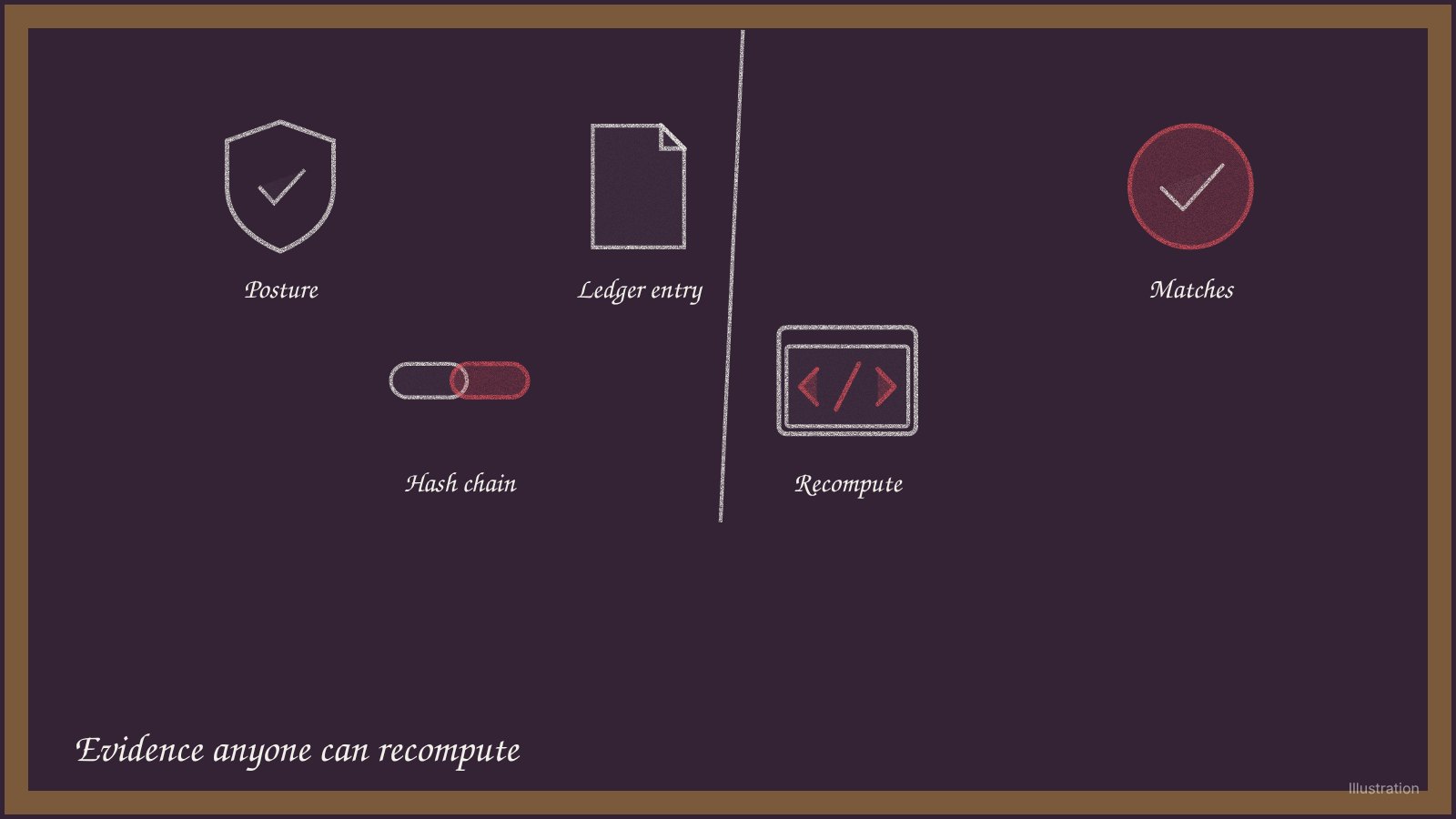
- A hash-chained ledger links each record's code to the previous one, like numbered pages in a bound book: you can't remove or rewrite a page without it showing.
- Recompute means anyone, including an auditor, can recalculate the codes themselves to check nothing was changed.
Why does this matter? Leaders need one honest picture of security, and auditors need proof that records weren't edited afterwards. "Trust us" isn't evidence, but mathematics anyone can check is.
The problem, in plain terms
- No single picture. Each security domain lives in its own tool, and each tool presents itself as the whole story.
- No business context. A critical CVE is critical, whether it's on a test box or on the API behind checkout. Severity alone can't tell you which one keeps the CEO up at night.
- No proof of integrity. Security records live in databases that admins can edit. When evidence matters (audits, incidents, disputes), "the database says so" isn't proof.
This release is the first step towards a unified security platform in TicketResolve, and it answers all three using what's already in your workspace.
One picture across nine domains
Posture shows nine domains side by side:
- vulnerability management;
- application and code;
- cloud;
- identity;
- endpoint;
- security operations;
- attack surface;
- AI security;
- data security.
For each domain you see its sources, open findings by severity, known-exploited and overdue findings, fixes verified in the last 30 days, and any source that failed to read.
Each finding's domain comes from the tool that reported it, so nothing is copied into a second store and there's no second number to reconcile.
A domain with nothing connected says so, and no figure is estimated. At launch, data security wasn't covered yet, and the page said that too. An empty domain is a gap to fill, not a clean bill of health.
Findings next to the business services they put at risk
The same page lists open findings on systems a business service depends on, with the business service, its tier and the customers who reach it. The link runs through the operations twin.
The risk score stays exactly as the tool reported it; business context sits beside it, not mixed into it. A critical CVE on a test box and a critical CVE on the API behind checkout are both critical. Only one of them puts checkout at risk, and now you can see which.
An evidence ledger anyone can recompute
Every security record is chained into a ledger for the workspace:
- finding status changes;
- source reads;
- security actions in the audit log;
- AI Data Safeguards events.
Each entry holds the SHA-256 of the record and a hash linked to the previous entry. The records themselves stay where they are; the ledger stores only pointers and hashes.
Verify now re-reads every record and recomputes the chain. It tells you exactly:
- which records were changed after they were chained;
- which were deleted;
- where the ledger itself was tampered with.
Each verification is audited, and chained too.
Security admins can export the ledger together with the algorithm, so an auditor can check it independently, without trusting TicketResolve.
There's a limit, and we state it plainly: the ledger proves records weren't changed after they were chained. It can't prove the scanner was right in the first place.
Five real-world scenarios
1. The board slide
How TR handles it. Posture gives the CISO nine rows: each domain, its sources, open criticals, known exploited, overdue, and verified fixes this month. Identity shows "1 source failed to read". The slide is one screenshot that's honest about its gaps.
2. "Which criticals actually matter?"
Situation. The CTO asks which of the 312 criticals she should care about personally.
How TR handles it. The business-context list shows 9 open findings on systems that tier 1 services depend on, with the services and their customers. That's the conversation: 9, not 312.
3. The auditor's question about May
How TR handles it. The security admin exports the ledger with the algorithm. The auditor recomputes the chain on their own laptop. The finding's status change in May hashes to the same value as when it was chained, and the chain is intact. The question is answered with mathematics instead of trust.
4. An edit someone shouldn't have made
Situation. During a stressful week, someone edits a finding's resolution date directly in the database.
How TR handles it. The next Verify now reports that this exact record was changed after it was chained, and when it was chained. The integrity problem is visible and specific, not a vague doubt.
5. A quiet source
Situation. The endpoint tool's API credentials were rotated and the connector broke.
How TR handles it. The endpoint domain shows source failed to read, so "zero new endpoint findings this week" is clearly not good news.
Before and after
Before. Five dashboards, five definitions of critical, a collage for the board, and "trust us" for the auditors.
After. One posture page that's honest about what's connected, findings ranked by the business services they endanger, and a ledger anyone can recompute.
Who it's for
- CISOs and security leaders reporting to boards and customers.
- Security engineers deciding what to fix first.
- Auditors and compliance teams who need evidence they can verify independently.
Mistakes to avoid
- Reading empty domains as safe. Connect a source before trusting a zero.
- Treating the ledger as proof the data is correct. It proves integrity after chaining, not accuracy at the source.
- Skipping business services. Without them, business context can't be shown.
What's next
This release is the foundation. Then come cloud and identity posture, attack paths, data security, application and supply-chain security, security operations, AI security and continuous validation, each built on the same findings, the same twin and the same ledger.
How it fits with the rest of TicketResolve
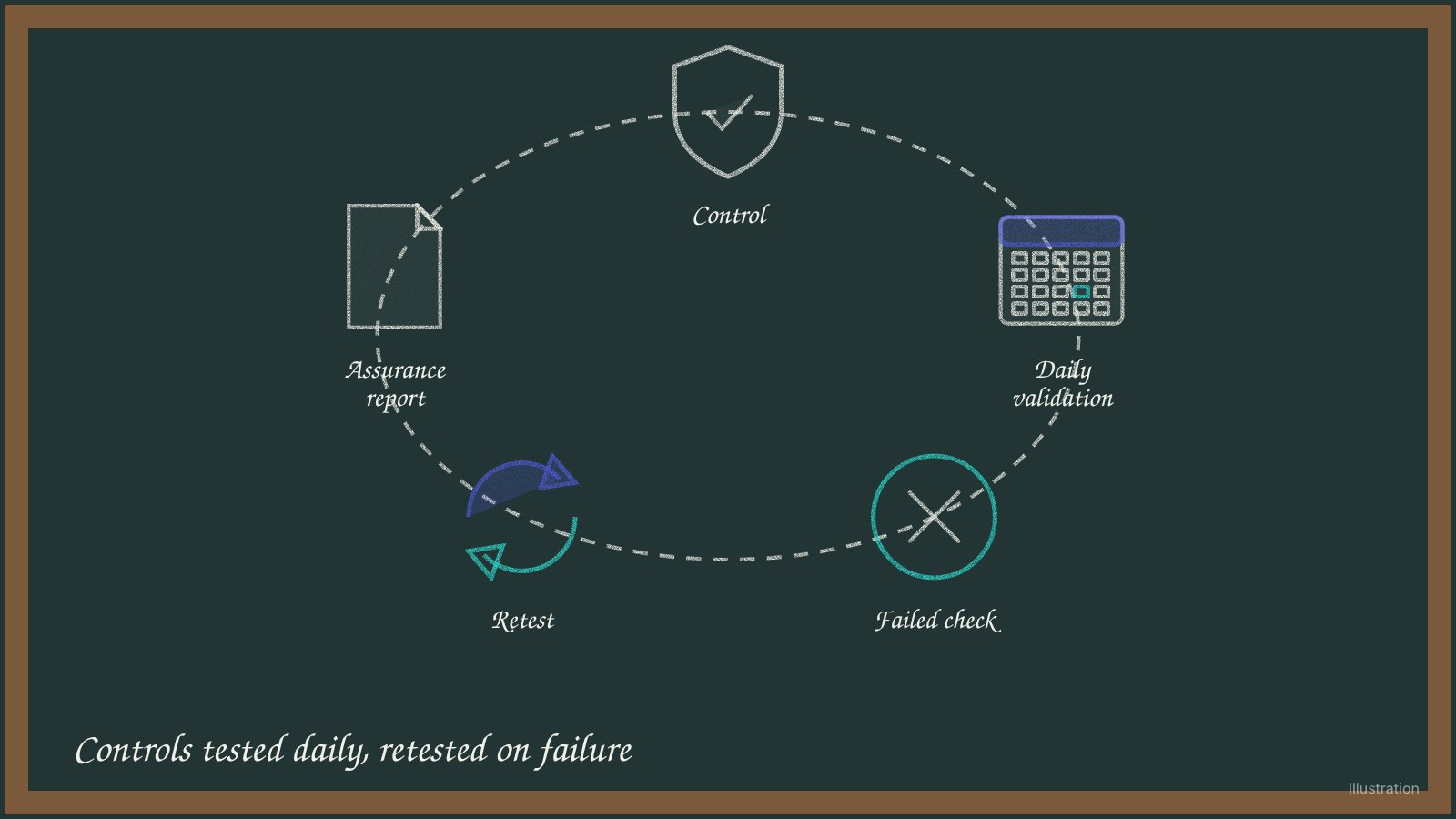
Posture is the foundation the rest of the security platform builds on. Attack paths use the same findings and the same operations-twin links to show where an exposed, exploitable asset leads. Assurance checks every day that sources are still being read and that the ledger still verifies, so a broken chain or a quiet connector is flagged the next morning. Incidents and response actions are chained into the same ledger, so the record of who approved what during an incident is as tamper-evident as the findings themselves. Because the ledger stores only pointers and hashes, adding it costs no duplicate storage, and records stay in the systems that own them.
A worked example, start to finish
Here's the CISO's fortnight, from board slide to audit.
Wednesday, 14:00. Instead of a collage, the CISO opens Security → Platform → Posture. Seven of the nine domains have sources connected. AI and data shows nothing connected, and says so. Security operations shows "source failed to read": the SIEM token expired on Monday.
14:15. The security engineer reconnects the SIEM. On the next read, the domain fills in.
14:30. Below the domains, the business-critical list shows 23 open findings on systems that tier 1 services depend on: 9 for Checkout, 14 for Billing. That's the slide: posture across nine domains, two gaps named honestly, and 23 findings that matter most, with the customers who reach those services.
Thursday. The board sees one screen and one list. The CISO commits to clearing the Checkout findings first.
Two weeks later. The auditors arrive. They pick a critical finding marked resolved in May and ask how they know the record wasn't edited.
10:00. The CISO opens Evidence → Verify now. Every chained record is re-read and its hash recomputed. Result: intact. Nothing was changed or deleted after it was chained.
10:10. A Security admin exports the ledger as JSON, with the hashing algorithm. The auditor runs their own script on their own laptop and gets the same result. They don't have to trust TicketResolve's screen.
10:30. The auditor follows the May finding through the ledger: first seen by the scanner, marked fixed with a commit link, then verified fixed by re-scan four days later. The timing is what the record says.
How to tell it's working
- Every domain you care about has a source, and failed reads are fixed promptly.
- The business-critical list is worked first, before the general backlog.
- Verify now is run regularly and reports intact.
- Auditors recompute the ledger themselves and get the same answer.
Do it in TicketResolve, step by step
Where: Security → Platform (/dashboard/security/platform). You'll need: access to TR Security Intelligence; exporting the ledger needs a Security admin. Full guide: Posture across domains and the evidence ledger.
- Open Posture. Each of the nine domains shows its sources and open findings. Domains with nothing connected say so. Connect at least one source per domain you care about.
- Check for failed reads. A domain showing "source failed to read" can't be trusted until it's fixed. Reconnect it first.
- Define business services in Business operations, if you haven't, so findings can be linked to what they endanger.
- Start with business-critical findings. The list under Posture shows open findings on systems a business service depends on, with the service, its tier and the customers who reach it. Work this list before the general backlog.
- Verify the evidence. Go to Evidence → Verify now. Every chained record is re-read and its hash recomputed. "Intact" means nothing was changed or deleted after it was chained; anything else is listed precisely.
- Export for an auditor. As a Security admin, export the ledger as JSON with the algorithm. The auditor can recompute it on their own machine, without trusting TicketResolve.
How to check it worked: your board slide is one Posture screenshot that's honest about its gaps, and the auditor's own recomputation matches your Verify now result.
Frequently asked questions
Does the posture page copy findings into a new store? No. Each finding stays where it is, and its domain comes from the tool that reported it.
Can TicketResolve edit the ledger without it showing? No. Any change to a record or to the chain itself shows up when the chain is recomputed, including by an auditor using the exported algorithm.
Does the business context change risk scores? No. Scores stay as reported; business context is shown beside them.
What does "Verify now" check? It re-reads every chained record, recomputes every hash and reports changed records, deleted records and any tampering with the chain.
What does "intact" mean? Nothing was changed or deleted after it was chained into the ledger.
Who can export the ledger? A Security admin.
What if a domain has no sources? It says so, rather than showing zero findings as if everything were fine.
Explore Topics
Written by
Ghulam Shabbir
Content creator and writer sharing insights and stories.