
When Customers Use Their Own Words: A Second, Reworded Search
If the first search finds only weak matches, TR-AI now searches again with the question reworded in help-article terms — finding the right article more often without ever raising a confidence score. Replies naming an API endpoint must match your documentation.
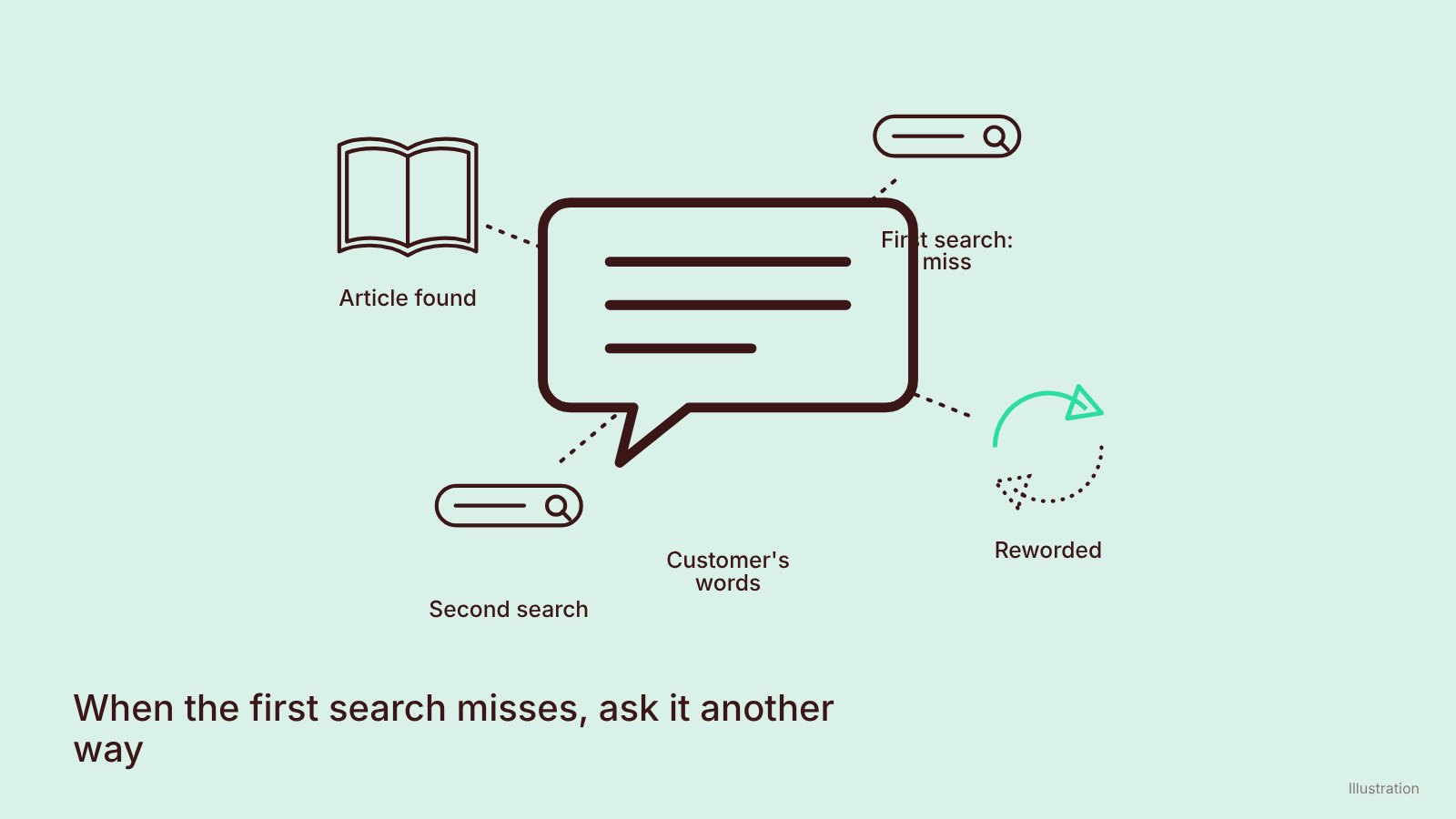
Customers don’t write like help articles. “I want to get all my stuff out into a spreadsheet” and “Export data to CSV” mean the same thing, but they share almost no words. When that happens, the first search comes back with only weak matches and the right article can be missed.
TR-AI now notices a weak first search and searches again, reworded. This post explains why the first search sometimes misses, how the second search works, what we measured, why it can't make a wrong reply more likely to be sent, and one thing we tried and decided not to ship. It also covers a new check on API endpoints in replies.
A few terms used in this post:
- Passage: a section of a help article, the unit TR-AI searches and reads.
- Similarity: how close a passage is to the question; it feeds the confidence score that decides whether a reply is sent.
- Retrieval: finding the passages TR-AI reads before it writes a reply.
- Benchmark: our fixed test set of help articles and customer-style questions, used to measure every retrieval change before release.
Why good answers start with the right passage
An AI support reply can only be as good as what the AI reads first. If the passage that answers the question never reaches it, one of two things happens: it writes a vague answer from general knowledge, which is held because no source backs it, or it gives up. Either way the customer waits for a person, even though the answer was in your help centre all along.
So retrieval — picking the passages — matters as much as the model. And retrieval has a stubborn weakness: it compares the customer's words with the article's words.
TicketResolve's search already does a lot to bridge that gap. It compares meaning, not only words, so "cancel my plan" finds "end your subscription". It also uses keywords, so a pasted error code like E1042 finds the article that mentions it exactly. It recognises synonyms, so "wire" finds "bank transfer". On most tickets that's enough.
But customers describe problems in their own terms, often vaguely, often with a story around them:
- "I want to get all my stuff out into a spreadsheet so my boss can look at it."
- "The thing at the top where you pick the team won't show my new people."
- "Hi, quick one, how do I make it so other people can't see my board?"
The articles that answer them are called "Export data to CSV", "Switch workspaces" and "Board privacy settings". Meaning-based search gets close, but on phrasing this far from the article, the best match can come back weak — below the level where TR-AI can rely on it.
How the second search works
When the best match of the first search is below 45%, TR-AI rewrites the question the way a help article would put it, and searches again.
The rewrite:
- keeps the words that matter — it drops greetings, hedging, pronouns and filler ("Hi, quick one, how do I make it so…");
- keeps quoted button names and error codes exactly as written — "the 'Share' button",
E1042; - adds the terms help articles use for everyday phrasing — "get my stuff out into a spreadsheet" also searches for export and CSV; "add my colleagues" also searches for invite members.
Then TR-AI combines the passages from both searches and picks the best ones to read.
No AI call is involved. The rewrite is a set of rules plus one extra embedding of the reworded question, done locally. It adds no AI cost and takes a few milliseconds — roughly ten for the embedding and a ranking pass over vectors that are already in memory.
Why only when the first search is weak
Running a second search on every ticket would be easy. It would also be pointless for most of them: when the first search already finds a strong match, a reworded search can only add noise. Limiting it to weak first searches means it runs where it can help and stays out of the way everywhere else.
On the benchmark, about a dozen of the 113 questions trigger it.
What we measured
Every retrieval change in TicketResolve is measured on the same benchmark before it ships. It's a fixed set of help articles and 113 customer-style questions written to be hard: typos, vague wording, jargon, pasted error codes, multi-part questions, long emails with signatures and quoted replies, and a few non-English tickets. For this release we also added a long FAQ article with sixteen questions, where the answering paragraph sits in the middle of the page, and four questions for it — the shape of a miss we had seen in production.
Two kinds of measure matter:
- Recall at k (R@k): a passage from the right article is among the top k.
- Answer at k (ans@k): a passage among the top k is from the right article and contains the answer itself, so the fact actually reaches TR-AI.
The second is stricter and closer to what customers experience. Finding the right article is good; finding the paragraph that answers the question is what makes a correct reply possible.
With the second search:
| Measure | Before | After |
|---|---|---|
| R@1 | 92.9% | 93.8% |
| R@3 | 96.5% | 97.3% |
| R@8 | 98.2% | 99.1% |
| ans@3 | 94.7% | 96.5% |
| ans@8 | 96.5% | 98.2% |
| Paraphrased questions, R@3 | 81.3% | 87.5% |
In plain words: the passage that answers the question now reaches TR-AI for 98.2% of benchmark questions, up from 96.5%. Paraphrased questions — the hardest kind, where the customer's wording shares little with the article — find their article in the top three 87.5% of the time, up from 81.3%.
These are benchmark numbers on our own test set, not measurements from your tickets. Your help centre, your customers' phrasing and your product's vocabulary are different. What the benchmark shows is that the change helps where it should — weak, paraphrased questions — and that every overall measure went up or stayed level.
It never makes a reply more likely to be sent
This is the most important design decision in the release.
A reworded search could, in principle, find passages that look like a better match for the reworded question than for what the customer actually wrote. If those inflated similarities fed the confidence score, the rewrite would make TR-AI more confident — and more likely to send a reply automatically — on exactly the tickets where it understood the customer least.
So the reworded search only decides which passages TR-AI reads. Every passage keeps the similarity it has to the customer's own words. The confidence score is exactly what it would have been with the same passages found by the first search.
The result: a better search leads to a better answer, and a better answer may score higher because it's genuinely backed by a relevant passage. But the rewrite itself never lowers the bar for sending anything. We check this in tests against the real search: the scores with and without the second search are compared, passage by passage.
We also re-ran our answer calibration set — 73 cases checking which replies would be sent — after the change. It was unchanged: precision 92.7%, recall 100%, and no wrong answer sent.
API endpoints are checked
The same release adds a check that matters for any product with an API.
A reply that names an API endpoint — for example GET /api/v2/tasks/{id} — is now held for review unless that endpoint appears in your documentation or in the customer’s question. IDs and placeholders are matched, so /tasks/42 counts as /tasks/{id}.
API endpoints are a classic place for an AI to be confidently wrong. Most REST APIs look alike, so /api/v2/tasks/{id}/comments is a plausible path whether or not it exists. A developer who copies a non-existent endpoint gets a 404 and loses trust in your documentation and your support at once.
The check runs in every route — replies backed by a source, replies sent on the AI's confidence, and general technical answers. It's part of the same product-claim gate that already holds replies naming menus, screens or buttons none of your sources contain.
What we measured and didn't ship
We also tried attaching the best other section of the same article to each top result, for long FAQ pages where the answer might sit a few paragraphs away from the passage that matched.
It made no difference on the benchmark, even with the new long FAQ added to it. Section-aware passages, plus the next passage that TicketResolve already attaches, were covering those cases. Adding more text to every prompt for no measured gain would only cost tokens and risk distracting the model, so it isn't part of this release.
We mention it because measuring and rejecting a change is part of the work. A retrieval change that sounds clever and does nothing on the benchmark is a change we don't ship.
A worked example, start to finish
This is an illustrative example.
A customer of a team-collaboration product writes: "Hey! My manager wants a copy of everything in our space so she can look at it in Excel. How do I get all my stuff out?"
First search. The best match is a passage about workspace storage limits, at 38%. Below 45%: weak.
The rewrite. Greeting and story dropped. Kept: "copy", "everything", "space", "Excel", "get … out". Matched to help-article terms: "get all my stuff out" adds export, data, download and CSV. The reworded question reads roughly "copy space Excel export data download csv".
Second search. The top passage is now "Export data to CSV" from the article on exporting, with the steps. It joins the passages TR-AI reads.
The reply. TR-AI explains the export steps and notes that CSV files open in Excel. The passage's similarity is measured against the customer's own words, not the rewrite, and the reply's score comes from how well that passage backs the answer. It clears the bar and is sent.
Without the rewrite, TR-AI would have read the storage-limits passage, written a vague reply, and held it. An agent would have answered it manually.
More real-world scenarios
These are illustrative.
A pasted error code. "Getting E1042 when I save, what does it mean?" The first search already finds the article with E1042 exactly, at a strong match. No second search runs.
A vague UI description. "The dropdown at the top where you pick the team doesn't show the new people." Weak first search; the rewrite drops the filler and keeps "dropdown", "pick", "team" and "new people", which is enough to find the article on switching teams and seeing new members.
A quoted button. "Where is the 'Archive' button gone?" The quoted word is kept exactly in the rewrite, which finds the article that mentions it after a recent interface change.
An invented endpoint. A developer asks how to list a task's comments via the API. The draft suggests GET /api/v2/tasks/{id}/comments. Your API docs list comments under a different path. The reply is held; the agent corrects it.
A question your help centre doesn't answer. The first search is weak, and so is the second. The rewrite can't find what isn't there. TR-AI's reply isn't backed, so it's held or handed to your team, as before.
What you can do to help retrieval
- Write article titles the way customers ask. "Export your data to a spreadsheet (CSV)" is found more easily than "Data portability".
- Put the answer near the top of each section. Passages are sections; an answer buried after three paragraphs of background is harder to find.
- Mention error codes and exact button labels. They're kept exactly and matched exactly.
- Document your API endpoints. Replies that name endpoints you haven't documented will be held.
- Check held drafts for "no source covers this question". It usually means an article is missing, not that search failed.
Frequently asked questions
Does the second search cost anything? No AI call is made. It adds one local embedding and a ranking pass — a few milliseconds.
Can the second search make TR-AI more confident? No. Passages keep their similarity to the customer's own wording, so confidence is computed exactly as before. A better answer may score higher because it's better backed — not because of the rewrite.
Will it always run? Only when the first search's best match is below 45%. On our benchmark, that's about a dozen questions in 113.
What if my articles use different terms? The rewrite adds common help-article terms for everyday phrasing — export, import, sign in, invite members and similar. It doesn't learn your product's own vocabulary, so the more plainly your articles name things, the better it works.
Why hold replies with undocumented endpoints? Because a confident, wrong endpoint wastes a developer's time and damages trust in your docs. If the endpoint is real, documenting it lets future replies go out automatically.
Update: endpoint names are now a note
Later on 22 November the send rule was simplified. A reply backed by a source at 88% or more that names an API endpoint your documentation doesn't contain is now sent with a note on the ticket instead of being held. Replies that contradict a source are still held or judged. The reworded search itself is unchanged. See One Send Rule: 88% From Your Sources, 90% From the Web or AI.
The short version
- When the first search is weak (below 45%), TR-AI searches again with the question reworded in help-article terms. No AI call.
- On our benchmark, the answering passage reaches TR-AI for 98.2% of questions (up from 96.5%); paraphrases find their article in the top three 87.5% of the time (up from 81.3%).
- The rewrite only changes which passages are read. Confidence still rests on the customer's own words.
- Replies naming an API endpoint that isn't in your docs or the question are held.
- A change that made no measured difference wasn't shipped.
Explore Topics
Written by
Ghulam Shabbir
Content creator and writer sharing insights and stories.