
The Fix Passed CI. Did It Fix the Problem, and Did It Slow Anything Down?
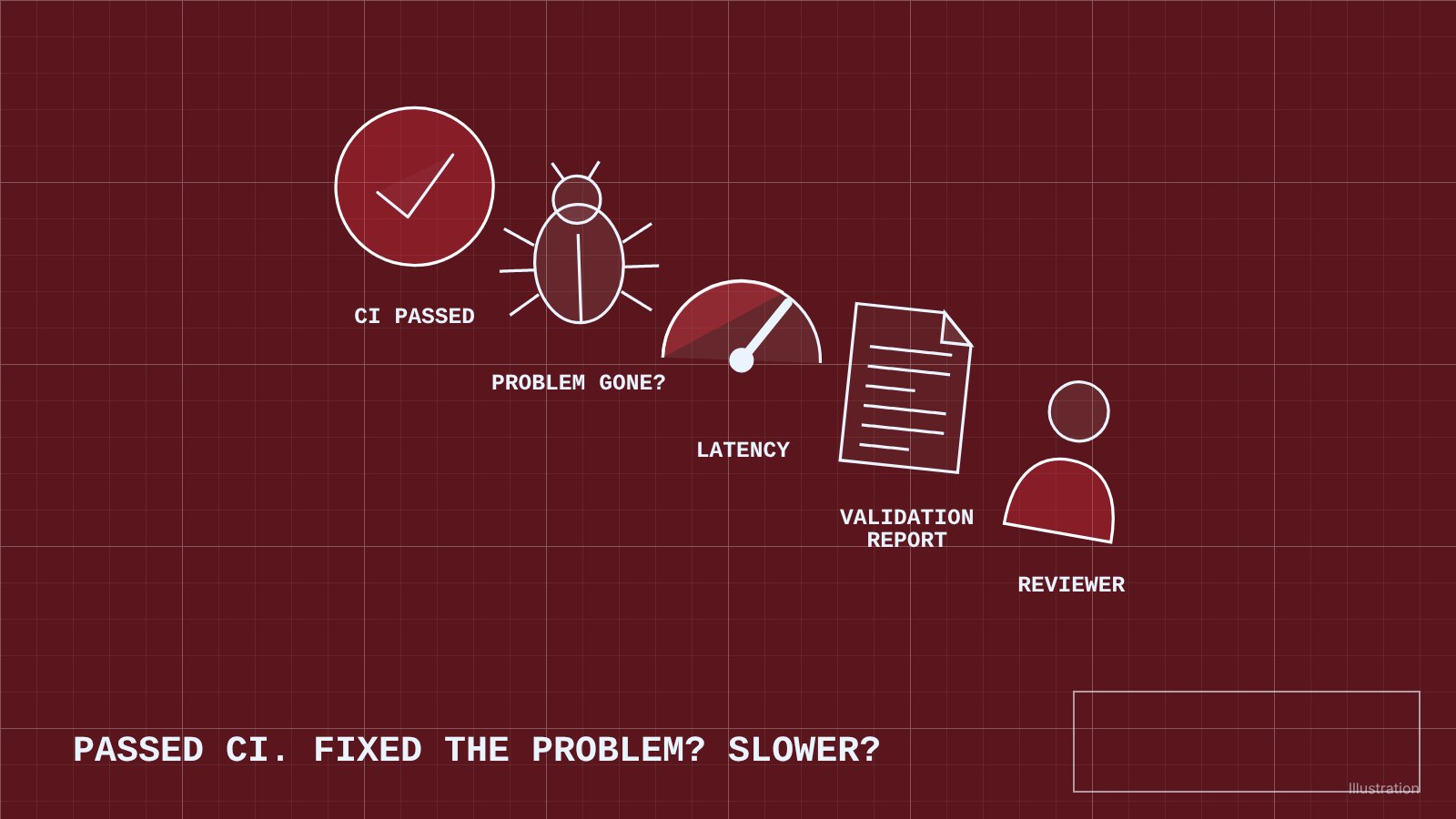
“CI is green” answers one question: did the tests that exist still pass? TicketResolve’s validation report adds expected API responses after the fix, before-and-after timings and the patch review, says “missing” instead of assuming a pass, and blocks the release when a required check fails.
"CI is green" answers one question: did the tests that exist still pass? It doesn't tell you whether the customer's request now returns the right answer, or whether it now takes three times as long.
Here's how that played out at a logistics software company. A customer reported that the shipment-tracking API returned the wrong delivery status for parcels split across two carriers. Engineering wrote a fix: look up both carriers and merge the results.
- CI: green. All 2,400 existing tests passed.
- Code review: approved. The change looked tidy.
- Release: promoted on Tuesday.
- Wednesday: the customer confirmed the status was now right. Good.
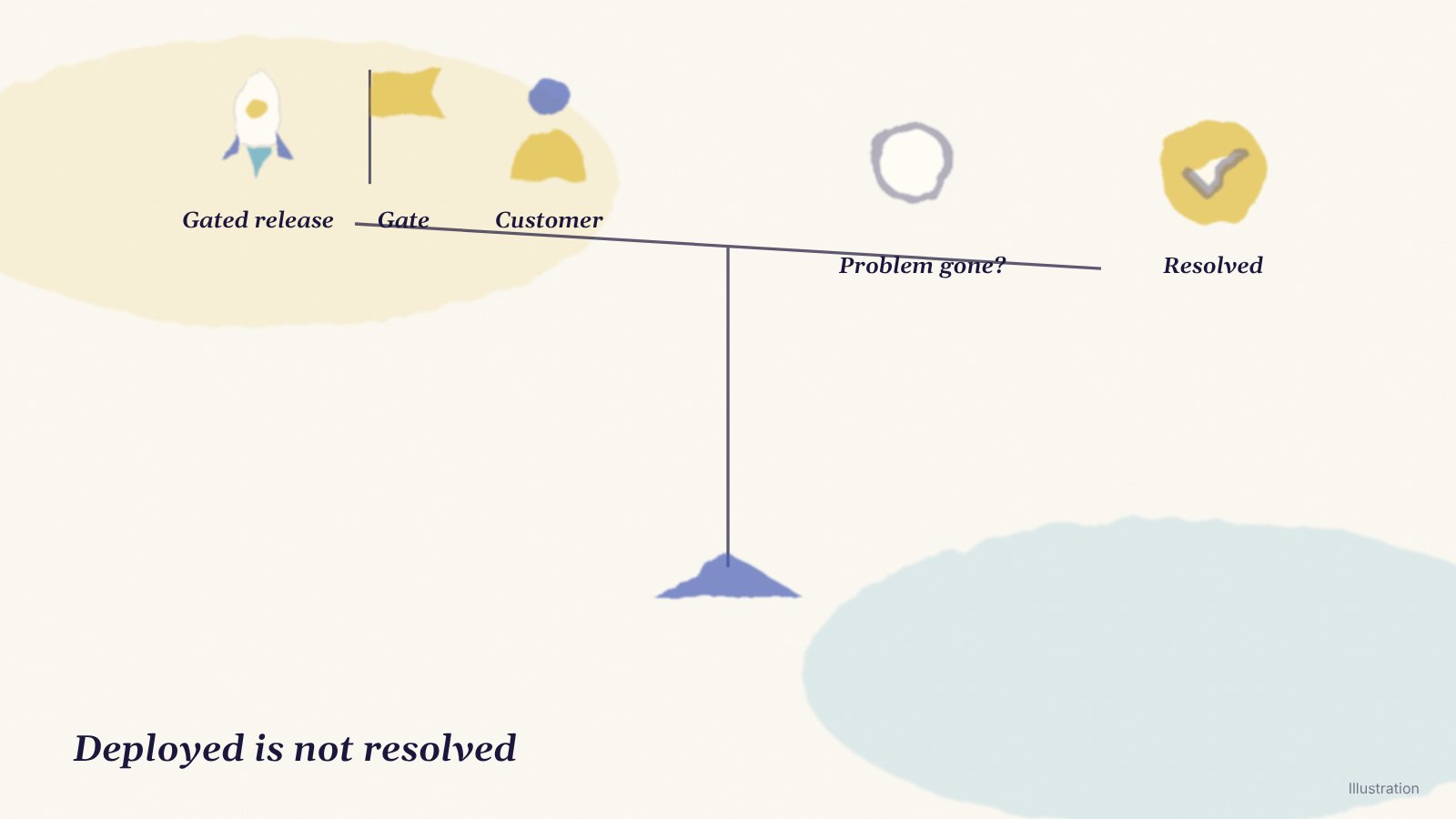
- Thursday: a different customer complained the tracking page had become painfully slow. The fix now called both carriers for every parcel, not just split ones. The tracking endpoint went from 180 ms to 1.4 seconds.
Nothing in CI measured time. Nothing re-ran the customer's actual request. The fix fixed the problem and created a new one, and both facts were knowable before release.
First, the basics
- CI (continuous integration) runs tests when code changes. Green means they passed.
- Targeted tests are the ones relevant to this fix. The base branch is the code before it; comparing tells you which failures the change caused.
- A mandatory check must run for a release to proceed.
- The sandbox scenario is the set of requests that reproduced the customer's problem.
- An expected response is what a request should return after the fix.
- A performance regression here is a request that got at least 1.5× slower and at least 200 ms slower.
- A patch review checks the code change for problems; a blocking finding must be fixed or overridden with a reason.
- The release orchestrator controls promotion; a gate is a check it must pass.
Why does this matter? Fixes are where regressions are born: a change made under pressure, tested against what already existed. A report that checks the customer's own requests, the timings and the review, and refuses to call missing checks "passed", catches the second problem before the first one is closed.
The problem, in plain terms
- Green CI only checks existing tests.
- The customer's request isn't re-run after the fix.
- Timings aren't compared, so slowdowns ship.
- Missing checks are treated as passing.
- Nothing stops a release when something is wrong.
One report per fix
TicketResolve's validation report puts together the checks that actually ran on a proposed fix:
- Targeted tests in your CI, compared with the base branch. It separates failures the change caused from failures that were already there, and flags mandatory checks that didn't run.
- Expected API responses. The sandbox scenario that reproduced the problem is run again after the fix, and every request must return what it should.
- Performance. Each request's time before and after the fix. A request that gets 1.5× slower and at least 200 ms slower is a performance regression.
- Patch review. Any blocking finding a reviewer hasn't overridden with a reason.
It can stop a release
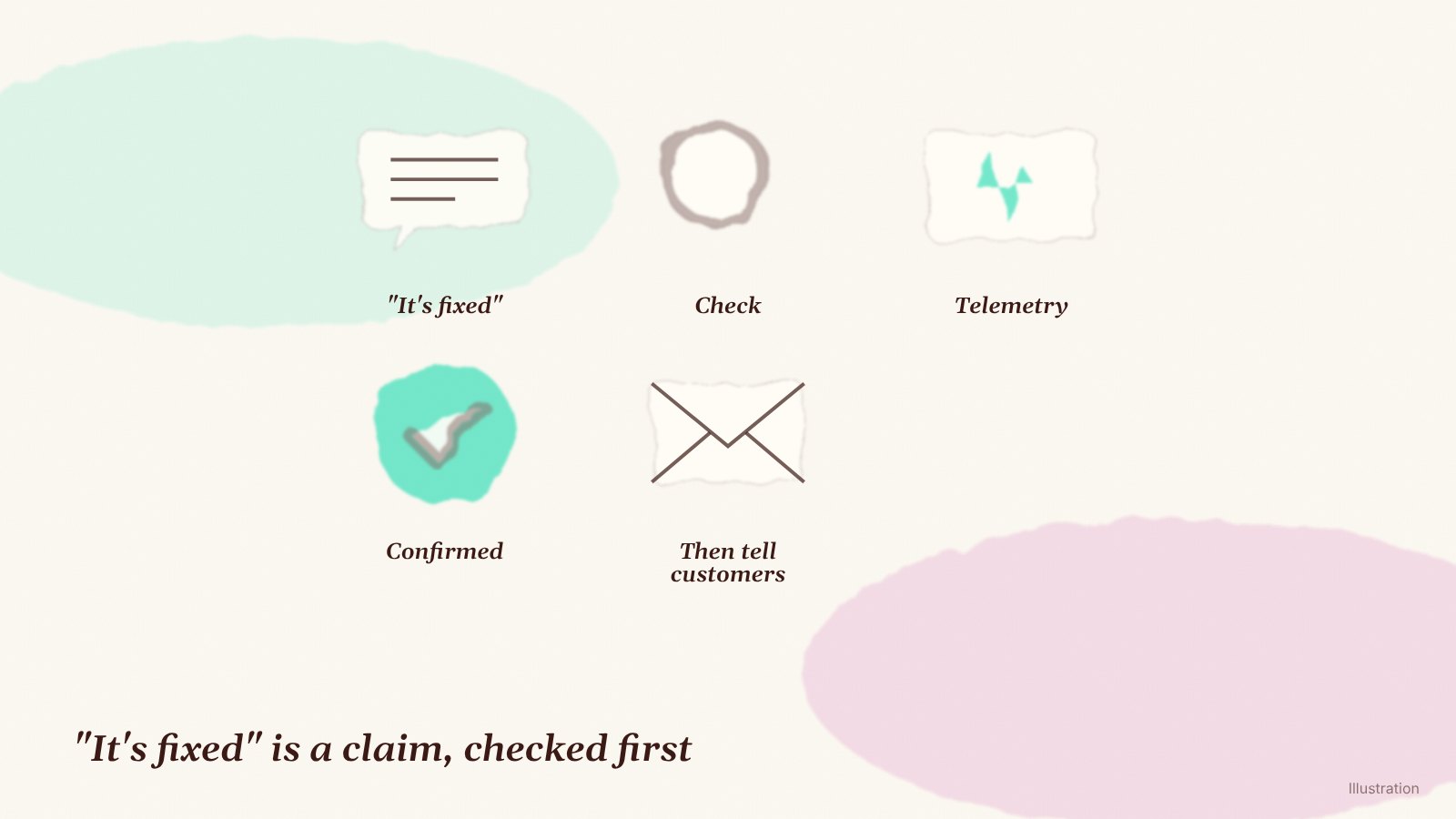
If a required check fails, the report is blocked, and the release orchestrator gets a failing "Regression validation" gate. The fix can't be promoted until the problem is fixed or the evidence changes.
Missing isn't passing
If no sandbox run exists, or CI hasn't run on the fix branch, the report says missing for that check. A report with missing checks is "incomplete", not "passed". Nothing is assumed to have worked because nobody checked.
Safe reproductions
The sandbox scenarios behind these checks refuse real-looking personal data: e-mail addresses, card numbers, tokens and live keys. Use synthetic fixtures or placeholders instead. An environment whose address looks like production needs a second person's approval.
A worked example, start to finish
Here's the split-carrier fix again, with the validation report. The details are illustrative.
Monday 10:00, reproduction. The support engineer builds a sandbox scenario from the customer's problem, with synthetic data: three tracking requests, one for a split parcel and two for ordinary ones. Against the current release, the split-parcel request returns the wrong status; the ordinary ones return correctly in about 180 ms.
Monday 15:00, the fix. Engineering pushes the fix branch. CI runs targeted tests, compared with the base branch: all pass; one failure already existed on base and is marked as such. No mandatory check missing.
Monday 15:20, the report.
- Targeted tests: passed.
- Expected API responses: the scenario re-runs after the fix: the split-parcel request now returns the correct status. All three requests return what they should.
- Performance: the two ordinary requests: 180 ms → 1,400 ms: more than 1.5× slower and more than 200 ms slower. Performance regression.
- Patch review: no blocking findings.
Report: blocked. The release orchestrator gets a failing Regression validation gate. The fix can't be promoted.
Monday 16:00. The engineer sees why immediately: the second carrier lookup runs for every parcel. She changes it to run only when the first carrier reports a split.
Monday 16:30, the report again. Responses: all correct. Performance: ordinary requests 185 ms (within limits); the split-parcel request 410 ms, a new request type with no "before" to regress from. Patch review: clear. Report: passed. The gate passes.
Tuesday. Promoted. Wednesday, the customer confirms the fix. Thursday, nobody complains about speed.
A different fix, the same week. A small change has no sandbox scenario. The report says missing for expected API responses and incomplete overall, not passed. The engineer builds a scenario before promoting.
Five more real-world scenarios
1. A failure already on base
Situation. A test fails on both the base branch and the fix branch.
How TR handles it. It's marked as already there, not caused by the change.
2. A mandatory check didn't run
Situation. The security scan didn't run on the fix branch.
How TR handles it. It's flagged; the report isn't passed.
3. Slightly slower
Situation. A request goes from 100 ms to 160 ms.
How TR handles it. Not a performance regression: it needs 1.5× and at least 200 ms slower.
4. A reviewer overrides a finding
Situation. A blocking patch-review finding is a false alarm.
How TR handles it. A reviewer overrides it with a reason; it no longer blocks.
5. Real data in the scenario
Situation. Someone pastes a real customer request into the scenario.
How TR handles it. The sandbox refuses it; use synthetic fixtures.
Reading a blocked report
A blocked report tells you which check failed and why. Work through it in this order:
- Expected responses first. If the customer's own request still returns the wrong thing, the fix hasn't fixed the problem. Nothing else matters until that's right.
- Then targeted tests. Separate the failures the change caused from those already on the base branch. Only the first kind is yours to fix now.
- Then performance. A regression names the request and its before and after times. Often the fix does more work than it needs to, as in the example above.
- Then the patch review. A blocking finding either needs a change, or an override with a reason a colleague would accept.
When you've fixed something, push again and the report is rebuilt from the new runs. The gate follows the report, so there's nothing to unblock by hand.
Why "missing" is so strict
It would be easy to treat a check that didn't run as harmless, especially for a small fix. But small fixes are exactly where nobody builds a reproduction, and where a slowdown or a wrong response slips through. Calling the report "incomplete" until every check has run is what makes "passed" mean something.
Before and after
Before. Green CI, a tidy review, the right status for one customer, and a tracking page eight times slower for everyone else.
After. The customer's requests re-run after the fix, timings compared before and after, a blocked gate on a 1.4-second regression, a better fix the same afternoon, and "incomplete" instead of "passed" when a check was missing.
How to tell it's working
- Blocked reports catch problems before promotion.
- Incomplete reports get their missing checks, rather than being waved through.
- Fewer post-release slowdowns from fixes.
Who it's for
- Engineers shipping fixes for customer problems.
- Release managers who own promotion gates.
- Support engineers who want the customer's own request checked.
How it fits with the rest of TicketResolve
The report brings together CI results, the reproduction sandbox, and patch review, and feeds the release orchestrator. It's the "validation report" step on the path from authorization to pull request.
What the thresholds mean
A performance regression needs both conditions, 1.5× slower and at least 200 ms slower, so tiny endpoints don't trip it with noise (10 ms to 16 ms is 1.6× but meaningless) and slow endpoints don't hide a big absolute change behind a small ratio. If your service has tighter performance needs, treat the report's timings as the floor and add your own checks in CI.
Mistakes to avoid
- Reading "incomplete" as "passed".
- Skipping the sandbox scenario for small fixes.
- Overriding patch-review findings without a real reason.
Do it in TicketResolve, step by step
Where: the investigation's fix, before promotion (/dashboard/investigate). You'll need: a sandbox scenario that reproduced the problem; CI connected; the release orchestrator for gating. Full guides: TR Investigate: from a ticket to a verified fix and API workbench: reproduce a customer's API call.
- Reproduce the problem in the sandbox with synthetic data.
- Push the fix branch so CI runs targeted tests against the base branch.
- Re-run the scenario after the fix.
- Read the report: targeted tests, expected responses, performance, patch review.
- Fix what's blocked, or override patch-review findings with a reason.
- Fill in what's missing until the report is complete.
- Promote once the Regression validation gate passes.
How to check it worked: the report shows each check as passed, failed or missing, and the gate's status in the release orchestrator.
Frequently asked questions
What does the report check? Targeted tests against the base branch, expected API responses, before-and-after timings, and the patch review.
What counts as a performance regression? A request at least 1.5× slower and at least 200 ms slower.
What if CI didn't run? The check says missing; the report is incomplete, not passed.
Can it stop a release? Yes. A failed required check blocks the report and fails the Regression validation gate.
How are pre-existing failures handled? They're separated from failures the change caused.
Can a reviewer override a finding? Yes, with a reason.
Can scenarios use real data? No. They refuse real-looking personal data and secrets.
What about production-looking environments? They need a second person's approval.
What should I fix first in a blocked report? Expected responses, then targeted tests, then performance, then the patch review.
Do I need to unblock the gate by hand? No. The report is rebuilt from new runs and the gate follows it.
Explore Topics
Written by
Ghulam Shabbir
Content creator and writer sharing insights and stories.