
Which Help Articles Actually Solve Problems? Measuring Knowledge by Outcomes
Your most-viewed help article can be the reason customers keep writing back. Knowledge effectiveness scores each article by what happened after TR-AI used it, verified, failed or came back, recommends a specific fix with its evidence, and sends every change through approval.
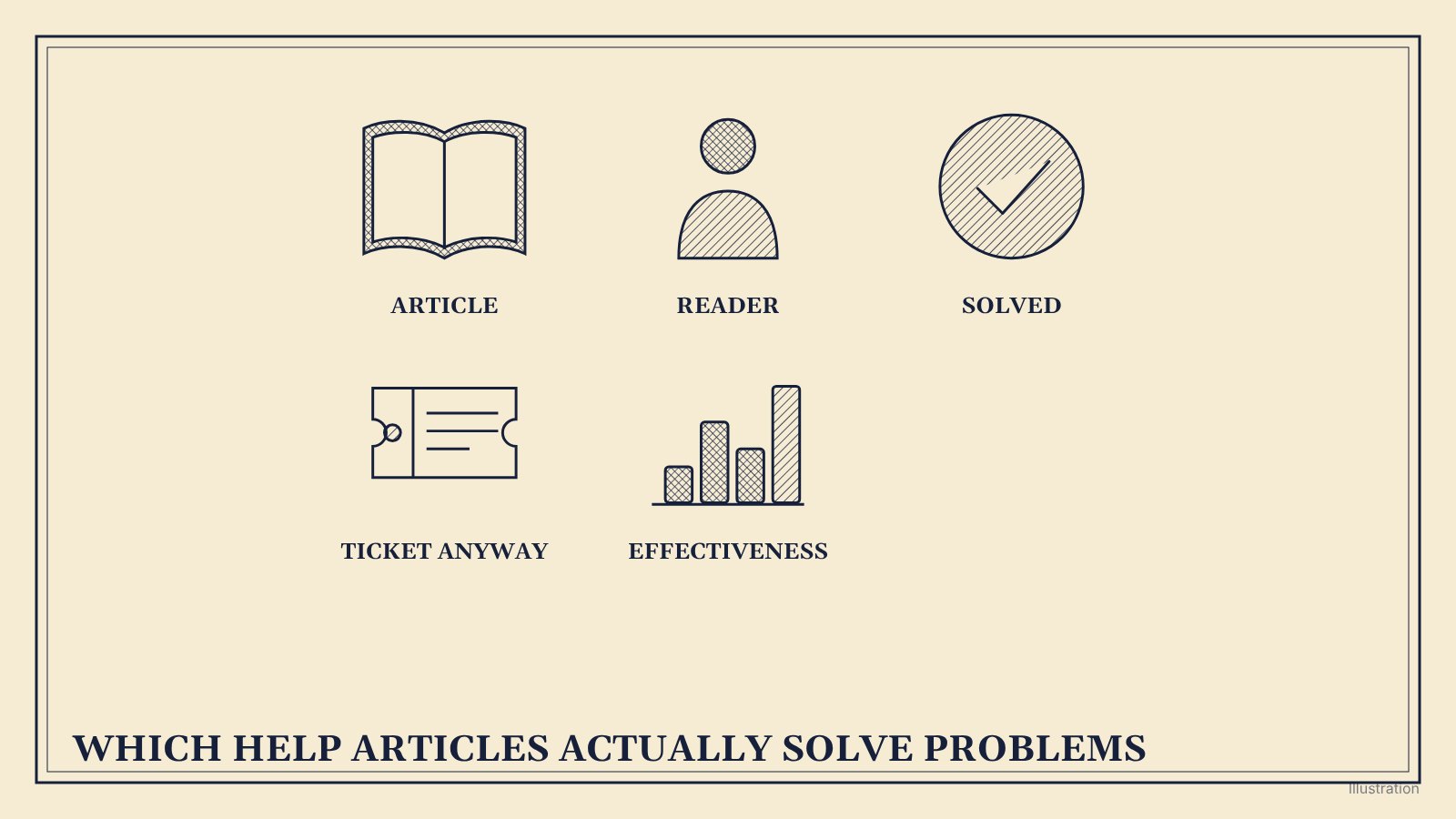
An article can be the most-viewed page in your help center and still be the reason customers write back. Views and "was this helpful?" buttons measure attention, not whether the problem went away.
Here's how that plays out at a company that sells a point-of-sale system to cafés and restaurants. The knowledge manager, Maeve, reviews her help-centre analytics every month:
- "Connecting your receipt printer" is the most-viewed article by far, with a respectable "was this helpful?" rating.
- She concludes it's one of the best articles in the help centre and moves on.
- Meanwhile, the support team quietly dreads printer tickets. TR-AI answers them from that article, customers follow the steps, and a few days later they write back: "Still not printing."
The article was written before the latest printer model came out. Its steps are right for the old model and silently wrong for the new one, which needs a firmware update first. Views went up because customers kept coming back to the article, not because it worked.
First, the basics
- A knowledge article is a page in your help centre or knowledge base.
- Citing means TR-AI relied on an article to write an answer.
- An outcome is what happened after an answer: verified, confirmed by the customer, failed, reopened or recurring.
- Knowledge effectiveness joins articles to the outcomes of answers that used them.
- A failure rate is the share of answers using an article that failed, were reopened or recurred.
- Stale means knowledge health flags an article as out of date.
- Conflicting documentation means an article contradicts another source.
- Knowledge governance is where changes to your knowledge base are approved.
Why does this matter? AI answers are only as good as the articles behind them. Measuring articles by whether their answers worked, instead of by views, shows you which articles are quietly causing repeat tickets, and which ones are doing their job.
The problem, in plain terms
- Views measure attention, not success.
- "Was this helpful?" is answered by few people, often before trying the steps.
- Failing articles keep getting used by AI answers.
- Duplicates and contradictions pile up unnoticed.
- Article changes go live without review.
Scored by what happened
Every answer TR-AI gives records which articles it relied on, and Resolution intelligence records what happened afterwards: verified, confirmed by the customer, failed, reopened or recurring. Knowledge effectiveness joins the two. For each article, over 30 or 90 days:
- how many answers used it
- how many of those were verified or confirmed by the customer
- how many failed, were reopened or recurred
- how many customers came back about the same problem
- the failure rate, and how it moved against the previous period
The overall score counts verified and confirmed answers fully, still-unverified ones as half, and failures as zero. It isn't shown until there are enough answers to mean something.
Recommendations with their evidence
Each recommendation says why:
- Improve this article. A large share of the answers that used it failed.
- Add the missing troubleshooting steps. Customers keep coming back after it.
- Resolve the conflicting documentation. It's flagged as contradicting another source.
- Review it. Knowledge health flags it as stale.
- Merge duplicates. Several sources share the same title.
- Write what's missing. Features and recurring problems no article mentions.
Changes still go through approval
Fixing an article from here, or from a corrected failed answer, files the change in Knowledge governance, where someone else approves it before your knowledge base changes.
A worked example, start to finish
Here's Maeve's month, with knowledge effectiveness. The figures are illustrative.
Monday, the report. She opens Quality → Resolution intelligence → Knowledge effectiveness for the last 30 days.
"Connecting your receipt printer."
- Used by 84 answers.
- Verified or confirmed: 29.
- Failed, reopened or recurred: 41.
- Customers who came back about the same problem: 33.
- Failure rate: about half, up against the previous period.
- Recommendations: Improve this article (a large share of answers that used it failed) and Add the missing troubleshooting steps (customers keep coming back after it).
Monday, the investigation. Maeve reads the failed answers. Almost all mention the new printer model. She checks with the hardware team: the new model needs a firmware update before pairing.
Monday, the change. She writes new text: a short section at the top, "Using the TP-200? Update its firmware first", with the steps. She files it from Knowledge effectiveness. It goes to Knowledge governance, where the hardware lead, Joon, approves it. Only then does the knowledge base change.
Other recommendations the same day.
- "Refunds and voids" and "How to void a sale": Merge duplicates; several sources share the same title.
- "Tipping settings": Resolve the conflicting documentation; flagged as contradicting the release notes.
- "Offline mode": Review it; knowledge health flags it as stale.
- Write what's missing: split bills by seat comes up in recurring problems, and no article mentions it.
A month later. "Connecting your receipt printer" shows a much lower failure rate, down against the previous period. The printer tickets the team dreaded mostly stop coming back.
"Gift cards", a newer article, has only a handful of answers. Its score isn't shown yet: there aren't enough answers to mean something.
Five more real-world scenarios
1. A popular article that works
Situation. An article is used often and almost always verified.
How TR handles it. High score, no recommendation. Leave it alone.
2. A rarely used article
Situation. An article was used by two answers this month.
How TR handles it. The score isn't shown until there are enough answers.
3. Unverified answers
Situation. Many answers haven't had an outcome yet.
How TR handles it. They count as half in the overall score.
4. A recurring problem with no article
Situation. Customers keep asking about a feature no article covers.
How TR handles it. Write what's missing.
5. A fix from a corrected answer
Situation. A reviewer corrects a failed answer and proposes new text for the cited article.
How TR handles it. It's filed in Knowledge governance for someone else to approve.
Before and after
Before. The most-viewed article judged the best, a quietly wrong set of steps, and printer tickets coming back every week.
After. The article's failure rate visible, two specific recommendations with evidence, a firmware section approved by the hardware lead, and the failure rate down the next month.
How to tell it's working
- Failure rates fall on the articles you fix.
- Duplicates and conflicts get resolved, not just noticed.
- Repeat contacts about the same problem go down.
Who it's for
- Knowledge managers and technical writers.
- Support leads who see the same tickets coming back.
- Product teams looking for documentation gaps.
How it fits with the rest of TicketResolve
Knowledge effectiveness is part of Resolution intelligence, using the articles TR-AI cites and the outcomes of its answers. It uses knowledge health for stale and conflicting flags, sends changes to Knowledge governance, and works alongside correcting failed answers and repeat contacts.
Why "unverified counts as half"
An answer with no outcome yet isn't a success or a failure; it's unknown. Counting it as zero would punish articles for being used recently. Counting it as a full success would flatter them. Counting it as half keeps it in the picture without letting it decide the score, and as outcomes arrive, the score moves towards the truth.
Fixing an article well
Most failing articles don't need a rewrite. They need one missing step, a warning for a specific version, or a link to the article customers actually needed. Read the failed answers before you edit: they usually point at the same gap. Put the fix where customers will see it first, often at the top. And after the change is approved, check the article again next month; the failure rate tells you whether the fix worked.
A monthly knowledge review
Knowledge effectiveness is most useful as a short, regular habit rather than a one-off audit.
- Start with the biggest movers. Sort by change against the previous period. An article whose failure rate jumped this month often points at a product change nobody documented.
- Then the highest failure rates among articles with enough answers to score. These are the ones costing you the most repeat tickets.
- Read three failed answers per article. You'll usually see the same gap three times: a missing step, a version the article doesn't mention, or a question the article never answers.
- Clear the easy recommendations. Merging duplicates and resolving conflicts are often quick, and they make every other answer more reliable because TR-AI stops choosing between two versions of the truth.
- Pick one "write what's missing" topic. New articles take longer; one a month adds up.
- Check last month's fixes. If an approved change didn't move the failure rate, the gap was somewhere else.
Where views still help
Views aren't useless. An article with high views and a low failure rate is doing exactly what it should. An article with high views and a high failure rate is your top priority, because many customers are reading it and it isn't working. And an article with low views but a high failure rate might simply be hard to find. Reading views next to outcomes tells you far more than either alone.
Mistakes to avoid
- Judging articles by views.
- Rewriting everything instead of fixing the gap.
- Skipping approval for "small" changes.
Do it in TicketResolve, step by step
Where: Quality → Resolution intelligence → Knowledge effectiveness (/dashboard/resolution-intelligence); changes in Knowledge governance (/dashboard/knowledge-governance). You'll need: a connected knowledge base; answers with outcomes. Full guides: Resolution intelligence and Your knowledge base: sources, sync and search.
- Open Knowledge effectiveness and choose 30 or 90 days.
- Sort by failure rate or by change against the previous period.
- Open an article to see answers that used it, outcomes and customers who came back.
- Read the recommendation and its evidence.
- Read the failed answers to find the gap.
- Propose the change; it goes to Knowledge governance.
- Have someone else approve it, then check the article next period.
How to check it worked: the article's failure rate falls against the previous period after the approved change.
Frequently asked questions
How are articles scored? By the outcomes of answers that used them, not by views.
What periods can I look at? 30 or 90 days, compared with the previous period.
How are unverified answers counted? As half; verified and confirmed count fully, failures as zero.
Why isn't an article's score shown? There aren't enough answers yet to mean something.
What recommendations are there? Improve, add missing steps, resolve conflicts, review, merge duplicates, and write what's missing.
Does each recommendation say why? Yes. Each one shows its evidence.
Can I change an article from here? You can propose a change; it's filed in Knowledge governance.
Who approves changes? Someone else, in Knowledge governance, before anything changes.
Does it replace "was this helpful?" ratings? It measures something different: whether the answers that used the article actually worked.
Explore Topics
Written by
Ghulam Shabbir
Content creator and writer sharing insights and stories.