
Adaptive Tests That Say How Sure They Are
An adaptive test picks each question from the answers so far, so it can measure as precisely with fewer questions. Ours also reports how precise each result is, and refuses to call an uncalibrated estimate a percentile.
Release 7.153.0 adds adaptive tests to the AI Recruitment Manager. It's the first release of the Intelligence Engine, which builds on the assessment engine already in the product.
Why adaptive
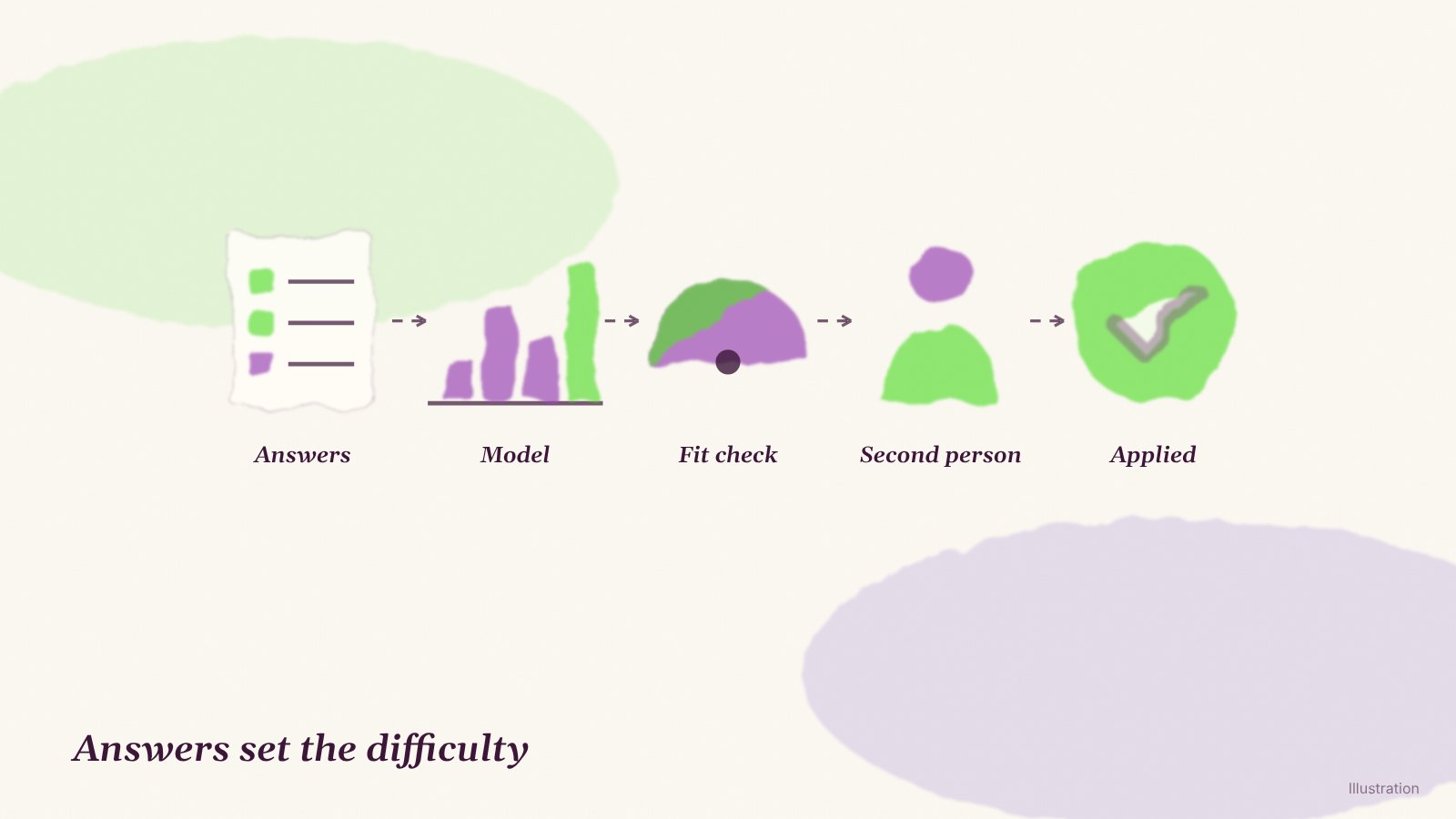
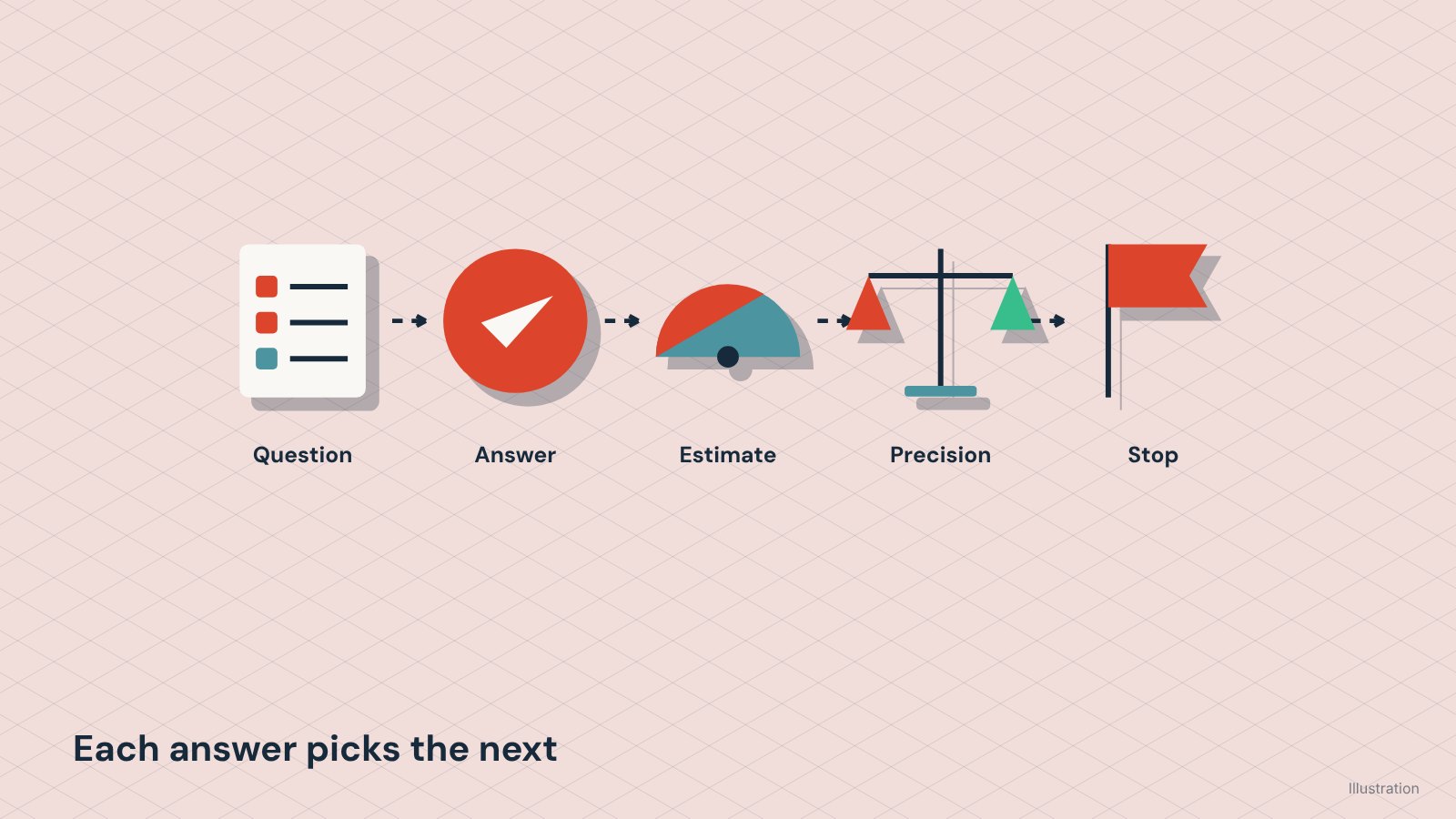
A fixed test gives everyone the same questions. For a strong candidate, the easy ones tell you almost nothing; for a candidate who is struggling, the hard ones don't either. An adaptive test chooses each question from the answers so far. A right answer moves it to harder questions, a wrong one to easier. Most questions are then pitched where they tell you the most about that person, so a shorter test can be as precise as a longer fixed one.
How it works
The engine uses the Rasch model, one of the simplest models in item response theory. A candidate's ability and a question's difficulty sit on the same scale, and the chance of a right answer depends on the gap between them. After every answer:
- Estimate. It updates the ability estimate and its standard error, which says how sure the estimate is.
- Next question. It picks the next question from the most informative unused ones, at random among the closest few, so the same items aren't shown to everyone. It also keeps the sections in balance, so a reasoning test doesn't turn into a numbers test.
- Stop or continue. It stops at the maximum number of questions, or earlier once the standard error reaches the target the test's author set.
Candidates are told before they start that the test is adaptive. They answer one question at a time and can't go back, because each answer has already chosen the next question. The questions are picked as they go, but from a pool fixed when the invitation was sent.
What it doesn't pretend
Adaptive testing is only as good as its question difficulties. Today those come from each question's easy, medium or hard rating, not from analysing thousands of real answers. So every result says so: the estimate orders candidates on this test only, and it isn't a norm or a percentile.
Calibrating difficulties from recorded answers is a later release. Until every question in a test's pool is calibrated, the label stays. The assessment also keeps its own validation status, and the result keeps the reminder that it is one input among others, never the only basis for a decision.
What the recruiter sees
The result shows:
- the estimate, its standard error and the number of questions;
- why the test stopped;
- each step: which question, how difficult, right or wrong, and the estimate after it;
- the usual question-by-question scoring.
Nothing about the estimate is hidden in a single number.
Checked by simulation
Before shipping, we simulated 200 candidates of known ability answering a 120-question bank under the same model. The adaptive estimates tracked their true ability closely, and most tests stopped at the precision target before the maximum. That shows the engine does what the model says. It isn't evidence that a particular test predicts job performance; that takes real outcome data, which is another planned release.
Explore Topics
Written by
Ghulam Shabbir
Content creator and writer sharing insights and stories.