
Fixed Once, Kept Fixed: Regression Tests From Every Verified Incident
A bug that comes back is worse than the first time. Phase 3 of TicketResolve 7.0 turns each verified incident into a regression test that has to prove it catches the bug, follows every issue from the customer’s ticket to the commit and release that fixed it, checks code owners before release, and gives support managers one queue of what each issue is waiting on.
A bug that comes back is worse than the first time. The customer already reported it, support already explained it, engineering already "fixed" it. Now everyone has to start over, and the customer trusts you a little less.
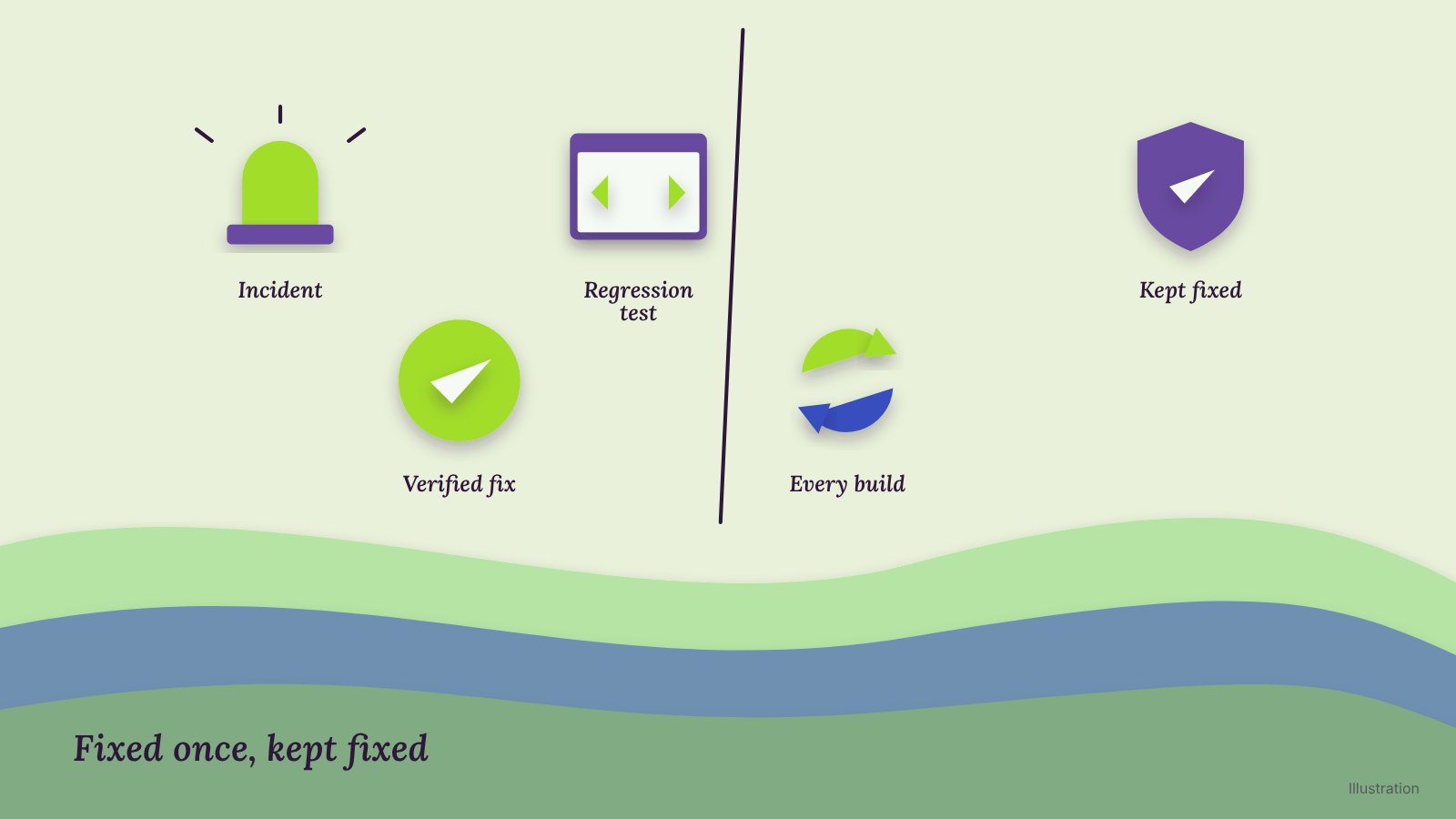
Phase 2 of TicketResolve 7.0 made sure a fix counts only once the customer's problem is verified gone in production. Phase 3 makes sure it stays gone.
Here's how bugs come back at a typical software company. In March, a customer reports that invoices with a 0% tax rate fail to export. It's fixed and verified. The pull request added a test, exports invoices, which passes. In June, a refactor of the tax module breaks 0% invoices again. The exports invoices test still passes: it never used a 0% tax rate, so it never tested the bug. The customer reports it again. Support finds the March ticket. Engineering is embarrassed.
Meanwhile, the support manager asks "Where is the June ticket?" every day for a week, and gets a different answer from each person.
First, the basics
- A regression is a bug that comes back after it was fixed. A regression test is meant to catch it if it does.
- Verified (post-deployment verification) means the customer's problem was confirmed gone in production.
- The original failure is the reproduction of the customer's problem, kept as the baseline.
- A sandbox scenario is a set of requests that reproduced the problem.
- Adopted means a test has joined your suite. Preserved means it's still there and passing.
- The base branch is your main code line.
- The investigation graph links a customer issue to everything related: tasks, pull requests, commits, tests, releases, deployments.
- A lifecycle stage is where an issue is on the path from investigating to verified.
- CODEOWNERS is a file naming who owns which code; code-owner review requires one of them to approve.
Why does this matter? A test that passes proves nothing unless it would have failed without the fix. Proving each regression test catches its bug, keeping it in the suite, and watching that it stays, is what turns "fixed once" into "kept fixed".
The problem, in plain terms
- Tests are added that never caught the bug.
- Tests get deleted or stop running, unnoticed.
- Issues can't be followed from ticket to commit to release.
- Nobody knows who has the next move.
- Code owners are skipped on sensitive changes.
A test for every verified incident
When post-deployment verification reaches fix verified, TicketResolve proposes regression tests from what the investigation already has:
- the test the fix's pull request added
- the test made from the original reproduction of the customer's problem
- the sandbox scenario that reproduced it
A test that passes proves very little on its own. It might pass whether or not the bug is there. So each candidate is validated against the original failure:
- Confirmed: it failed without the fix and passes with it
- Passes only: it passes with the fix, but nobody has seen it fail without it
- Didn't fail before: it probably doesn't test this bug at all
- Fails with the fix: something is still wrong
- Waiting: no run with the fix yet
A test made from the reproduction counts as confirmed only after a run with the fix passes. It was built from a run that showed the bug, so the "before" half is already known. A test from the pull request usually starts as "passes only", because CI ran it with the fix but not on the code before it, and TicketResolve says so rather than guessing.
Reviewed by someone else, then kept
Someone other than the person who proposed the test or wrote the fix has to approve it. A rejection needs a reason. To approve a "passes only" test, the reviewer has to acknowledge that it has never been seen failing and say why it's still worth keeping.
An approved test joins the suite in the way that fits its source:
- A pull request test is adopted only after your reviewers have merged the pull request and the file is on the base branch. TicketResolve never merges.
- A reproduction test stays active in the regression library, so it runs with every test plan and every post-deployment verification.
- A sandbox scenario is kept to re-run before later releases.
Then TicketResolve keeps checking. Every six hours, adopted tests are checked again. Preserved means the test is still in the suite and passing. Failing means the regression may be back. Removed means someone deleted the test or the file is gone from the branch. Each check records how many releases have shipped since the test was added.
From the ticket to the commit that fixed it
The investigation graph follows the whole path: engineering task, pull request, head commit, latest test run, releases, deployments, post-deployment verification, and the regression tests left behind.
Every link still says how certain it is and which record it comes from. A green test run supports the change, while a failing one speaks against it. Only a post-deployment "fix verified" confirms the fix. A merged pull request is a stored fact, not proof of a resolution.
Each investigation shows its lifecycle stage at the top of the Engineering tab:
- investigating
- root cause confirmed
- with engineering
- in code review
- testing
- awaiting deployment
- deploying
- verifying in production
- awaiting customer confirmation
- verified
An issue can also leave this path as fix unsuccessful or regression detected. Next to the stage you see who has the next move, and a timeline built from the audit trail.
One queue for support managers
The Execution queue lists every open customer issue by stage and what it's waiting on: support, engineering, code reviewers, CI, release approvers, the deployment, verification, or the customer. Filter by product, team (the repository that owns the fix), customer, severity, release or stage.
That answers the question support managers ask most often: where is this, and who has it? An issue only reaches Verified through post-deployment verification. A merged pull request or a completed deploy doesn't move it there.
Code owners before a release goes out
Releases can require code-owner review. You can switch this on in a repository policy, and the change risk asks for it on authentication and security changes. The release gate then reads your repository's CODEOWNERS file in the usual GitHub, GitLab or Bitbucket locations, finds the owners of every changed file (the last matching rule wins), and checks that one of the named people approved the pull request.
Team owners (@org/payments) and e-mail owners can't be confirmed from outside your provider. TicketResolve doesn't pretend: it warns that your branch protection enforces those owners and never counts them as approved. If code owners are required and the repository has no CODEOWNERS file, the gate fails.
A worked example, start to finish
Here's the 0% tax invoice bug, with Phase 3. The details are illustrative.
March, verified. The fix for "invoices with 0% tax fail to export" reaches fix verified. TicketResolve proposes three regression tests:
- From the pull request:
exports invoices. CI ran it with the fix. Passes only: nobody has seen it fail without the fix. - From the reproduction:
export invoice with 0% tax rate, built from the customer's failing run. A run with the fix passes: Confirmed. - Sandbox scenario: the three requests that reproduced it, kept to re-run before releases.
March, review. The QA lead, Ines, who neither proposed the tests nor wrote the fix, reviews them. She approves the reproduction test. For exports invoices, approving would mean acknowledging it has never been seen failing; she rejects it with the reason "doesn't use a 0% rate, so it doesn't test this bug". She approves the sandbox scenario.
March, kept. The reproduction test stays active in the regression library: it runs with every test plan and every post-deployment verification.
Every six hours: preserved, with the count of releases since it was added.
June, the refactor. A pull request refactors the tax module. The test plan includes the reproduction test; it fails. The refactor is caught in CI, before release. The June bug never reaches a customer.
A different issue, the queue. The support manager, Okafor, opens the Execution queue, filtered by customer: Brightline Ltd. One issue: in code review, waiting on code reviewers, with a timeline from the audit trail. He knows who has it.
Code owners. The fix for that issue touches auth/session.ts. The change risk asks for code-owner review. The gate reads CODEOWNERS: auth/ is owned by @dana and @org/security. Dana approved the pull request: passes for her. For @org/security, the gate warns that branch protection enforces team owners, and doesn't count them as approved.
Five more real-world scenarios
1. A test that didn't fail before
Situation. A proposed test passed both with and without the fix.
How TR handles it. Didn't fail before: it probably doesn't test this bug.
2. Someone deletes a test
Situation. A cleanup removes an adopted regression test file.
How TR handles it. The six-hourly check marks it removed.
3. A merged pull request
Situation. The fix's pull request merges and deploys.
How TR handles it. The issue isn't Verified until post-deployment verification says so.
4. No CODEOWNERS file
Situation. Code owners are required, but the repository has none.
How TR handles it. The gate fails.
5. A "passes only" test worth keeping
Situation. A test covers a related path and is valuable, though never seen failing.
How TR handles it. The reviewer acknowledges that and says why it's worth keeping.
Before and after
Before. A test that never used a 0% rate, a bug back in June, and a support manager asking "where is this?" every day.
After. A test confirmed against the original failure, a weak one rejected with a reason, a regression caught in CI three months later, an Execution queue that shows who has each issue, and code owners checked before release.
How to tell it's working
- Regression tests are confirmed, not just passing.
- Adopted tests stay preserved.
- "Where is this?" is answered from the queue.
Who it's for
- QA and engineering leads who own regression suites.
- Support managers tracking customer issues through engineering.
- Security and platform teams who rely on code owners.
How it fits with the rest of TicketResolve
Phase 3 builds on post-deployment verification (Phase 2) and the engineering task, fix review and CI tests (Phase 1). Engineering performance (Phase 4) measures it all.
Mistakes to avoid
- Approving "passes only" tests without thinking.
- Treating a merge as a resolution.
- Relying on team owners being counted: they're warned, not approved.
Do it in TicketResolve, step by step
Where: the investigation's Engineering tab, and the Execution queue (/dashboard/execution-queue). You'll need: post-deployment verification; a reviewer who didn't propose the test or write the fix. Full guide: TR Investigate: from a ticket to a verified fix.
- Reach fix verified. Regression tests are proposed.
- Read each candidate's validation: confirmed, passes only, didn't fail before, fails with the fix, or waiting.
- Approve or reject with a reason (someone else).
- Let tests join the suite the way that fits their source.
- Watch the six-hourly checks: preserved, failing or removed.
- Follow the lifecycle stage at the top of the Engineering tab.
- Use the Execution queue to see what each issue waits on.
- Require code-owner review in repository policy where it matters.
How to check it worked: an adopted test shows preserved with the releases since it was added, and the queue lists each issue's stage and next move.
Frequently asked questions
When are regression tests proposed? When post-deployment verification reaches fix verified.
What makes a test "confirmed"? It failed without the fix and passes with it.
Why are pull request tests often "passes only"? CI ran them with the fix, not on the code before it.
Who approves a test? Someone other than the proposer or the fix's author.
How often are adopted tests checked? Every six hours.
Does a merged pull request mean verified? No. Only post-deployment verification moves an issue there.
How are code owners found? From CODEOWNERS, last matching rule wins, for every changed file.
Are team owners counted? No. TicketResolve warns that branch protection enforces them.
Explore Topics
Written by
Ghulam Shabbir
Content creator and writer sharing insights and stories.