
Every Hold Needs a Reason: How We Audited a Day of Held Tickets and Fixed the Engine
We went through every ticket TicketResolve held or handed to a person in one day and asked one question of each: was there a real reason? Most were justified. Four kinds were not — and they were the engine’s fault, not the answer’s.
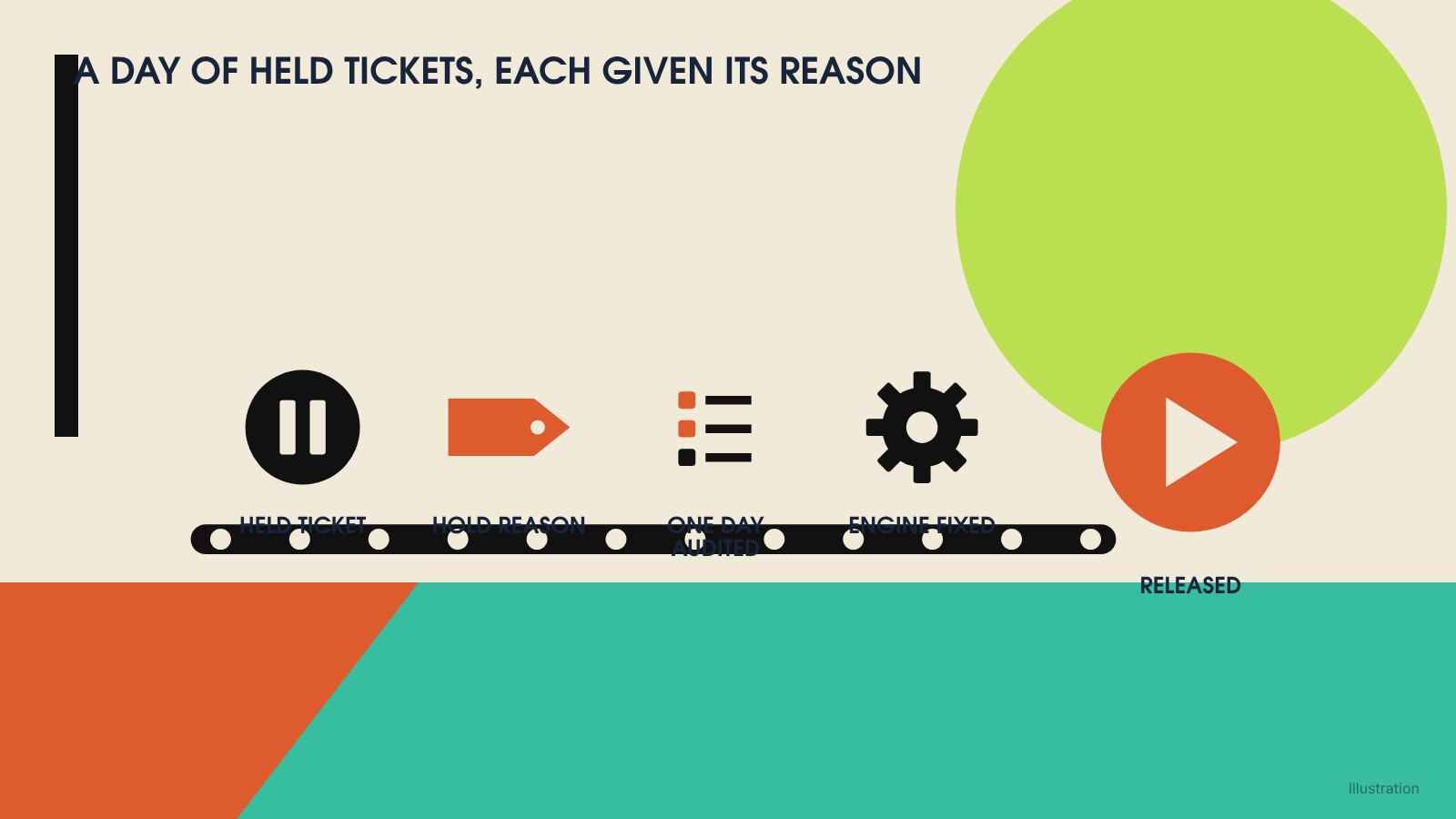
A held ticket is not free. When TicketResolve holds a reply for review, a customer waits for a person who may be busy, asleep or in another time zone. That wait is worth it when the hold protects the customer from a wrong answer. It is pure cost when the answer was right and the engine held it anyway.
The safety checks in TicketResolve are deliberately cautious. They look for replies that contradict a source, invent a menu or setting, quote the wrong number, or rest on knowledge-base articles that disagree with each other. Cautious is good. But "cautious" can drift into "holds things for reasons nobody can explain", and that's what one of our owners asked us to check:
Review the tickets that were held and see how we can improve the rules so they're not held unless there is properly justified reasoning.
So we did exactly that, ticket by ticket, for a whole day on one workspace. This post explains what we found, what we kept, what we fixed, and what we deliberately left for a separate decision.
The method: one question per ticket
The workspace in question — a source-control hosting company with a large help center and product site — had 80 tickets that day. Fifty-one were answered automatically. Twenty were held for review, and nine were handed to the team without a draft.
For each of the 29, we pulled the engine's own log and asked one question: was there a reason a careful support lead would accept?
Not "did a check fire?" — a check always fires on a hold. The question was whether the thing the check found was real and mattered for this reply.
The answers fell into three groups.
Group 1: holds that were right
Most holds were justified, and it's worth saying so plainly, because "fewer holds" is never the goal by itself.
- Two were not customers at all. HubSpot sends a "new email channel connected" message into the inbox. Handing those to a person is correct.
- Three rested on knowledge that genuinely disagrees. One help article said a hosted plan includes up to 500 GB of storage; another said one terabyte with free egress. Another pair disagreed about who operates a private-cloud deployment — the vendor or the customer. Whichever side a reply picked could be wrong. Those holds protect customers, and the real fix is in the knowledge base, not the engine.
- Several answers were mostly not backed by anything. A question about a VS Code plugin produced a draft where only 37% of the content traced to a source, and it named shortcut keys and ports no source mentioned. A question about
svn:keywordsscored 61% with 29% backed. Holding those is the system working. - Billing changes with no help article. "How do I switch from monthly to annual billing?" had no article behind it. A general-knowledge guess about someone's billing is exactly what shouldn't go out unreviewed.
Group 2: holds the engine caused
Four patterns had nothing to do with the quality of the answer. They came from how the engine was wired. These are the ones we fixed in this release.
1. The restart window
TicketResolve has a contradiction judgment: when an automatic check flags a sentence as possibly contradicting a source, a second, stricter step reads the actual sources and decides whether the reply is wrong. Only a verified "send" — with quotes that really appear in the sources — lets the reply go.
Because this step can send replies, it has to prove itself first. When a server process starts, it runs a self-check against a set of known-wrong answers and must hold every one of them. Until that passes, the judgment runs in record-only mode: it writes down what it would have done, but it holds the ticket regardless.
The self-check takes three to four minutes. And every release restarts every process.
The ticket "How do I clone a Git repository over HTTPS?" arrived inside that window. The help article matched at 99%. A word-level check flagged a sentence. The judgment looked at it and recorded "would send". The ticket was held anyway, purely because of when it arrived.
On a day with several releases, that window opens several times. Nothing about those tickets was risky; they were simply unlucky.
The fix: a new process now carries over the most recent self-check that passed within the last 24 hours — but only if it was for exactly the same judging instructions, the same model and the same test cases. We store a fingerprint of those three things with every self-check, so any change to any of them means a fresh start. The new process still runs its own self-check immediately, and if that fails, it drops straight back to record-only mode.
The safety property is unchanged: live judgment only ever runs on a configuration that has passed the known-wrong test. We just stopped re-proving the same thing every time the server restarted.
2. A conflict check that didn't read the reply
Before sending, TicketResolve checks whether the sources behind a reply contradict each other. The idea is sound: if two help articles disagree, any reply built on them may be wrong.
But the check only looked at the sources. It never looked at the reply.
The ticket "I get the error 'Partner exited unexpectedly' when connecting to Perforce" shows why that matters. One article said the error usually means a misconfiguration — set your environment variables. Another said it can mean a dropped network connection — contact support. The conflict check called that a contradiction and held a reply that scored 90%, with 93% of it backed by the sources.
Those two articles don't contradict each other. They describe two possible causes of the same error, and a good troubleshooting reply mentions both. Any experienced support engineer would read them that way.
The fix: the conflict check is now given the reply that would be sent, and the question it answers has changed. It holds a ticket only when:
- two sources state incompatible facts about the same specific thing — a number or limit, whether something is possible, who operates something, a required step — and the reply states, relies on or picks a side of that fact, or
- the reply itself states something a source contradicts.
Different possible causes, and different fixes for the same error, are now listed explicitly as complementary rather than conflicting. If sources disagree about something the reply doesn't touch, that's a knowledge-base clean-up item — not a reason to make this customer wait.
The storage case still holds: if a reply quotes 500 GB or 1 TB, it depends on the disputed fact.
3. No judgment for help-site and web answers
When the help center's indexed articles don't fully answer a question, TicketResolve can search the customer's own live help site, and — if allowed — the wider web. Those answers are scored the same way: what share of the reply the pages back, whether it contradicts them, whether it invents details.
But the contradiction judgment only existed on the main route. On the help-site and web routes, a flagged sentence held the ticket outright.
"How often are repositories backed up, and how fast is failover?" got a help-site answer backed by a 91.6% source. A word check flagged one sentence as saying the opposite of a source. There was no second look; the ticket was held.
The fix: help-site and web answers now get the same judgment, under the same conditions:
- it only runs when the answer would otherwise be sent under the owner rule (a source at 88% or more, or Web Search or the AI at 90% or more);
- it only covers the same kinds of flags — an opposite statement, something a source says isn't possible, or a plan or limit stated for something else;
- wrong numbers and contradictions of known product facts still hold, with no judgment;
- only a verified "send" sends; and
- a judged answer still goes through the source-conflict check afterwards.
4. Holds that didn't say why
Two tickets were answered with full confidence — one from a 100% help article — and then held after the answer was written. The log said "held for review" and nothing else.
Several things can hold an answer at that stage: a workspace escalation rule, signs in the conversation that a person is already handling it, the category's automation stage, or the escalation check that looks for things like security or churn signals. Each is legitimate on its own. But a hold nobody can explain can't be judged justified or not — and can't be fixed if it's wrong.
The fix: every one of those holds now writes its reason to the log — the escalation rule by name, what the conversation showed, the category and its stage, or the escalation check's findings.
Along the way we found an inconsistency. Under the owner rule, an answer sent from a source at 88% or more lets the escalation check note its concerns rather than hold the reply. Answers sent from Web Search or the AI at 90% didn't get the same treatment. They now do, so the same rule applies to every route that the owner rule sends.
Group 3: patterns we're not changing yet
Two more patterns came out of the audit. Each changes what gets sent, so we're measuring them first and proposing them separately.
Single-word sensitive topics. One word — "security", "price", "GDPR" — can mark a ticket as sensitive and hold an entire 100% answer. "How do I turn on source code security scanning?" was treated as a security incident. "Does the Perforce Cloud price include licenses?" was treated as a sales inquiry, though the help center answered it fully. The likely direction: trigger on incident language (hacked, breached, compromised) rather than the word "security", and send help-center-backed answers to informational pricing questions while still telling sales.
General Git and SVN questions. Questions like "How do I use git worktree?" or "How do I revert a merge commit?" aren't in a hosting provider's help center. They went to web search, where answers are often only partly backed by the pages found, and were held at around 78%. They never reached the general-knowledge route, where the AI's own score at 90% can send them. Changing that order affects how many general answers go out unreviewed, so it needs measuring on known-good and known-wrong answers first.
Illustrative scenarios: what changes for a support lead
The scenarios below are illustrative, built from the patterns above rather than taken from a specific customer.
Release afternoon. A team ships three updates during business hours. Before this release, each one opened a short window in which correct, flagged-then-cleared answers piled up in the review queue. Now those answers go out as they would at any other time, and the queue holds only tickets that actually need a person.
The troubleshooting article family. A product has five articles about connection errors, written over three years by different people, each naming the cause its author saw most. Before, nearly any reply drawing on two of them risked a "conflict" hold. Now the conflict check asks whether the reply depends on a real disagreement — and it doesn't when it presents several causes in turn.
The unexplained hold. A lead sees a 100%-confidence answer sitting in review and wonders why. The log now says, for example, that an escalation rule named "Cancellation requests" requires review. The lead can decide whether the rule is doing what they want, instead of guessing.
What we can and can't claim yet
Some of this is verified and some isn't, so here is which is which.
- Verified by tests: the restart carry-over (the fingerprint, the 24-hour limit, and dropping back on failure), when help-site and web answers are judged, the conflict check receiving the reply, and the hold reasons being logged.
- Not yet measured: the conflict check's new wording on live tickets. It is a change in instructions to a model, and its effect shows up in production. The logs record every conflict decision with its summary, so we'll be able to see whether it holds what it should and releases what it should.
- Unchanged: every hold in group 1. The goal was never fewer holds — it was holds you can explain.
Frequently asked questions
Does this make TicketResolve send more answers? Yes, but only answers that were held for reasons unrelated to their quality: arriving during a restart, two sources describing complementary causes, or a missing second look on help-site and web answers. Answers held for being wrong, unbacked or built on disagreeing facts are still held.
Is it safe to carry over a self-check after a restart? It carries over only when the judging instructions, the model and the test cases are identical to the ones that passed, and only for 24 hours. The new process still runs its own self-check straight away and falls back to record-only mode if it fails.
What happens if my knowledge base really does disagree with itself? If a reply relies on the disputed fact, the ticket is held exactly as before, and the hold names the conflicting claims. That's a signal to fix the out-of-date article.
Where do I see why a ticket was held? In the ticket log and the engine's logs, which now name the reason for every hold after an answer: the escalation rule, the conversation, the automation stage, or the escalation check.
Will the sensitive-topic and general-question changes happen automatically? No. They change what gets sent, so they'll be measured first and proposed for a decision.
The short version
- We audited every held or handed-over ticket from one day and asked whether each hold had a real reason.
- Most did: system emails, genuinely conflicting knowledge, unbacked answers and billing questions with no source stay held.
- Four engine causes did not, and are fixed: the post-restart record-only window, a conflict check that ignored the reply, no contradiction judgment on help-site and web answers, and holds with no stated reason.
- Two further patterns — single-word sensitive topics and the route for general Git/SVN questions — will be measured before any change.
Explore Topics
Written by
Ghulam Shabbir
Content creator and writer sharing insights and stories.